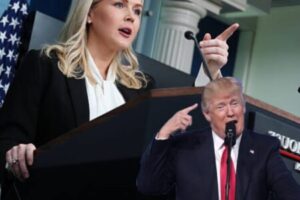




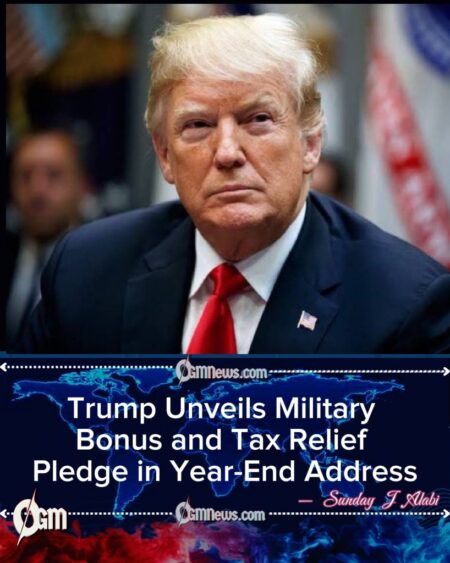
President Donald Trump, serving his second term as U.S. president, used a nationally televised year-end address to promise sweeping financial relief for millions of Americans, including a proposed special cash payment for active-duty troops and what he described as the largest tax refunds in U.S. history. Speaking from the White House, Trump framed the address as both a summary of his first 11 months back in office and a forward-looking pitch aimed at reassuring voters facing persistent economic pressure.
The 18-minute primetime speech, delivered without a live audience, blended policy claims, campaign-style rhetoric, and pointed criticism of Democrats and the previous administration. While presenting his remarks as evidence of national recovery, Trump acknowledged public anxiety over costs and jobs, insisting that his economic agenda is beginning to reverse what he repeatedly called a dire inheritance.
A Holiday Promise to the Military
A central announcement of the address was Trump’s proposal to issue a one-time “warrior dividend” of $1,776 to all 1.45 million active-duty U.S. troops before Christmas. The president described the payment as both a holiday bonus and a symbolic recognition of military service, tying it to broader claims of restoring national strength.
Trump argued that the dividend reflects his administration’s commitment to service members at a time of global uncertainty. While details on funding and congressional approval were not provided, the announcement was positioned as an immediate and tangible benefit amid broader economic debates.
The proposal comes as military families, like many Americans, face rising living costs. The White House has not yet released formal legislative language, leaving questions about timing and implementation unresolved.
Economic Claims and Tax Refund Predictions
Trump devoted much of the address to economic messaging, asserting that tariffs, tax cuts, and regulatory changes have placed the U.S. economy on an upward trajectory. He predicted that Americans would see the “largest tax refund season of all time” in the spring, citing legislation that ends taxes on tipped wages and Social Security benefits.
Using visual charts during the broadcast, Trump claimed that prices for gas, cars, airfare, prescription drugs, and even entertainment have declined since he returned to office. Another slide focused on food prices, with the administration asserting progress in reducing the cost of basic essentials.
However, the president largely dismissed concerns about affordability, despite recent data showing unemployment has risen to a four-year high. Critics argue that many households have yet to feel the improvements Trump described.
Tone, Delivery, and Political Messaging
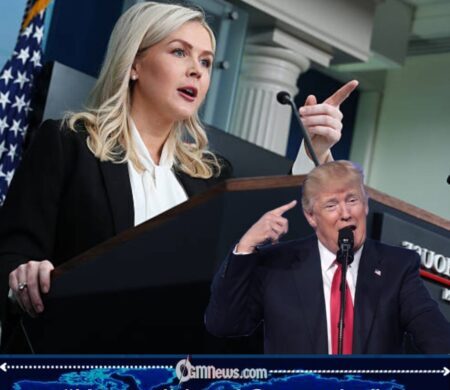
The address stood out for its combative tone and sparse staging. Trump spoke forcefully into a microphone, at times raising his voice as he read from a teleprompter, frequently returning to grievances about what he termed the failures of the previous administration.
Throughout the speech, Trump repeatedly assigned blame to Democrats for inflation, economic stress, and political division. He framed his own policies as corrective measures, declaring that the United States had gone from being “dead” economically to becoming “the hottest country anywhere in the world.”
The remarks also served as an early preview of campaign-style messaging ahead of the 2026 midterm elections, as Trump made clear his intention to actively support Republican candidates nationwide.
Trump Administration Foreign Policy and Security Record
On foreign affairs, Trump highlighted what he described as significant progress, including a ceasefire agreement in Gaza. He reiterated claims that his administration has helped end or de-escalate more than a dozen global conflicts, though he did not specify all the cases referenced.
The president did not repeat earlier campaign pledges that the war between Russia and Ukraine would end immediately upon his election, acknowledging instead achievements he says were more attainable. He also emphasized border enforcement, crime reduction efforts in major cities, and immigration crackdowns as core achievements of his second term so far.
Despite these claims, the administration has fallen short of its stated goal to deport one million undocumented immigrants by the end of 2025, with official figures showing removals at roughly 600,000 since January.
Political Headwinds and Public Opinion
Trump’s address came amid heightened political tension within the Republican Party, which remains divided over healthcare policy and abortion ahead of challenging midterm elections. The speech followed reports of internal West Wing friction, sparked by a recent magazine article detailing candid remarks from senior staff.
Public opinion remains mixed. A recent NPR/PBS News/Marist poll found that only 36 percent of Americans approve of Trump’s job performance, the lowest figure recorded across both of his terms. Separate polling from Daily Mail/JL Partners shows a majority of respondents disapproving of his leadership.
Still, Trump appeared undeterred, presenting the address as a closing argument for his administration’s first year and a foundation for the next phase of his presidency.
A Solemn Day Behind the Scenes
Earlier on the day of the speech, Trump traveled to Delaware to participate in the dignified transfer of two Iowa National Guard members and a civilian Army interpreter killed in an ambush in Syria. The president met privately with the families of the fallen before returning to Washington for the televised address.
The juxtaposition of solemn military rites and an upbeat economic message underscored the complexity of the moment, as the administration balances national security realities with domestic political and economic challenges.
As the holiday season approaches, Trump’s message was clear: financial relief, in his view, is imminent—even as many Americans remain skeptical about when or whether that relief will fully arrive.