










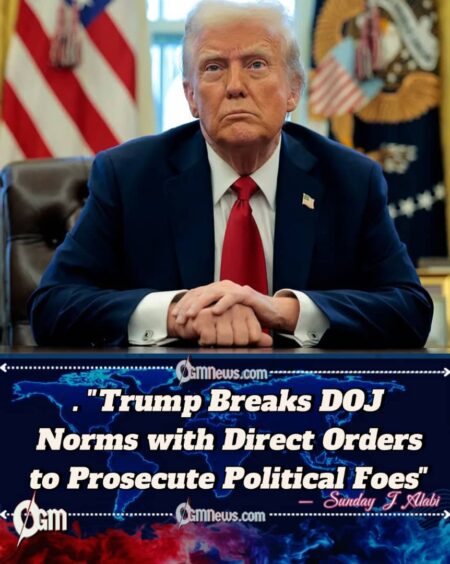
President Donald Trump has intensified his calls for the Department of Justice to aggressively pursue criminal investigations against his political opponents, directly addressing Attorney General Pam Bondi in a series of social media posts that have drawn sharp criticism from Democratic leaders and raised concerns about the independence of federal law enforcement.
President Trump Demands for Action
In a pointed social media message directed at Bondi, the current U.S. president serving his second term expressed frustration with what he perceives as inaction within the Justice Department. “We can’t delay any longer, it’s killing our reputation and credibility,” Trump wrote, specifically calling for investigations into former FBI Director James Comey, New York Attorney General Letitia James, and Democratic Senator Adam Schiff, who oversaw his first impeachment proceedings.
The president Trump’s public pressure campaign represents an unprecedented direct intervention in prosecutorial decisions, breaking with decades of established norms regarding the independence of the Justice Department. Trump followed up his initial post by praising Bondi, stating she was “doing a great job” while simultaneously expressing impatience with the pace of investigations against his perceived adversaries.
Trump’s frustration appears to stem from reviewing “over 30 statements and posts” from supporters who echo his sentiment that previous promises of accountability have not materialized. “Same old story as last time, all talk, no action. Nothing is being done,” the president stated, specifically naming the individuals he believes should face prosecution.
Democratic Response and Constitutional Concerns
The president’s public demands have triggered a swift and forceful response from Democratic leadership, with Senate Minority Leader Chuck Schumer characterizing Trump’s actions as authoritarian overreach. “This is the path to a dictatorship,” Schumer declared during a Sunday CNN interview, emphasizing the Justice Department’s historical commitment to pursuing law violators “without fear or favour” regardless of political affiliation.
Democratic leaders have expressed alarm at what they view as Trump’s attempt to weaponize federal law enforcement agencies against political opponents. Schumer specifically criticized the president’s approach, stating, “He’s turning it into an instrument that goes after his enemies, whether they’re guilty or not.” This criticism reflects broader concerns about the erosion of institutional norms and the potential politicization of criminal justice proceedings.
The controversy has highlighted the tension between Trump’s campaign promises to seek accountability from those he considers responsible for various investigations against him and the traditional expectation that prosecutorial decisions should be made independently of political considerations. When pressed about his comments, Trump remained defiant, insisting, “They have to act. They have to act fast.”
Personnel Changes and Prosecutorial Pressure
The president Trump’s public statements coincided with significant personnel changes within the Justice Department, most notably the departure of federal prosecutor Erik Siebert. Trump claimed to have fired Siebert after the prosecutor allegedly failed to pursue charges against New York Attorney General Letitia James over mortgage fraud allegations, though initial reports suggested Siebert had resigned.
According to reporting by The New York Times, Siebert had informed senior Justice Department officials that investigations into James had not produced sufficient evidence to warrant prosecution. James, who successfully brought a civil fraud case against Trump in 2023, has categorically denied the mortgage fraud allegations, characterizing them as “baseless” and motivated by political “revenge.”
Trump announced his intention to nominate Lindsey Halligan as Siebert’s replacement, praising Attorney General Bondi while suggesting she needs “a tough prosecutor in the Eastern District of Virginia” to advance his agenda. The president’s direct involvement in selecting prosecutors for specific cases represents another departure from traditional practices designed to insulate prosecutorial decisions from political influence.
Since assuming office for his second term, Trump has taken various retaliatory actions against those involved in previous investigations, including revoking security clearances for James and Manhattan District Attorney Alvin Bragg, who successfully prosecuted the criminal hush-money case against him. The president has also dismissed several prosecutors who worked under special counsel Jack Smith and has taken actions against law firms whose attorneys participated in investigations into allegations against him.


