










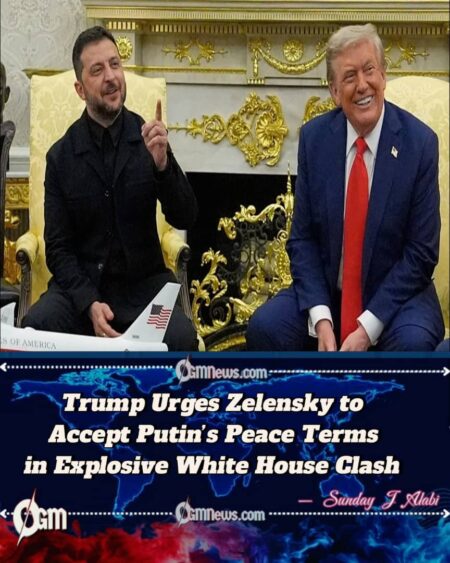
An explosive meeting unfolded at the White House on Friday when U.S. President Donald Trump, now serving his second term, reportedly urged Ukrainian President Volodymyr Zelensky to accept Russian President Vladimir Putin’s conditions to end the two-year war. According to accounts cited by the Financial Times, the meeting degenerated into a shouting match, with both leaders exchanging heated words over Ukraine’s refusal to cede territory.
Zelensky, who visited Washington seeking additional military support, found himself facing a blunt demand from Trump: concede the Donbas region or risk “destroying” Ukraine. Sources familiar with the encounter said Trump dismissed frontline maps presented by Zelensky and insisted that Putin’s terms were “reasonable,” reiterating the Russian claim that the invasion was a “special operation, not even a war.”
The confrontation echoed a previous Oval Office episode in February when Trump and Vice President JD Vance reportedly berated the Ukrainian leader over U.S. arms requests. Friday’s tense exchange underscored the widening rift between Kyiv and Washington over how to bring an end to the conflict.
Trump’s Push for Peace — or Pressure for Concession?
President Trump defended his stance as a pragmatic approach to stop further bloodshed. “Enough blood has been shed, with property lines being defined by War and Guts,” he later wrote on Truth Social. “They should stop where they are. Let both claim victory; let history decide.” His remarks reflected a desire to bring about a ceasefire by freezing the conflict along existing battle lines — a position critics say would effectively reward Russian aggression.
During the White House talks, Trump also rejected Ukraine’s request for Tomahawk missiles, stressing the need to preserve U.S. military readiness. “We want this war over because it’s not easy for us to keep sending massive weapons,” he reportedly said. Zelensky countered by proposing a cooperative defense initiative, suggesting joint U.S.-Ukraine production — Tomahawks for drones — to bolster both nations’ defense industries.
Trump hinted that Hungarian Prime Minister Viktor Orbán could host a potential peace summit involving both Zelensky and Putin, signaling his interest in mediating a diplomatic breakthrough. The U.S. president has long touted his personal rapport with Putin as a potential asset for peace, though the proposal drew skepticism from analysts who fear it could sideline NATO’s influence.
Zelensky Holds Firm, Warns Against “False Peace”
Following the meeting, Zelensky offered a measured response, avoiding direct criticism of Trump but standing firm on Ukraine’s position. Speaking to reporters, he remarked, “The president is right — we have to stop where we are, and then to speak.” Yet he emphasized that Putin “does not want peace,” reaffirming Kyiv’s belief that only sustained pressure can bring Moscow to the negotiating table.
The tense encounter followed Trump’s recent claim that Putin was ready to make peace and that a resolution was “in sight.” Zelensky, however, publicly rebuked that assessment, warning that any premature settlement could embolden Russian forces to regroup and strike again.
Just weeks earlier, Trump had expressed a more sympathetic tone, saying Ukraine could still reclaim all its lost territories — a sharp contrast to Friday’s exchange. Analysts now see the latest meeting as a clear indication that the Trump administration’s patience with Kyiv’s resistance may be waning, signaling a potential recalibration of U.S. foreign policy toward Russia’s war in Ukraine


