










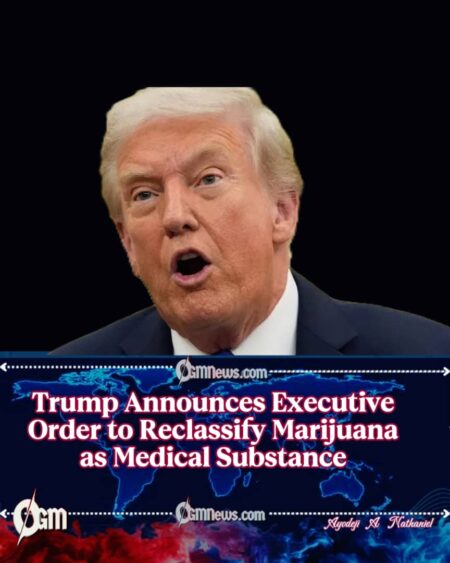
Donald Trump, the current U.S. president serving his second term, announced plans to sign an executive order that would reschedule marijuana under federal law, moving it from Schedule I to Schedule III. The decision represents a notable shift in U.S. drug policy and signals formal federal recognition of marijuana’s legitimate medical uses.
In outlining the move, Donald Trump said the reclassification reflects evolving medical evidence and changing public attitudes toward cannabis. The announcement places the White House at the center of a long-running national debate over health policy, criminal justice, and federal-state regulatory alignment.
Details of the Executive Order
The executive order will direct federal agencies to begin the process of reclassifying marijuana under the Controlled Substances Act. Schedule I substances are defined as having no accepted medical use, while Schedule III substances are recognized as having medical value with regulated controls.
According to administration officials, Donald Trump views the change as a policy correction rooted in science rather than ideology. The move would not legalize recreational marijuana nationwide but would significantly alter how the federal government regulates medical cannabis.
What Schedule III Status Means
A Schedule III classification would ease several federal restrictions, particularly those affecting research and prescribing. Medical professionals and scientists have long argued that Schedule I status limited comprehensive clinical study of marijuana.
By supporting the change, Donald Trump is aligning federal policy more closely with the majority of U.S. states that already permit medical marijuana. Analysts note that the shift could accelerate pharmaceutical development and standardized medical use.
Medical and Research Implications
Medical experts say rescheduling could expand research into treatments for chronic pain, epilepsy, cancer-related symptoms, and other conditions. Federal funding and approvals for studies may become more accessible under the new classification.
Supporters argue that Donald Trump’s decision acknowledges realities already recognized by many healthcare providers. Critics, however, caution that clearer regulatory guidelines will be essential to avoid confusion during implementation.
Economic and Industry Impact
The legal cannabis industry is expected to feel immediate effects from the policy shift. A Schedule III status could reduce certain tax and compliance burdens that currently affect medical marijuana businesses operating under conflicting state and federal laws.
Industry analysts suggest that the move supported by Donald Trump may encourage investment, stabilize markets, and improve long-term regulatory clarity for legitimate operators.
Criminal Justice and Social Effects
While the executive order does not automatically decriminalize marijuana or expunge prior convictions, advocates say it could influence future reforms. Reduced penalties and revised enforcement priorities may follow over time.
Civil rights groups describe the decision as a partial step toward addressing disparities in drug enforcement, noting that broader legislative action would still be required for systemic change.
Next Steps and Implementation
Federal health and law enforcement agencies are expected to begin the formal rescheduling process following the executive order. Regulatory updates and guidance will likely be issued in the coming months.
As implementation proceeds, the decision is set to become a defining moment in modern U.S. drug policy, reshaping how marijuana is regulated, researched, and prescribed at the federal level.


