








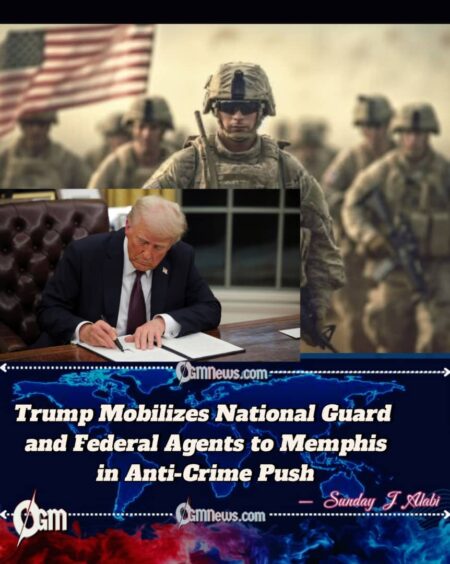
President Trump, now serving his second term, signed a presidential memorandum Monday mobilizing federal law enforcement agents and directing the Tennessee National Guard to assist in Memphis. The initiative, described as a “replica” of earlier efforts in Washington, D.C., is part of his broader campaign to reduce violent crime in major U.S. cities.
The task force will include members of the FBI, ATF, DEA, ICE, Homeland Security Investigations, and U.S. Marshals, alongside the Tennessee National Guard. Defense Secretary Pete Hegseth emphasized the Guard’s readiness, stating, “They’re a volunteer state. We’re not going to have any problems with the Tennessee National Guard.”
Memphis becomes the third U.S. city to host such a deployment, following earlier operations in Los Angeles and the nation’s capital. President Trump suggested Chicago and St. Louis may also see federal forces in the near future, arguing that those cities face similarly urgent crime challenges.
Tennessee Leadership Aligns with Trump Administration Strategy
Tennessee Governor Bill Lee, a Republican, stood with the president in the Oval Office during the signing of the memorandum, calling it a long-anticipated step in his administration’s collaboration with Washington. “The next phase will include a comprehensive mission with the Tennessee National Guard, FBI, Tennessee Highway Patrol, Memphis Police Department, and other law enforcement agencies,” Lee explained.
Unlike governors in other states who have resisted National Guard deployments, Lee has been receptive to Trump’s strategy. Illinois officials, by contrast, have openly rejected a similar plan for Chicago, with Governor JB Pritzker and Mayor Brandon Johnson insisting the federal presence would be counterproductive.
Memphis Mayor Paul Young, a Democrat, noted he had not requested Guard assistance but pledged to cooperate. “We’ll work with them to strategize on how they engage in this community,” Young said in a press conference.
A Controversial Model for Urban Security
The president Trump’s use of federal forces in Los Angeles earlier this year is still under legal scrutiny. A federal judge ruled that elements of that deployment violated laws restricting military involvement in domestic law enforcement. In Washington, hundreds of National Guard troops remain on city streets, assisting in what the administration describes as “beautification” and security support efforts, though critics say the line between civilian and military policing is being blurred.
On Sunday, President Trump previewed the Memphis decision on Truth Social, claiming crime reductions were already visible due to five months of federal presence in the city. He insisted, however, that “the real work by us has barely begun.” In his words, federal deployments would spark a “no crime miracle” similar to what he described in Washington, D.C.
While the President Trump insists the measures are necessary to “save” cities with high crime rates, opposition voices argue the approach raises constitutional and civil liberties questions. The unfolding Memphis deployment is likely to intensify that national debate.