










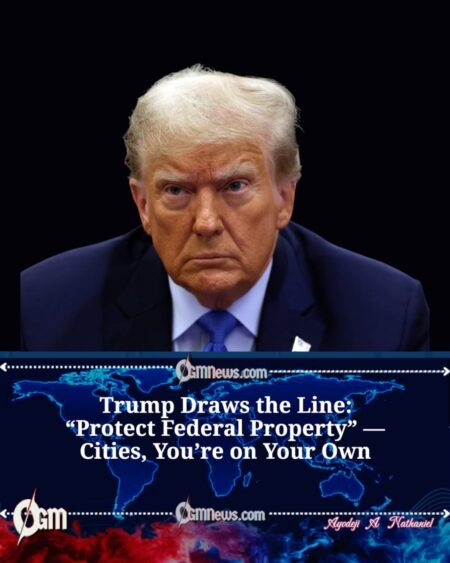
President Donald Trump, currently serving his second term as U.S. president, has issued a directive to the Department of Homeland Security (DHS), including Secretary Kristi Noem, instructing federal agencies how to respond to civil unrest in the wake of violent demonstrations at federal sites. The president’s guidance, shared on social media, emphasizes that federal forces will not proactively quell protests in local jurisdictions unless formally requested, while committing to a strong and forceful defense of federal buildings and government property. The announcement follows recent unrest in Eugene, Oregon, where protesters breached a federal courthouse, and widespread demonstrations in other cities related to immigration enforcement actions and controversial federal deployments.
The policy shift underscores a recalibration of federal intervention in domestic protests, maintaining a firm stance on protection of federal assets while largely deferring to state and local authorities for broader public order needs.
Context: Unrest at Federal Sites in Oregon and Elsewhere
The immediate catalyst for the president’s directive was a protest in Eugene, Oregon, where demonstrators reportedly breached a federal building and damaged property during a demonstration related to immigration enforcement policies. Local law enforcement characterized the situation as a riot, and the incident drew national attention as federal property was targeted.
Similar demonstrations have occurred in cities including Los Angeles, Minneapolis and Portland, often tied to broader debates over federal immigration actions and controversial law enforcement deployments. Federal authorities have cited these events as justification for a need to safeguard government facilities and personnel.
Trump’s Directive: Federal Assistance Conditioned on Local Requests
In his social media announcement, President Trump stated that federal law-enforcement personnel — including DHS components such as U.S. Immigration and Customs Enforcement (ICE) and U.S. Border Patrol — would not intervene in protests or riots in cities unless those local governments formally request federal help.
This marks a notable policy position: the federal government is not poised to unilaterally deploy forces into ongoing civil unrest in municipal jurisdictions without a formal invitation from state or local leaders. This departure reflects an effort to respect local governance while clearly delineating federal priorities.
Federal Protection of Government Property
Despite the limitation on proactive federal intervention in local unrest, President Trump emphasized a robust federal commitment to defending federal institutions and buildings. In his statement, the president said he had “instructed ICE and/or Border Patrol to be very forceful in this protection of Federal Government Property,” pledging a firm response to actions such as attacking, damaging, or threatening officers or federal infrastructure.
The language used indicates that federal agencies will act decisively when federal property is directly threatened or when officials are under attack, even as they await formal local requests for broader engagement.
Role of DHS and Kristi Noem
The directive places DHS, led by Secretary Kristi Noem, in a key role for implementing the president’s guidance on law enforcement response. DHS components such as ICE and Border Patrol, along with other federal agencies, are thus positioned to carry out the defensive posture established by the president.
Trump’s instruction makes clear that federal law-enforcement officials will serve as a backup to local and state responses and will act forcefully when authorized to defend federal assets or when formally requested by subnational authorities.
Trump Local and State Responsibilities
Trump’s statement reiterates the principle that local and state governments have primary responsibility for managing protests and riots within their jurisdictions, a longstanding aspect of U.S. federalism. By conditioning federal intervention on formal requests for assistance, the administration is signaling a respect for local authority — even as it underscores a willingness to act decisively when federal infrastructure is threatened.
This balance aims to avoid the perception of federal overreach into municipal law enforcement while protecting national interests and assets.
Political Reactions and Public Debate
The directive has generated discussion across the political spectrum. Supporters of the president’s announcement argue that protecting federal property and personnel is a legitimate and necessary role for the federal government, particularly in the face of property damage and incidents perceived as attacks on government institutions.
Critics, however, emphasize concerns about civil liberties, the proportionality of force used by ICE and other agencies, and the implications of federal involvement in protests. Local leaders in some cities have expressed the wariness of federal intervention following controversial deployments in places such as Minneapolis, Portland and Chicago.
Legal Considerations and Protests Policy
Federal involvement in domestic unrest is governed by longstanding legal frameworks, including the Posse Comitatus Act and related statutes that limit the use of military force in civilian law enforcement, and provisions that allow federal law enforcement to protect federal property and personnel. Historical debates have occurred over use of federal forces without local consent, particularly during flashpoints such as the civil rights era and more recent large-scale protests.
The president’s policy reflects these legal lines: federal authorities stand ready to defend federal infrastructure and only engage more broadly when local officials formally request assistance.


