









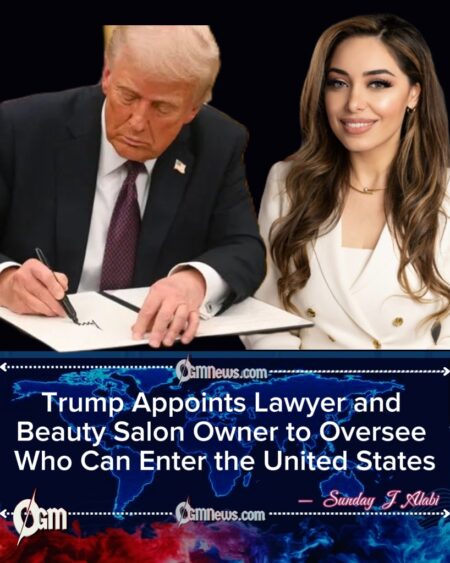
President Donald Trump, serving a second term as U.S. president, has appointed attorney and business owner Mora Namdar as Assistant Secretary of State for Consular Affairs, placing her in charge of one of the federal government’s most consequential immigration-related portfolios. The role gives Mora Namdar oversight of visa approvals and revocations, as well as the issuance of U.S. passports, positioning her at the center of the administration’s hardline immigration and foreign policy agenda.
Mora Namdar’s appointment, announced on Monday, marks her second stint in the role. She previously served on an interim basis in 2020 and has since remained a prominent figure within Trump’s foreign policy team. Her confirmation underscores the Trump administration’s preference for officials who combine legal training, ideological alignment, and prior service in implementing its priorities.
Mora Namdar :Key Consular Appointment With Broad Authority
As Assistant Secretary of State for Consular Affairs, Namdar will supervise the bureau responsible for determining which foreign nationals may enter or remain in the United States. The office manages millions of visa applications annually and holds the authority to revoke visas on national security or foreign policy grounds.
During her Senate confirmation hearing, Namdar emphasized a strict interpretation of that authority. She stated that consular officers have the power to revoke visas from individuals who undermine U.S. foreign policy objectives, aligning her approach closely with President Trump’s restrictive immigration stance.
The position also places her at the intersection of diplomacy and domestic policy, as visa decisions often reflect broader geopolitical considerations. In this capacity, Namdar is expected to play a central role in shaping how the administration balances border security, diplomatic relations, and legal immigration pathways.
Professional Background in Law and Government
Mora Namdar is a trained attorney who previously ran Namdar Law, with offices in Dallas and Washington, D.C. According to the firm’s website, she has stepped away from active legal practice following her confirmation, in compliance with requirements set by the Senate Foreign Relations Committee.
Her government experience extends beyond consular affairs.Mora Namdar served as a Senior Bureau Official in the Bureau of Near Eastern Affairs during Trump’s second administration, where she was involved in U.S. diplomacy across the Middle East and North Africa.
Her State Department biography highlights her participation in policy initiatives related to President Trump’s Gaza peace plan and efforts to counter Iran’s nuclear ambitions, areas that have remained central to the administration’s foreign policy agenda.
Entrepreneurial Ventures in the Private Sector
In addition to her legal and government career, Mora Namdar is also a business owner. She owns BAM, a chain of beauty salons based in Texas, with locations in Dallas, Fort Worth, and Plano. The salons specialize in professional blowouts and styling services.
Speaking to DMagazine in 2017, Mora Namdar described her motivation for entering the beauty industry as a desire to create a space that treats women’s styling as an art form. Her dual background as a lawyer and entrepreneur has drawn attention, particularly from critics who question the relevance of her business experience to a senior diplomatic role.
Supporters, however, argue that her private-sector work demonstrates managerial skill and an understanding of regulatory and operational challenges—qualities they say are transferable to senior government service.
Immigration Stance and Views on Iran
Mora Namdar, the child of Iranian immigrants, has been outspoken on issues involving Iran and U.S. national security. She has sharply criticized diplomatic engagement with Tehran pursued during the Biden administration, accusing the Iranian government of committing “genocide” against its own citizens.
Former colleagues have said she pushed for internal policy memos to adopt a more pessimistic assessment of Iran’s prospects, reflecting her belief that engagement strategies were ineffective. These views align closely with President Trump’s confrontational posture toward Iran during both of his terms in office.
Her immigration philosophy similarly mirrors the administration’s emphasis on strict enforcement and national interest considerations, particularly where foreign policy and security concerns intersect.
Political Controversy and Internal Criticism
Mora Namdar’s tenure in previous roles has not been without controversy. Responsible Statecraft, a publication affiliated with the Quincy Institute, reported internal tensions within the Bureau of Near Eastern Affairs, alleging that Namdar favored loyalists over more experienced diplomats, affecting morale.
One unnamed source described what they characterized as a culture of exclusion for staff outside her inner circle, while criticizing promotion practices that allegedly prioritized ideological alignment over expertise.
The State Department strongly rejected those claims at the time. A spokesperson said Namdar was advancing personnel with the merit and experience necessary to implement President Trump’s agenda, dismissing reports of mismanagement as unfounded.
Confirmation Vote and Official Defense
Mora Namdar was confirmed by the U.S. Senate in a 53–43 vote. No Democrats supported her nomination, while all Republicans voted in favor, reflecting the deeply partisan nature of her confirmation.
More recently, the administration has pushed back against media portrayals focusing on her business background. State Department spokesperson Tommy Pigott criticized such descriptions as sexist, emphasizing that Mora Namdar is an accomplished lawyer, business owner, and public servant.
Pigott said Americans could be proud that officials like Mora Namdar are stepping forward to serve the country and advance national interests, reinforcing the administration’s confidence in her leadership as she assumes control of the consular bureau


