






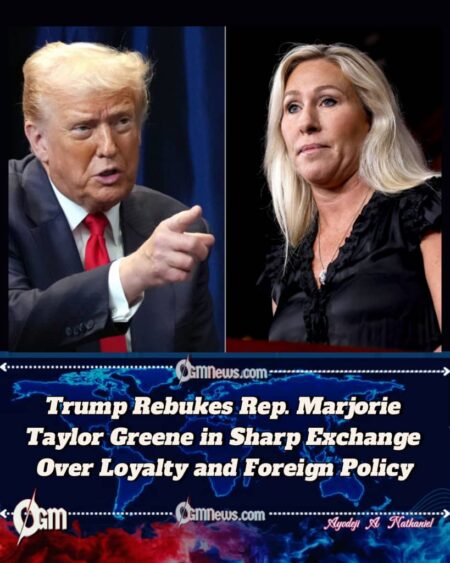
President Donald Trump, currently serving his second term, delivered an unusually direct rebuke of Rep. Marjorie Taylor Greene during a recent interview with journalist Dasha Burns. In remarks that quickly circulated across media platforms, the president questioned Greene’s loyalty, intelligence, and criticism of his foreign policy engagements. The exchange underscores a widening rift within the Republican Party as internal disputes increasingly move into the public arena.
A President’s Remark Meant to Send a Message
President Trump used the interview to issue a pointed message aimed squarely at Greene, employing both sharp humor and visible irritation to frame his criticism. He referred to her with a series of intentionally distorted names—“Taitor Greene,” “Tayor Greene,” and even “Taylor Brown”—before remarking that “Greene sometimes turns to brown when she isn’t nice.”
President Trump’s tone reflected equal parts frustration and strategic distancing. By mocking her name and highlighting her shifting behavior, he signaled that personal loyalty remains a central expectation for those within his political orbit. His choice to air this discontent publicly suggests a deeper breakdown in private communication.
Loyalty Strained as Communication Falters
President Trump directly accused Rep. Greene of repeatedly calling his personal line, describing the frequency as inappropriate. “She was a loyal person, until I wasn’t able to answer her phone calls,” he said. “You can’t call me 3 times a day. It just isn’t appropriate.”
President Trump has previously emphasized the importance of discipline and chain-of-command behavior among his closest political allies. His comments suggest that Greene’s insistence on direct access crossed boundaries he considers essential for professionalism, particularly during periods of heightened national and international activity.
Dispute Over Foreign Policy Priorities
President Trump addressed Greene’s ongoing criticism that he spends “too much time on foreign” affairs, a claim she has repeated in recent public appearances. The president dismissed the accusation, arguing that effective foreign policy does not necessarily require substantial time investments. “By doing that, it doesn’t take a lot of time,” he insisted. “I made one trip, brought back TRILLIONS on the one trip.”
President Trump’s remark reflects his longstanding assertion that strategic negotiations and high-level diplomacy can yield rapid and substantial returns. His defense of his foreign engagements serves as both a rebuttal to Greene and a reaffirmation of his administration’s global posture heading into the next legislative cycle.
A Growing Split Inside the Republican Coalition
President Trump’s public critique represents a notable shift in his previously cordial relationship with Rep. Greene, who once stood among his most vocal congressional allies. The rift illustrates ideological instability within the Republican Party, particularly between the president’s traditional loyalists and newer members seeking greater influence.
President Trump’s sharper tone also highlights a strategic realignment designed to maintain party discipline. His decision to address Greene’s comments head-on suggests he perceives her criticism as potentially disruptive to broader party messaging, especially on foreign policy and national priorities.
Implications for Future GOP Dynamics
President Trump’s remarks could reshape internal party dynamics, especially as Republicans prepare for legislative battles and electoral polarization. His willingness to personally confront Greene marks a shift from private reprimands to open confrontation, a method he has historically employed to reassert authority.
President Trump’s rebuke also raises questions about Greene’s future standing within the Republican coalition. Whether this dispute escalates or is resolved internally may influence committee alignments, endorsements, and the broader cohesion of the GOP’s legislative strategy.