










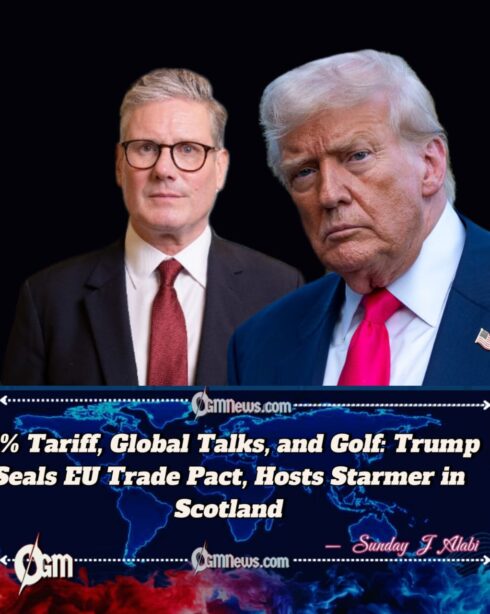
In a major diplomatic breakthrough, U.S. President Donald Trump and European Commission President Ursula von der Leyen announced a new transatlantic trade agreement late Sunday evening, following negotiations at Trump’s Turnberry golf resort in Scotland. The landmark deal introduces a blanket 15% tariff on most EU goods imported into the United States, replacing Trump’s earlier threat of a crippling 30% tariff.
The new agreement, which will come into effect on Friday, is being hailed by Trump allies as a strategic win for American industry. It is also seen as a calculated compromise that spares the EU from the brunt of economic retaliation while still granting the U.S. a strong negotiating edge. “The entire European press is singing the president’s praises right now,” Vice-President JD Vance wrote in a late-night post on X. “Tomorrow, the American media will undoubtedly run headlines like ‘Donald Trump Only Got 99.9 Percent of What He Asked For.’”
Although the 15% blanket tariff may still raise eyebrows in Brussels, the mood across European capitals is one of cautious relief. The deal preserves critical access to the U.S. market and avoids the deeper shock of a 30% tariff regime, which could have sparked a wider trade war.
High-Stakes Meeting With Starmer at Trump Resort
Just hours after announcing the trade pact, President Trump is set to host British Prime Minister Sir Keir Starmer at his Turnberry resort in Ayrshire this morning. This marks Starmer’s first official meeting with Trump since taking office and the U.S. president’s second high-profile engagement on his five-day visit to Scotland.
The two leaders are expected to discuss a wide range of pressing global issues, including the wars in Gaza and Ukraine, transatlantic trade, and climate cooperation. Starmer’s aides say the Prime Minister is keen to raise humanitarian concerns in Gaza, where growing famine fears have intensified international calls for intervention.
Following their talks in Ayrshire, Trump and Starmer will travel north to Aberdeenshire to visit Trump’s other Scottish property—another symbolic gesture reflecting the unusual combination of personal and political diplomacy on display during this visit. With both leaders navigating post-Brexit trade dynamics and growing geopolitical tensions, today’s meeting could set the tone for a renewed US-UK relationship.
What the Deal Means for the EU – and the U.S.
Under the terms of the new US-EU trade framework, a uniform 15% tariff will apply to most European exports entering the American market, ranging from automobiles and industrial goods to wine and agricultural products. While still significant, the figure represents a climbdown from the earlier threat of a 30% levy that had sparked alarm within European business circles.
From Washington’s perspective, the deal is being framed as a rebalancing act. “This is a win for American workers and manufacturers,” Trump declared during a brief press conference with von der Leyen at Turnberry. “We’re putting America first—but we’re also doing it with respect for our partners.”
In Brussels, EU officials have spun the agreement as a diplomatic save. “While we do not agree with tariffs in principle,” one official told reporters, “this deal averts the worst-case scenario and gives our industries room to adapt.” Analysts say the compromise may protect fragile sectors while giving both sides time to negotiate further over specific industry exemptions.
UK’s Trade Angle and Concerns Over Gaza
While today’s US-EU deal doesn’t directly involve the United Kingdom, it is expected to shape the broader conversation between Trump and Starmer, especially given Britain’s own bilateral trade arrangement with the U.S. Earlier this year, the UK finalized a deal that imposes a 10% tariff on most British goods exported to America, a pact critics say is less favorable than EU terms.
British officials are likely to push for tariff revisions, particularly in areas such as aerospace, pharmaceuticals, and agriculture, where UK exporters are currently at a disadvantage. “This is a strategic moment for the UK,” one senior trade adviser noted. “We need to align closer with our U.S. partners while defending British economic interests.”
Another major topic expected to dominate discussions is Gaza. As humanitarian conditions worsen and international pressure mounts, Starmer is reportedly set to press Trump for stronger U.S. action. Although Trump has so far adopted a cautious stance, today’s private meeting could prompt a shift in tone—or at least a stronger show of transatlantic unity on the issue.
Looking Ahead: Winners, Losers, and Global Impact
While Trump celebrates what is being billed as a personal diplomatic coup, the long-term consequences of the deal are still unfolding. American manufacturers and agriculture may benefit in the short term, while European industries brace for price hikes and potential market losses. However, the avoidance of an all-out tariff war has been broadly welcomed by markets on both sides of the Atlantic.
Experts say the next steps will be crucial. “What we have now is a framework, not a final destination,” said trade analyst Dr. Hannah Ellis. “Whether this leads to deeper cooperation or further fragmentation depends on how both sides manage the fallout.”
With Trump’s presidential campaign heating up and Starmer still establishing his international credentials, today’s events could also have major political implications. As both leaders shake hands at Turnberry and move toward future talks, the world watches closely to see if this renewed transatlantic engagement can deliver sustained stability—or just a temporary truce.


