










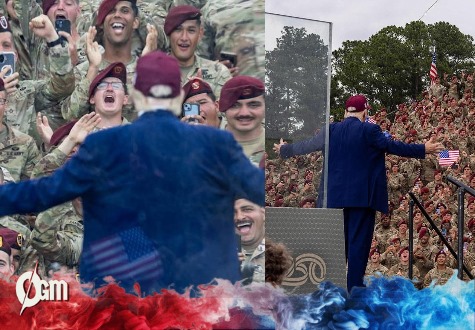
Trump Is Building a Loyalist Army | In what was billed as a patriotic appearance to commemorate the Army’s 250th birthday, President Trump’s rally at Fort Bragg took a disturbing turn. Uniformed troops were reportedly screened for their appearance and political alignment ahead of his arrival. Soldiers who did not align with the administration’s views were swapped out, and vendors selling pro-Trump campaign merchandise dotted the scene. Far from a routine morale-booster, the event marked a chilling breach of longstanding military norms—raising questions about partisan encroachment on one of America’s most sacrosanct institutions. Below, we examine the grave consequences of politicizing the U.S. military.
Trump Is Building a Loyalist Army as Civil-Military Norms Shattered
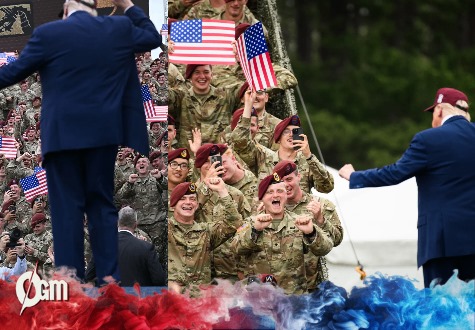
The American military is built on a foundational principle: it serves the Constitution, not any political leader or party. Department of Defense policies clearly forbid active-duty personnel from engaging in political activities while in uniform. At Fort Bragg, however, those boundaries were flagrantly ignored. Troops were encouraged to cheer the president, boo his political rivals, and stand behind him as props for a rally that echoed campaign theatrics more than statesmanship.
Trump Is Building a Loyalist Army | From Principle to Performance:
The presence of MAGA merchandise booths near the stage, and the president’s pointed jabs at political adversaries like President Biden and Governor Gavin Newsom, turned what should have been a neutral platform into a partisan pep rally. It not only violated internal military policy but also signaled that political allegiance might now be a prerequisite for service recognition or visibility.
Authoritarian Parallels Take Shape as Trump Is Building a Loyalist Army
A Familiar Playbook
Authoritarian leaders have historically leveraged military loyalty to entrench power. Be it Hitler’s Wehrmacht or Kim Jong Un’s parades, politicized armed forces often mark the final chapter in a democracy’s decline. Trump’s actions at Fort Bragg mirror such tactics—selective displays of support, purging dissenting troops, and enforcing image-conscious optics like “no fat soldiers.”
Trump Is Building a Loyalist Army | Building a Loyalist Force
The shift from national defense to political theater is no small matter. What we are witnessing is not just unorthodox—it’s unprecedented in modern American history. Critics like Tom Nichols warn this could evolve into a standing loyalist force rather than a professional apolitical military. And once that transformation is complete, reversing it becomes nearly impossible.
OGMNews.COM
The MAGA Militia Moment? When the Military Swore Allegiance to a Man, Not the Constitution
Trump Is Building a Loyalist Army | Sidestepping Safeguards
Federal law, most notably the Posse Comitatus Act, was enacted to prevent presidents from deploying the military for domestic political aims. Yet Trump’s readiness to invoke the Insurrection Act, paired with his heavy-handed response to protests, hints at a dangerous readiness to bypass these legal protections.
From Defender to Enforcer
By suggesting he would deploy troops against “No Kings Day” protestors and labeling dissenters as “animals” and “foreign enemies,” Trump demonstrates a willingness to use military power not as a last resort, but as a rhetorical and real-time hammer against domestic opposition. Such moves challenge the very essence of constitutional checks and civilian oversight.
The Impact on Military Cohesion
A Fractured Force — Trump Is Building a Loyalist Army
Partisan filtering of soldiers not only risks alienating those who disagree with the administration but also damages the cohesion that makes the military effective. Morale may suffer, unit trust may erode, and diverse perspectives — essential for adaptive leadership—may be silenced.
End of the Professional Soldier?
When troops are expected to mirror the politics of their commander-in-chief, the distinction between citizen-soldier and political pawn fades. The idea that soldiers may be judged or sidelined for their political beliefs sets a precedent that could divide ranks, destabilize units, and diminish public confidence in the armed forces.
Trump Is Building a Loyalist Army | Damage to Global Reputation
Democracy’s Double Standard
The U.S. has long promoted civilian control of the military abroad. But with campaign gear being sold on military bases and troops being vetted for loyalty to the president, America risks being seen as hypocritical. Allies may hesitate, and authoritarian regimes may feel emboldened to copy these tactics under the guise of American precedent.
Trump Is Building a Loyalist Army | A Blow to Credibility
At a time when the U.S. is urging other nations to avoid military entanglement in politics—from Taiwan to Ukraine—it’s difficult to preach what we no longer practice. The symbolic damage done by using troops as backdrops for partisan messaging may take years, if not decades, to repair.
Expert Concerns Mount as Trump Is Building a Loyalist Army
Warnings from Within
Civil-military relations scholars and retired generals alike have sounded the alarm. The use of active-duty troops in what amounts to political theater crosses lines that, once blurred, are difficult to redraw. The oath taken by service members is to the Constitution, not to a commander-in-chief seeking re-election or ideological supremacy.
Unchecked Power
What’s at stake is more than military neutrality—it’s the future of democratic governance. When one branch of government uses military power unchecked by the other two, the delicate balance envisioned by the Founders tips toward autocracy. It becomes not a question of if, but when, power will be abused further.
🔚 Final Thoughts: The Rubicon Is in Sight
Trump Is Building a Loyalist Army | The Danger Isn’t Hypothetical: This is not alarmism. It is a sober acknowledgment of how quickly norms can erode when not defended. A military that serves one man cannot serve the many. A nation that tolerates partisan shows in uniformed ranks risks seeing those uniforms used for more than applause lines.
Democracy Must Draw the Line
The role of the military must remain apolitical and constitutionally grounded. The moment we accept otherwise, we open the door to something far darker than campaign rallies or troop cheers. We invite the possibility of rule by force instead of rule by law.
Let Fort Bragg be the wake-up call—not the new normal.


