


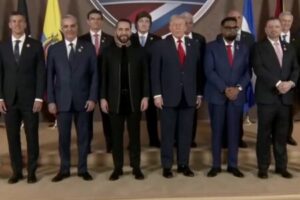


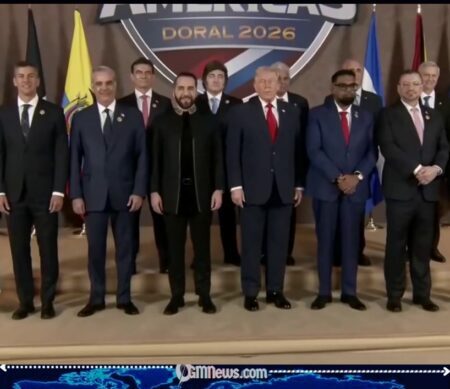
United States President Donald Trump, currently serving his second term in office, convened a high-level meeting of Latin American leaders in Miami on Saturday, marking a renewed focus on regional cooperation across the Western Hemisphere. The gathering, described by the White House as the “Shield of the Americas” summit, brought together 12 leaders from across Latin America and the Caribbean to discuss coordinated responses to organized crime, economic stability, and geopolitical competition.
Held at Trump’s Miami-area golf club, the summit represented a shift in U.S. foreign policy attention toward the Americas after months dominated by international crises elsewhere. Addressing the assembled leaders, Trump emphasized the need for collective action to dismantle powerful drug cartels and to counter the growing economic and political presence of China in the region.
According to the President Trump, a regional alliance similar to past international coalitions against terrorism could be instrumental in tackling transnational criminal networks and strengthening security cooperation among nations of the hemisphere.
Gathering of Regional Leaders in Miami
The summit brought together leaders from Argentina, Bolivia, Chile, Costa Rica, the Dominican Republic, Ecuador, El Salvador, Guyana, Honduras, Panama, Paraguay, and Trinidad and Tobago. The White House described the meeting as a platform for building stronger political, economic, and security partnerships across the region.
Trump told the participants that regional unity would be essential in confronting threats that cross national borders. He compared the proposed cooperation to earlier international coalitions formed to combat extremist groups.
“Just as we formed a coalition to eradicate ISIS, we now need a coalition to eradicate the cartels,” Trump said during his address. He argued that criminal organizations involved in narcotics trafficking and violence are destabilizing communities throughout the hemisphere.
The summit also served as an opportunity for diplomatic engagement among leaders facing similar challenges related to security, migration, and economic development.
Focus on Drug Cartels and Regional Security
A central theme of the discussions was the growing influence of transnational drug cartels. Trump emphasized that cartel violence remains a major threat to stability in the Americas, identifying Mexico as a key epicenter of the problem.
“The cartels are fueling and orchestrating much of the bloodshed and chaos in this hemisphere,” the president said. He suggested that coordinated intelligence sharing, law enforcement collaboration, and border security initiatives could form the backbone of the proposed coalition.
Recent developments in the fight against organized crime were also highlighted. U.S. law enforcement agencies reportedly provided intelligence support during a recent operation in Jalisco, Mexico, aimed at capturing Nemesio Oseguera Cervantes, widely known as “El Mencho,” the leader of the Jalisco New Generation Cartel (CJNG). Authorities said the cartel leader was wounded during a shootout and died while being transported to Mexico City.
Trump praised Mexico’s president, Claudia Sheinbaum, for her government’s efforts against organized crime, though she did not attend the Miami summit.
Leadership Changes and Diplomatic Roles
Another notable development during the event was the appearance of Kristi Noem, who recently stepped down as U.S. Secretary of Homeland Security. Noem addressed the gathering in her new role as the U.S. special envoy to the coalition initiative.
She described the proposed alliance as a framework for mutual cooperation among nations seeking to protect sovereignty, strengthen border security, and improve economic prospects. According to Noem, the coalition aims to demonstrate how regional collaboration can address shared challenges.
“Now that America is secure, and our borders are secure, we want to focus on our neighbors and help our neighbors with their borders and the challenges they have,” she said.
Although she did not elaborate on her swift transition from cabinet secretary to envoy, Noem highlighted her experience in border management as an asset in shaping the initiative.
Trump Administration Shifting Dynamics in Venezuela and Cuba
The summit occurred amid evolving political circumstances in several Latin American countries. The meeting came just two months after a U.S. military operation captured Venezuela’s former president Nicolás Maduro, who is currently awaiting trial in the United States on drug and weapons conspiracy charges.
Trump spoke positively about Venezuela’s interim president Delcy Rodríguez, noting that she had expressed willingness to cooperate with the United States. The U.S. government formally recognized the Venezuelan administration in recent weeks, signaling a new phase in diplomatic relations.
The president also commented on the situation in Cuba, predicting significant political and economic change. Trump argued that the country’s economic struggles—exacerbated by the loss of Venezuelan oil supplies—have placed the government under severe pressure.
While critical of Cuba’s political system, Trump indicated that the island nation had shown interest in negotiations with the United States, suggesting the possibility of future diplomatic engagement.
Countering Foreign Influence in the Hemisphere
Beyond security concerns, Trump framed the summit as part of a broader effort to limit the influence of outside powers in the Americas. He warned that foreign economic and political involvement—particularly from China—could undermine regional sovereignty.
The president referenced what he called the “Donroe doctrine,” a policy approach emphasizing cooperation among Western Hemisphere nations to safeguard strategic assets and political independence.
“We will not allow hostile foreign influence to gain a foothold in this hemisphere,” Trump said, specifically mentioning the importance of protecting strategic infrastructure such as the Panama Canal.
The statement reflected longstanding U.S. concerns about Beijing’s expanding economic presence across Latin America, including investments in infrastructure, energy, and telecommunications.
Support from U.S. Cabinet Officials
Several senior U.S. officials attended the summit and echoed the administration’s emphasis on strengthening ties within the hemisphere.
Secretary of State Marco Rubio praised the president for prioritizing regional relationships and described the participating nations as reliable partners. Rubio said the United States intends to deepen cooperation with countries that have consistently supported American diplomatic and security initiatives.
“At a time when we have learned that an ally, when you need them, may not be there for you, these are countries that have been there for us,” Rubio said, suggesting that partnerships within the Americas could become increasingly important.
Defense Secretary Pete Hegseth added that U.S. strategic attention had often been directed toward distant regions while neglecting issues closer to home. According to Hegseth, renewed focus on the Western Hemisphere could strengthen both national and regional security.
Outlook for the Proposed Coalition
Although the summit concluded without formal treaty announcements, the discussions laid the groundwork for continued dialogue among participating nations. Officials indicated that future meetings and working groups could be established to refine plans for intelligence sharing, economic collaboration, and joint law enforcement operations.
Observers note that the success of the initiative will depend on sustained diplomatic engagement and concrete policy measures among the participating countries.
For now, the Shield of the Americas concept represents an effort by the United States and its regional partners to address security threats, economic challenges, and geopolitical competition through closer hemispheric cooperation.