










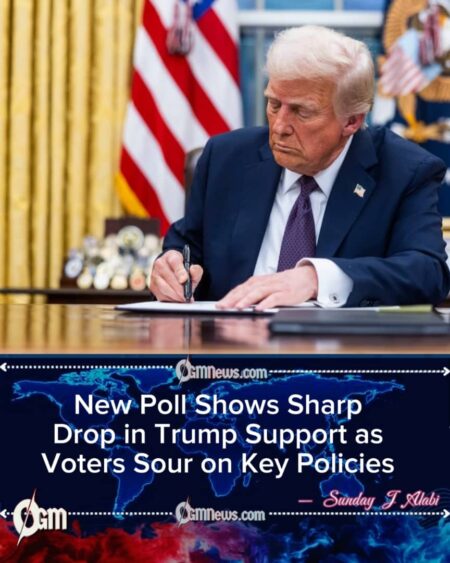
President Donald Trump, now serving his second term, is facing a significant downturn in public approval as new Daily Mail/JL Partners polling reveals a sharp decline in voter confidence—even on issues that once secured his re-election. The survey, conducted November 19–20, places Trump’s approval at 45 percent, down six points from the previous poll and ten points in just two months, marking the lowest point of his second-term presidency.
The findings suggest that core pillars of Trump’s political identity—particularly his economic agenda, immigration enforcement, and confrontational governing style—are increasingly driving voters away rather than solidifying their support. Declining approval among Hispanic, Black and young voters further underscores a shifting national political landscape.
Voter Concerns Rise Amid Sharp Decline in Approval
Trump’s latest approval rating represents a dramatic shift from the more optimistic numbers recorded earlier in the year. In September, he held a 55 percent approval rating—his highest in the Daily Mail’s polling. Now, that same figure reflects the portion of respondents who disapprove of his performance.
Voters identifying inflation, economic stagnation, and governance style as their top concerns are giving the president some of his weakest ratings yet. Those who cited inflation as their primary issue offered Trump just 40 percent approval, while voters prioritizing economic growth gave him 44 percent.
While the White House argues that Trump is “delivering on the promises he was elected to enact,” the polling suggests growing skepticism across multiple demographic and ideological groups.
Economic Strain Emerges as the Leading Factor
Economic dissatisfaction remains the biggest driver of Trump’s falling numbers. Inflation—now hovering at around 3 percent—has eased significantly from its 2022 peak of more than 9 percent, yet many Americans report feeling continued financial pressure.
The administration’s sweeping tariffs, imposed on “nearly every country” earlier this year, have contributed to sharp increases in consumer prices. Apparel and textiles have risen between 8 and 17 percent; groceries are up as much as 25 percent in some categories. Clothing, food items, and household necessities have all become more expensive, forcing the president to issue tariff exceptions on certain staples like coffee and bananas.
Although Trump now promises a proposed $2,000 “tariff stimulus” check for middle- and low-income Americans, the mechanism for such payments remains unclear, adding further uncertainty to the administration’s economic strategy.
Immigration Enforcement Loses Its Edge with Voters
While immigration was once among Trump’s strongest issues—powering both his 2016 campaign and his second-term return to office—recent data shows diminishing returns. The president’s net approval on ICE operations dropped four points in the new poll, surprising analysts who long viewed immigration as Trump’s most resilient strength.
A growing share of voters express discomfort with the intensity of ongoing ICE raids and enforcement efforts. According to the poll, 41 percent of those who disapprove of Trump cite the administration’s approach to ICE as a primary reason. Immigration attorney Benjamin Peña criticized the operations as “inhumane” and lacking regard for the people affected.
The erosion of support on an issue once central to Trump’s political brand suggests deeper concerns about the impact of aggressive enforcement on immigrant communities and on the national conscience.
Healthcare Struggles Add Pressure to Trump the Administration
Compounding voter frustration is the White House’s difficulty in securing an extension of Affordable Care Act subsidies, which are set to expire at the end of February. Despite Republican assurances during government funding negotiations, no conclusive plan has emerged.
The looming expiration threatens millions of Americans with increased healthcare costs, creating another point of tension between the administration and voters already wary of economic instability.
Internal Republican divisions are also widening. Former Trump ally and high-profile conservative Marjorie Taylor Greene recently announced her mid-term retirement from Congress following a public split with the president—another sign of political strain within Trump’s second-term coalition.
Demographic Shifts Worsen the Approval Slide
Trump’s most significant losses are emerging among young voters, Hispanic Americans, and Black voters. The Daily Mail/JL Partners poll shows only 36 percent approval among both Hispanic voters and those aged 18–29, with Black voter approval dropping to just 24 percent.
These declines represent a reversal from Trump’s improved numbers among minority and younger voters during the 2024 election, raising concerns for Republicans about their long-term electoral strategy.
Experts argue that rising consumer prices, tariff-driven inflation, and concerns about aggressive immigration enforcement disproportionately affect these communities, accelerating the erosion of support.
White House Pushes Back as Critics Intensify Attacks
The White House maintains that Trump has already accomplished major components of his second-term agenda. Spokeswoman Abigail Jackson highlighted border security, reduced drug prices, lowered taxes on tips and overtime, and efforts to ease inflation as signs of success.
Critics, however, argue the opposite. Progressive strategist Bradley Beychok labeled the administration’s tariff policies a “circus,” predicting that the economic consequences will worsen. He argued that the poll reflects the moment when voters finally see through what he called “Don the Con.”
These competing narratives underscore a widening divide over Trump’s economic and immigration agenda as his administration approaches the one-year mark of his second term.
Political Landscape Shifts as Voters Lose Confidence
After reaching a high point in September, the administration now faces a sobering political reality. With 55 percent of voters expressing disapproval and key demographic groups drifting away, the president’s coalition appears to be weakening.
As Trump nears the end of his first year back in office, the new polling signals an inflection point. While supporters continue to highlight gains in border security and national safety, the broader electorate is increasingly focused on economic pressures and governance concerns—factors that could shape the trajectory of Trump’s second-term legacy.


