



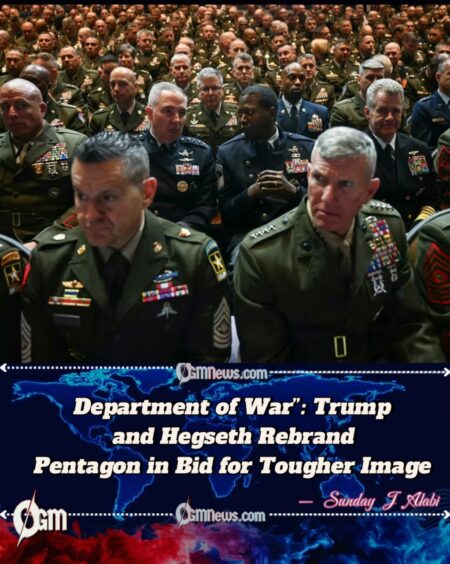
In a rare and tightly controlled gathering at the National Museum of the Marine Corps in Quantico, Virginia, hundreds of U.S. generals and admirals from across the world were called together last week by Defense Secretary Pete Hegseth and President Trump, who is serving his second term in office. The purpose of the meeting was not disclosed beforehand, heightening speculation among the military leadership about its significance.
Hegseth, who has drawn attention for his sharp criticisms of what he terms “toxic leadership” in the armed forces, used the occasion to press his case for stricter standards within the U.S. military. He promoted the rebranded title “Department of War,” a name he said reflected America’s martial spirit, though Congress has yet to officially authorize the change. He accused past leadership of lowering standards and declared his intent to roll out ten new directives, including stricter physical fitness requirements and grooming policies.
“Fat troops and fat generals are unacceptable,” Hegseth told the assembled officers, emphasizing that fitness was essential to both readiness and appearance. He argued that lowering standards had weakened the armed forces, insisting that a return to “the highest male standard” was needed for combat effectiveness.
Trump Declares “Reawakening of the Warrior Spirit”
President Trump, in an hourlong speech, echoed Hegseth’s call for renewed rigor and framed the gathering as part of a broader military revival under his leadership. “Together, we’re reawakening the warrior spirit,” he told the generals, praising their service and vowing that his administration would always have their backs.
Trump also announced a pledge of $1 trillion in military spending for 2026, far surpassing current defense allocations. He said the investment would expand the U.S. Navy by 19 new vessels, including submarines and assault ships. “The purpose of the American military is not to protect feelings—it’s to protect our republic,” he declared.
In addition, Trump touted diplomatic efforts his administration is pursuing, citing peace talks involving Israel and Hamas as well as discussions on the conflict between Ukraine and Russia. He closed his remarks with a familiar refrain, branding his administration’s defense posture as unmatched: “We will fight, fight, fight, and we will win, win, win.”
Civil Disturbances and “Training Grounds” Debate
The president also returned to his controversial use of the military in domestic contexts. He referenced an August executive order directing the National Guard to be better trained and prepared for “quelling civil disturbances.” Trump suggested that American cities could serve as “training grounds” for troops, specifically citing Chicago as a target for deployment.
His comments drew immediate pushback from Democrats. Sen. Dick Durbin of Illinois denounced the proposal, calling it “a dangerous assault on our democracy” and warning against treating U.S. cities as battlefields. Trump, however, argued that a strong domestic response was essential to addressing what he termed “the enemy within.”
In the same context, Trump also appeared to endorse more forceful responses to protesters. Recalling incidents of confrontations between demonstrators and federal officers, he said: “They spit, we hit,” signaling a shift in the administration’s stance on rules of engagement for troops and law enforcement.
The “Department of War” Vision
Both Hegseth and Trump returned repeatedly to the idea of renaming the Pentagon as the “Department of War.” Trump asserted that the change would help deter conflict by projecting strength, calling it “a historic reassertion of our purpose, identity, and pride.”
“The Department of War is going to stop wars,” he said, underscoring his belief that the renaming is more than symbolic. While Congress retains authority to officially change the name, Trump vowed his administration would continue embracing the term in policy and rhetoric.
The meeting concluded with Trump praising the resilience of the armed forces. “Nobody does it like you,” he said, describing America’s military as “the best, the boldest, the bravest that the world has ever seen.”