







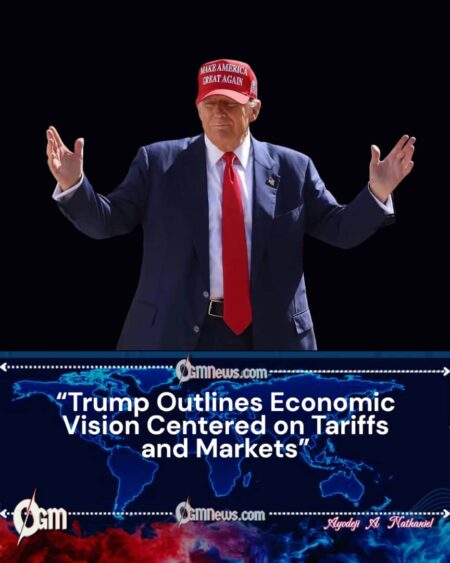
President Donald Trump, the current U.S. president serving his second term, has predicted that the United States stock market will double by the end of his administration, attributing the projected surge to what he described as “great tariffs.” The statement, delivered amid ongoing debates over trade policy and economic direction, places tariffs once again at the center of the administration’s economic narrative.
The forecast comes as investors, businesses, and policymakers closely monitor signals from Washington for clues about fiscal priorities, trade relations, and long-term growth expectations. While the prediction is optimistic, it also raises questions about feasibility, timing, and the broader economic trade-offs of an aggressive tariff-driven strategy.
President Donald Trump’s Economic Claim
President Trump framed his projection as a natural outcome of policies designed to prioritize domestic production and protect American industries. According to the president, tariffs will continue to incentivize manufacturing at home, strengthen corporate balance sheets, and ultimately drive equity valuations higher.
Trump argued that markets respond positively when economic policy is “clear, tough, and pro-American,” suggesting that predictability in trade enforcement could outweigh short-term volatility. The administration maintains that tariffs are not merely punitive tools but leverage for restructuring global trade relationships.
Tariffs as a Core Policy Tool
Tariffs have been a defining feature of President Trump’s economic approach across both terms. The administration views them as a mechanism to correct long-standing trade imbalances, particularly with major export economies, and to protect strategic industries such as steel, technology, and manufacturing.
Supporters argue that tariffs can shield domestic firms from unfair competition and encourage investment within U.S. borders. Critics, however, counter that tariffs often raise input costs, strain supply chains, and risk retaliatory measures that could dampen growth rather than accelerate it.
Market Reaction and Investor Sentiment
Financial markets tend to respond quickly to presidential economic forecasts, though reactions are often mixed. Optimistic projections can lift investor confidence in the short term, but markets also weigh underlying fundamentals such as earnings growth, inflation, and interest rates.
Analysts note that while tariffs may benefit specific sectors, broad-based market doubling would likely require sustained productivity gains, stable monetary conditions, and strong consumer demand. As such, investors are expected to parse policy details rather than rely solely on headline predictions.
Economic Fundamentals and Policy Constraints
A doubling of the stock market within a single presidential term would be historically significant. Economists point out that such growth would depend not only on trade policy but also on fiscal discipline, corporate profitability, and global economic stability.
There are also constraints beyond executive control, including Federal Reserve policy, geopolitical risks, and external economic shocks. These factors could either amplify or limit the impact of tariff-centered strategies on overall market performance.
Political Context and Strategic Messaging
President Donald Trump’s statement also functions as a political message, reinforcing an economic platform centered on strength, growth, and national advantage. By linking market performance directly to tariffs, the administration draws a clear contrast with alternative economic philosophies that emphasize multilateral trade and reduced barriers.
In a polarized political environment, such forecasts resonate differently across audiences. Supporters see confidence and decisiveness, while opponents view the prediction as overly ambitious and insufficiently grounded in economic complexity.
What to Watch Going Forward
As trump’s administration advances its second-term agenda, attention will focus on how tariff policies are implemented and whether complementary measures such as tax policy, infrastructure investment, or regulatory changes support the stated market goals.
Ultimately, the credibility of the forecast will hinge on measurable outcomes: corporate earnings reports, employment trends, inflation data, and long-term investor confidence. For now, the prediction sets a high benchmark against which the administration’s economic record will be judged.