










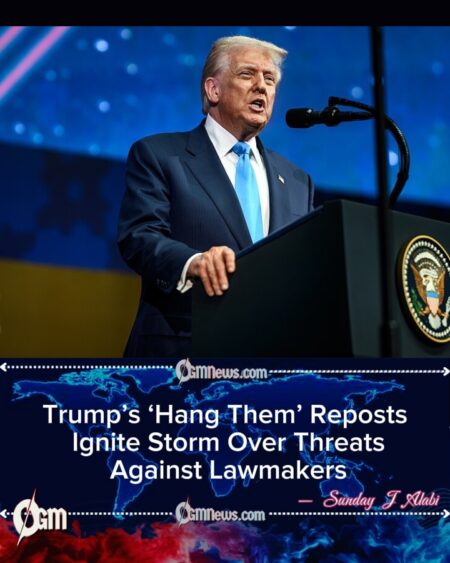
Top Democrats in the U.S. Congress have condemned President Donald Trump after he accused six Democratic lawmakers of “seditious behavior” and amplified online calls for their execution.
The current U.S. president, now serving his second term, posted on social media that Democratic members of Congress who urged military and intelligence personnel to refuse illegal orders should be arrested and tried for sedition. In a subsequent message, he declared in capital letters: “SEDITIOUS BEHAVIOR, punishable by DEATH!” He then reposted another message that read, “HANG THEM, GEORGE WASHINGTON WOULD!”
Senate Minority Leader Chuck Schumer responded from the Senate floor, warning that the president Trump’s’s rhetoric represented “an outright threat” that must be treated as “deadly serious.” He argued that such statements increase the risk of real-world violence, saying Trump was “lighting a match in a country soaked with political gasoline.”
The Video That Triggered Trump’s Outburst
The president Trump’s posts came in response to a video featuring six Democratic lawmakers: Senators Mark Kelly of Arizona and Elissa Slotkin of Michigan, along with Representatives Jason Crow of Colorado, Chris Deluzio and Chrissy Houlahan of Pennsylvania, and Maggie Goodlander of New Hampshire.
The group, all veterans or former national security officials, used the video to address what they described as growing threats to the U.S. Constitution. They urged active-duty service members and members of the intelligence community to “refuse illegal orders,” stressing that the duty to the Constitution supersedes loyalty to any individual leader.
In a joint statement issued on Thursday, the lawmakers said the most revealing aspect of the controversy was that the president considered their public restatement of existing law to be a capital offense. “What’s most telling is that the President Trump considers it punishable by death for us to restate the law,” they said. “This isn’t about any one of us. This isn’t about politics. This is about who we are as Americans.”
Lawmakers: “This Is About Who We Are as Americans”
The six lawmakers framed the dispute as a test of national character rather than partisan rivalry. “Every American must unite and condemn the President Trump’s’s calls for our murder and political violence. This is a time for moral clarity,” their statement said.
Elissa Slotkin later released a video response, appealing to citizens across the political spectrum. She said she hoped “people of all backgrounds — Democrat, Republican, Independent — would agree that threatening death for people you disagree with is beyond the pale of who we are as Americans.”
Slotkin vowed not to back down, declaring, “I refuse to be intimidated out of defending the country I love.” Her message underscored the lawmakers’ broader argument: that challenging unlawful directives is a legal responsibility, not an act of rebellion.
A Different Brand of Political Violence”
Representative Chrissy Houlahan, speaking in an interview, described the moment as especially alarming. “This is the president of the United States calling for the death of a member of Congress, six members of Congress,” she said, calling it “a different brand of political violence and political retribution.”
The comments captured mounting concern within the Democratic caucus about the normalization of violent political language. Many lawmakers warned that such rhetoric could embolden extremists or individuals inclined toward political violence, particularly in a polarized climate.
Schumer told reporters he had asked for special U.S. Capitol Police protection for Senators Slotkin and Kelly, highlighting the security implications of the president’s statements. He urged “every American, regardless of party,” to condemn the president Trump’s words “immediately and without qualification,” warning that “if we don’t draw a line here, there is no line left to draw.”
Democratic Leadership Demands Retraction and Security
Democratic leaders in both chambers of Congress moved swiftly to formalize their objections. In the Senate, Schumer insisted that Trump “must be condemned forcefully, loudly and without excuses, before someone takes his words as permission to do the unthinkable,” arguing that anything less “enables the flames of hatred to grow and spread.”
In the House, Minority Leader Hakeem Jeffries, Democratic Whip Katherine Clark and Democratic Caucus Chair Pete Aguilar released a joint statement denouncing what they called “disgusting and dangerous death threats against Members of Congress.” They disclosed that they had been in contact with the House Sergeant at Arms and U.S. Capitol Police to ensure the safety of the targeted lawmakers and their families.
“Donald Trump must immediately delete these unhinged social media posts and recant his violent rhetoric before he gets someone killed,” the House Democratic leaders said, urging Republicans to join them in a bipartisan denunciation.
Republicans Walk a Tightrope on Trump’s Rhetoric
House Speaker Mike Johnson initially declined to criticize the president’s language, focusing instead on the content of the Democrats’ video. He argued it was “wildly inappropriate” for lawmakers to encourage members of the military to disobey orders, warning that “we have got to raise the bar in Congress, this is out of control.”
Johnson asserted that the president was “defining the crime of sedition” with his remarks. But when pressed again later in the day, he distanced himself somewhat from the severity of Trump’s words. “The words that the president chose are not the ones that I would use, okay?” Johnson said. “Obviously, I don’t think that these are crimes punishable by death or any of that.”
He characterized Trump’s language as “heated rhetoric” and redirected attention back to the lawmakers’ video, asking reporters, “Do any of you agree that that’s appropriate, that they should be telling young members of the military to defy orders?” His comments reflected the broader Republican balancing act: defending the president’s authority while attempting to soften the impact of his most extreme statements.
White House Defends President Trump Cites “Chain of Command”
At the White House, press secretary Karoline Leavitt was asked directly whether the president was calling for the execution of members of Congress. “No,” she replied, rejecting that interpretation.
Leavitt argued that the focus should be on the lawmakers’ actions, not only the president’s response. “Let’s be clear about what the president is responding to,” she said, accusing the lawmakers of conspiring to produce “a video message to members of the United States military, to active-duty servicemembers, to members of the national security apparatus, encouraging them to defy the president’s lawful orders.”
She insisted that “the sanctity of our military rests on the chain of command,” signaling that, in the administration’s view, the lawmakers’ appeal crossed a line by allegedly undermining that chain. Critics, however, point out that U.S. military law obliges service members to refuse unlawful orders, not to follow them blindly.
Fears of Escalating Political Violence
The clash has exposed deep anxieties over the state of American democracy and the boundaries of political speech. Schumer warned that each time Trump uses such language, “he makes political violence more likely,” describing the current climate as “a country soaked with political gasoline.”
For the six targeted lawmakers, the episode has become a rallying point for defending democratic norms and rejecting intimidation. “This is about who we are as Americans,” their statement emphasized, calling for “moral clarity” and insisting that threats of execution against elected officials have no place in the nation’s political life.
As Democrats urge an unmistakable rebuke of the president’s words and Republicans struggle to reconcile loyalty with alarm over the tone of the rhetoric, the dispute underscores the fragile line between heated political debate and incitement — and the stakes when that line begins to blur.


