










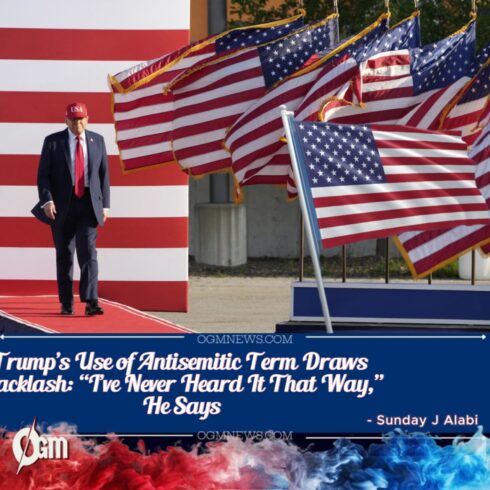
President Donald J. Trump is facing widespread criticism after using the word “shylocks”—a term long associated with antisemitic stereotypes—during a celebratory speech in Iowa on Thursday evening. The remarks, made as the president touted the recent passage of his landmark One Big Beautiful Bill Act, sparked outrage from Jewish organizations and political figures alike, who condemned the language as harmful and offensive.
The president Trump, however, defended himself when questioned by reporters, saying he was unaware of the word’s antisemitic connotations. “I’ve never heard it that way,” Trump said. “The meaning of shylock is somebody that’s a moneylender at high rates. You view it differently. I’ve never heard that.”
The controversy adds to an already volatile political landscape, as both supporters and critics weigh in on the implications of the president’s choice of words.
The Controversial Remark: “Shylocks and Bad People”
The controversy began during a campaign-style event in Iowa, where President Trump addressed a cheering crowd while celebrating the passage of his sweeping economic legislation, the One Big Beautiful Bill Act. While discussing the law’s elimination of the estate tax, Trump remarked, “Think of that. No death tax, no estate tax. No going to the banks and borrowing from in some cases a fine banker, and in some cases shylocks and bad people.”
The use of the term “shylock” immediately raised concerns. The word originates from William Shakespeare’s The Merchant of Venice, where Shylock is a Jewish moneylender portrayed as greedy and vengeful—a depiction that has fueled antisemitic stereotypes for centuries. In modern discourse, the term is widely considered offensive and loaded with bigotry.
Although the remark appeared unscripted, its inclusion in the president’s rhetoric struck a nerve with many Jewish advocacy groups and political leaders, who swiftly condemned the language.
Jewish Organizations Condemn President’s Language
The Anti-Defamation League (ADL), one of the leading organizations combatting antisemitism, responded forcefully to the president’s remarks. In a statement posted Friday on X (formerly Twitter), the group called Trump’s use of the term “very troubling and irresponsible,” emphasizing that it “evokes a centuries-old antisemitic trope about Jews and greed that is extremely offensive and dangerous.”
The ADL has long campaigned against the casual use of this term, warning that such language perpetuates harmful stereotypes that have historically led to discrimination and violence against Jewish communities. The organization reiterated that public figures, particularly those in positions of power, bear a heightened responsibility to avoid language that could fuel hatred or division.
In past instances, the ADL has used similar moments to engage in public education about antisemitic tropes, and the group expressed concern that the president’s words could legitimize fringe views.
Political Fallout: Lawmakers Weigh In
The political response was swift, with several lawmakers condemning the president’s choice of words. Representative Dan Goldman, a Jewish Democrat from New York, took to X to denounce Trump’s comments as “blatant and vile antisemitism,” asserting that the president “knows exactly what he’s doing.”
“Anyone who truly opposes antisemitism calls it out wherever it occurs—on both extremes—as I do,” Goldman added, emphasizing the need for bipartisan condemnation of such rhetoric.
The incident comes at a sensitive time in American politics, as issues of racism, antisemitism, and extremism continue to shape public discourse ahead of the 2024 election. While some Republicans defended Trump by downplaying the significance of the term, others remained silent, highlighting the ongoing divisions within the party over how to address inflammatory language from its standard-bearer.
OGMNews.COM
Trump Sparks Outrage After Using Antisemitic Slur in Iowa Speech, Claims Ignorance of Offensive Meaning

When confronted by reporters after the event, President Trump sought to distance himself from any antisemitic intent. “The meaning of shylock is somebody that’s a moneylender at high rates,” he said. “You view it differently. I’ve never heard that.”
Trump’s comments echo past instances where he has brushed aside allegations of offensive language, often framing criticism as political attacks. He has maintained that his administration remains strongly supportive of Israel and Jewish Americans, citing his past policy decisions, including the relocation of the U.S. Embassy to Jerusalem.
Despite his denials, critics argue that ignorance of a term’s offensive nature does not absolve public figures from responsibility, particularly when the term has a well-documented history of bigotry.
A Familiar Pattern: Echoes of Biden’s 2014 Gaffe
The controversy surrounding Trump’s remark has also revived memories of a similar incident involving then-Vice President Joe Biden in 2014. Speaking about predatory lenders who targeted U.S. service members, Biden referred to them as “shylocks,” prompting backlash from the ADL and a subsequent apology.
At the time, Biden called the remark a “poor choice of words,” and the ADL praised him for acknowledging the error and using the moment as an opportunity for public education.
The Trump episode has drawn comparisons, though critics argue that the context and the current political climate make this incident particularly damaging. Advocates stress that both sides of the political spectrum must remain vigilant in rejecting antisemitic language, regardless of intent or party affiliation.
Broader Implications: Words Matter in Divided Times
The incident underscores the power of language in shaping public attitudes, particularly in an era of heightened political polarization and rising antisemitism globally. Jewish advocacy groups warn that even unintended use of such terms can embolden hate groups and normalize dangerous stereotypes.
In recent years, reports of antisemitic incidents have surged in the United States and around the world, prompting renewed calls for leaders to set a higher standard in public discourse. The ADL and others argue that failure to confront offensive language—especially when it comes from the nation’s highest office—risks sending the wrong message to society.
As the 2024 campaign season intensifies, both allies and critics of President Trump will likely watch closely to see whether this incident becomes part of a broader narrative about the role of language, prejudice, and accountability in American politics.


