










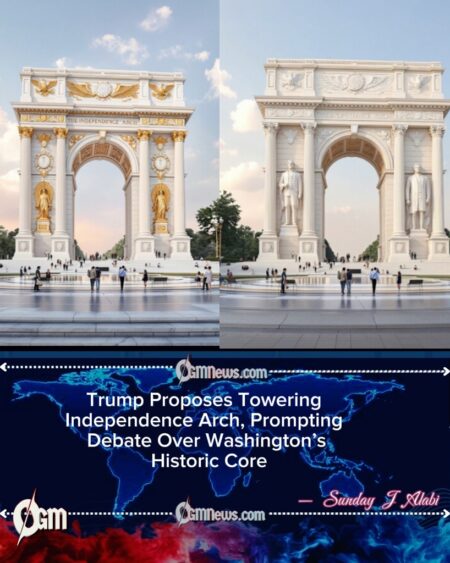
President Donald Trump, now serving a second term as U.S. president, is reportedly considering plans for a monumental new structure on the Washington skyline: a 250-foot triumphal arch intended to mark the 250th anniversary of American independence. According to reports, the proposed structure—tentatively named the Independence Arch—would tower over nearby landmarks, including the Lincoln Memorial, and become one of the most prominent architectural statements in the nation’s capital.
The proposal, which is still informal but gaining shape within the Trump administration, has already sparked discussion among architects, historians, and urban planners. While supporters argue that Washington lacks a large triumphal arch celebrating national achievements, critics question whether the scale, location, and symbolism of such a structure fit within one of the city’s most historically sensitive corridors.
Trump’s Vision for a Landmark Commemorating Independence
The Independence Arch is envisioned as a permanent structure standing approximately 250 feet tall—more than double the height of the Lincoln Memorial and significantly taller than Paris’s Arc de Triomphe. Although it would still fall short of the Gateway Arch in St. Louis, the proposed height would make it one of the most imposing monuments in Washington, D.C.
President Trump has reportedly embraced the numerical symbolism of the project, linking the arch’s height to the 250th anniversary of the Declaration of Independence in July. According to people familiar with private discussions, he has framed the proposal as a bold national statement, emphasizing that the United States should surpass European precedents in commemorating its own history.
Proposed Location and Its Historical Sensitivity
Reports indicate that President Trump is considering a plot of land near Memorial Bridge over the Potomac River, an area under the jurisdiction of the National Park Service. The site lies between the Lincoln Memorial and Arlington National Cemetery, a corridor long regarded as one of the most solemn and symbolically charged landscapes in the capital.
Urban planners note that this stretch of Washington was carefully designed to balance remembrance, reconciliation, and national unity. Any major addition, especially one of such scale, could alter established sightlines and reshape the visual and symbolic relationship between existing memorials.
Architectural Debate Over Scale and Proportion
The size of the proposed arch has raised concerns among architectural experts. Art critic Catesby Leigh, who initially proposed a far smaller and temporary arch to commemorate the independence anniversary, has expressed reservations about the expanded vision. Leigh has argued that an arch of this magnitude may overwhelm its surroundings rather than complement them.
He has suggested alternative locations where a large arch could stand more independently, such as Barney Circle in southeast Washington, where fewer competing monuments exist. In such a setting, proponents argue, the structure might achieve prominence without disrupting a historically somber landscape.
Designers, Allies, and White House Involvement
Despite reservations from some quarters, the proposal has attracted interest among architects sympathetic to grand, classical forms. Nicolas Leo Charbonneau, an architect who publicly advocated for a triumphal arch in the United States, has reportedly been engaged by the White House to contribute to design work.
The Trump administration’s interest in large-scale construction is not limited to the arch. President Trump is already overseeing the construction of a new East Wing ballroom at the White House, a project that itself has drawn attention for its scale and cost. Leftover funds from that effort have reportedly been discussed as a possible funding source for the arch.
Symbolism, Setting, and National Memory
Beyond questions of size, critics have raised concerns about thematic appropriateness. Memorial Circle and its surroundings are closely associated with remembrance and sacrifice, particularly given their proximity to Arlington National Cemetery and the Lincoln Memorial’s legacy of national unity after the Civil War.
John Haigh, chair of Benedictine College’s architecture program, has described the area as a “somber corridor,” cautioning that a celebratory triumphal arch could introduce a discordant note. Supporters, however, counter that independence itself is a foundational national achievement deserving of bold commemoration.
Oversight, Precedent, and the Path Ahead
Washington, unlike many global capitals, does not have a major triumphal arch, a point often cited by advocates of the project. President Trump has reportedly noted this absence in conversations, framing the proposal as a way to fill a symbolic gap in the city’s monumental landscape.
Atlanta philanthropist and developer Rodney Mims Cook Jr., now appointed to the Commission of Fine Arts, is expected to play a role in reviewing or shaping the proposal. Any final decision would still require navigating regulatory processes, public scrutiny, and inter-agency approvals before construction could begin.


