








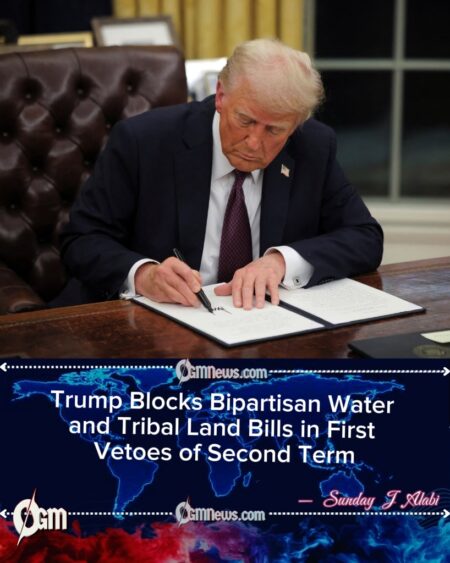
President Donald Trump, the current U.S. president serving a second term, has issued the first vetoes of his new administration, rejecting two bipartisan bills passed by Congress that addressed long-standing water infrastructure needs in Colorado and land governance issues involving the Miccosukee Native American Tribe in Florida. The vetoes, announced this week, have triggered sharp reactions across party lines and reopened debates about federal spending priorities, tribal sovereignty, and executive authority.
Both measures had cleared the House and Senate by voice votes, signaling broad bipartisan support. Their rejection now sets the stage for a possible congressional override attempt, though such efforts face steep political and procedural hurdles.
Trump First Vetoes of the New Term
The White House confirmed on Monday that President Trump vetoed the two bills shortly after they reached his desk earlier this month. The decision marked the first use of his veto power since returning to office, underscoring an early willingness to challenge Congress even on measures with cross-party backing.
Historically, presidential vetoes are relatively uncommon, particularly when the president’s party maintains influence in Congress. During his first term, President Trump vetoed 10 bills, all in the final two years of that administration. Former President Joe Biden, by comparison, used the veto power 13 times during his presidency.
Under the Constitution, Congress may override a presidential veto with a two-thirds majority vote in both chambers. While lawmakers from both parties have criticized the president’s decision, achieving that margin remains uncertain.
The Miccosukee Bill and Tribal Land Control
One of the vetoed measures, the Miccosukee Reserved Area Amendments Act, focused on land and flood protection in the Florida Everglades. The bill sought to add the Osceola Camp, a small village, to land already controlled by the Miccosukee Tribe and required the Department of the Interior to take steps to protect the area’s structures from flooding.
The proposal drew bipartisan support from Florida lawmakers, including Republican Senators Rick Scott and Ashley Moody, Republican Representative Carlos Gimenez, and Democratic Representative Darren Soto. Supporters framed the bill as a matter of conservation and fairness toward a Native American community facing environmental risks.
Representative Gimenez argued on the House floor that the legislation would strengthen tribal autonomy, enabling the Miccosukee people to safeguard their homes, land, and cultural traditions.
Trump Administration Objections and Immigration Dispute
In a formal message to Congress explaining his veto, President Trump argued that the Miccosukee bill primarily benefited “special interests” and criticized the tribe for opposing his administration’s immigration policies. He accused the tribe of seeking federal funding while actively challenging measures supported by voters in the last election.
Earlier this year, the Miccosukee Tribe joined a lawsuit against an immigration detention center in the Everglades known by officials as “Alligator Alcatraz.” The tribe has said the facility could harm the surrounding environment, affecting hunting grounds and ceremonial practices.
The president Trump also contended that Osceola Camp was established without federal authorization, stating that it was not the federal government’s responsibility to address problems in an area the tribe had not been formally approved to occupy. As of publication, the tribe had not publicly responded to the veto.
Colorado Water Pipeline Blocked
The second veto targeted the Finish the Arkansas Valley Conduit Act, a bill intended to advance a long-delayed water pipeline project in southeastern Colorado. The pipeline, originally proposed during President John F. Kennedy’s administration, is designed to provide clean drinking water to as many as 50,000 residents.
The project stalled for decades due to funding requirements that placed heavy financial burdens on local communities. A 2009 law adjusted the cost-sharing formula, and the newly vetoed legislation would have further eased repayment terms by reducing interest payments and extending deadlines.
Supporters argued that the bill addressed an urgent public health and infrastructure need in rural areas that have struggled with water quality issues for years.
Trump Administration Cost Concerns and Fiscal Argument
President Trump defended his veto of the Colorado pipeline bill as part of a broader effort to curb what he described as excessive federal spending. He cited estimates from the U.S. Bureau of Reclamation projecting the project’s cost at approximately $1.4 billion as of 2023, roughly double earlier projections.
In his veto message, the president Trump said the legislation would force federal taxpayers to shoulder an unfair share of the cost for what he characterized as a local project. He argued that approving the bill would perpetuate “failed policies of the past” by expanding federal financial responsibility.
The measure had been supported by Colorado’s two Democratic senators, John Hickenlooper and Michael Bennet, as well as Republican Representatives Lauren Boebert and Jeff Hurd, whose districts include communities that would benefit directly from the pipeline.
Political Fallout and Congressional Response
Reaction to the vetoes was swift and pointed. Representative Boebert described the decision as “very disappointing,” emphasizing that the effort to complete the pipeline would continue. In separate remarks, she rejected suggestions that the bill was controversial and questioned whether political considerations influenced the president’s action.
Senator Hickenlooper accused the president Trump of engaging in partisan politics at the expense of rural communities, while Senator Bennet said the veto reflected an attempt at political retaliation. Both warned that the decision could prolong water access challenges in southeastern Colorado.
The vetoes also come amid broader political tensions between the White House and Colorado officials, including disputes over election-related cases and federal-state relations. Whether Congress will attempt to override the vetoes remains to be seen.