





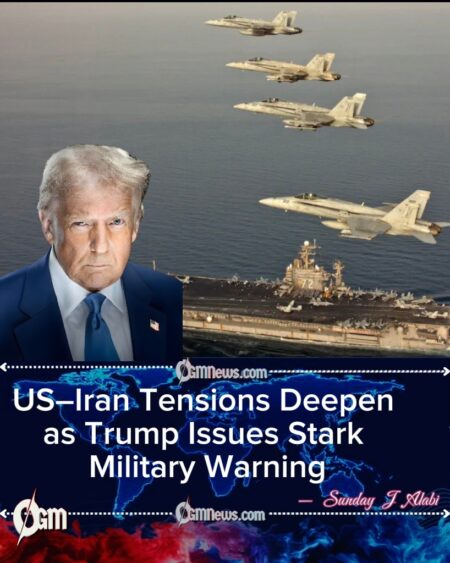
The risk of open conflict between the United States and Iran has intensified following a fresh warning from US President Donald Trump, who said time was running out for Tehran to agree to a new nuclear deal. Trump disclosed that a large US naval armada, led by the aircraft carrier USS Abraham Lincoln, is moving rapidly towards the region and is prepared to act with force if negotiations fail. His remarks have heightened global concern over the prospect of a military confrontation with far-reaching regional and international consequences.
The president Trump’s comments mark one of the strongest signals yet that Washington is prepared to consider military action should diplomatic efforts collapse. While US officials insist that the deployment is defensive, the language used by Trump has underscored the urgency and gravity of the standoff, placing renewed pressure on Iran at a time of heightened instability in the Middle East.
Rising Military Posturing and Trump’s Warning
In a series of social media posts, President Trump stated that the US fleet heading towards Iran was larger than recent deployments elsewhere and was “prepared to rapidly fulfil its missions with speed and violence if necessary.” He urged Iran to return to the negotiating table to agree to what he described as a fair and equitable deal that would permanently block Tehran from acquiring nuclear weapons.
Trump referenced a previous US operation against Iran, warning that any future strike would be “far worse” if Iran failed to comply. This rhetoric represents a notable escalation from earlier statements that framed the US military presence as a response to unrest inside Iran and concerns over civilian deaths. The focus has now shifted decisively towards Iran’s nuclear programme and broader military capabilities.
US officials later clarified that the administration would also maintain a “pre-emptive defensive option” if there were credible signs of an impending Iranian attack on American forces. This position reflects growing anxiety within Washington over Iran’s missile arsenal and drone capabilities, which are believed to pose a direct threat to US personnel stationed across the region.
Regional Risks and Iran’s Response
Iranian officials have reacted sharply to the latest US statements, warning that any military action would be considered the start of a full-scale war. Ali Shamkani, a senior adviser to Iran’s Supreme Leader, said any attack would trigger an “immediate, comprehensive and unprecedented” response, targeting US interests and its allies, including Israel.
The Iranian mission to the United Nations also recalled the heavy human and financial costs of past US military interventions in the Middle East, arguing that Iran remains open to dialogue but will not negotiate under pressure or threats. Tehran has consistently rejected talks that involve preconditions, particularly demands to curb its missile programme or regional influence.
Meanwhile, European diplomats and regional actors have expressed concern about the possibility of rapid escalation. Gulf States and Turkey are reported to be engaging in quiet diplomacy with both Washington and Tehran in an effort to de-escalate tensions, amid fears that any conflict could quickly spread beyond Iran’s borders.
Diplomatic Uncertainty and Global Implications
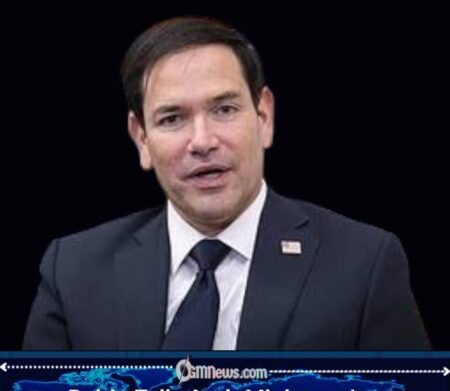
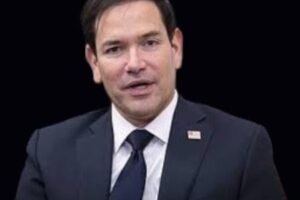
US Secretary of State Marco Rubio told the Senate that the Iranian government is weaker than it has been in decades, following recent unrest in which activists claim tens of thousands were killed. However, Rubio warned that Iran still possesses significant military capabilities, including thousands of ballistic missiles and one-way drones capable of striking US forces.
Trump’s special envoy, Steve Witkoff, has maintained that a negotiated agreement remains possible, stressing that any deal must address missile development, uranium enrichment, Iran’s stockpile of nuclear material, and its support for non-state armed groups. Despite this, recent comments from Trump suggesting that Iran’s leadership should exit the global stage have further complicated the diplomatic landscape.
Analysts note that the escalation comes at a politically sensitive moment for the US administration, fuelling speculation that the heightened rhetoric may also serve domestic political purposes. Regardless of motive, the sharpening tone has increased the risk of miscalculation, with global markets and international observers closely monitoring developments.