
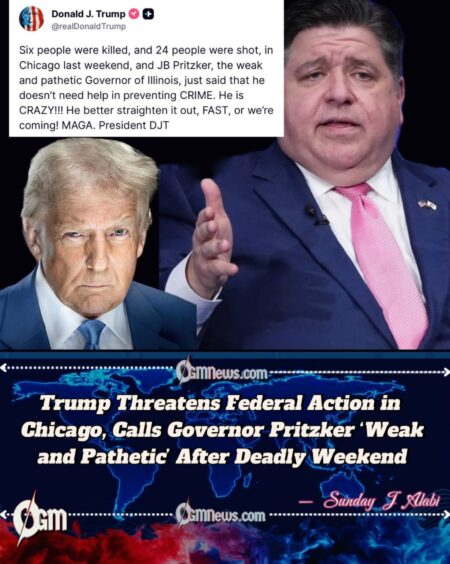
Another bloody weekend in Chicago has reignited debate over crime control by President Trump and governance in the state of Chicago Illinois. Six people were killed and 24 others injured in shootings across the city last weekend, deepening concerns about public safety and the city’s ability to curb violent crime.
The spike in gun-related fatalities follows a troubling pattern that has left residents fearful and local leaders under pressure. Chicago has long been a flashpoint in the national conversation on urban violence, with critics accusing state officials of failing to implement decisive measures.
Trump Targets Governor Pritzker Over Crime Response
President Donald Trump sharply criticized Illinois Governor JB Pritzker for rejecting his administration’s offers of federal assistance. In a fiery Truth Social post on Saturday night, Trump branded Pritzker “weak and pathetic,” warning him to “straighten it out FAST” or face federal intervention.
The president Trump accused Pritzker of failing his constituents, declaring: “He is CRAZY!!! He better straighten it out, FAST, or we’re coming! MAGA.” Trump’s remarks came just days after he mocked the governor’s physical fitness, escalating what has become a deeply personal feud between the two leaders.
Federal Troop Deployment on the Table
Trump pointed to his administration’s recent federalization of security in Washington, D.C., where National Guard troops and federal police were deployed to quell unrest after a series of violent incidents. He boasted that within two weeks, the capital had become a “crime-free zone,” crediting the military and federal law enforcement with “liberating the city.”
The president Trump hinted that similar measures could be applied in other urban centers, explicitly naming New York, Los Angeles, Baltimore, Oakland, and Chicago as possible targets for federal troop deployment. “We’re going to take back our capital,” he said, “and then we’ll look at other cities also. But other cities are studying what we’re doing.”
Pritzker and Chicago Leaders Push Back
Governor Pritzker has rejected the president’s overtures, describing federal intervention as both “unconstitutional” and “a dangerous power grab.” Responding to Trump’s jabs about his weight, Pritzker shot back, saying, “It takes one to know one on the weight question. The president himself is not in good shape.”
Chicago Mayor Brandon Johnson also criticized Trump’s approach, calling it “out of control.” Johnson signed an executive order barring the Chicago Police Department from cooperating with federal authorities on immigration enforcement or militarized patrols. He emphasized that his administration would safeguard residents’ constitutional rights “amidst the possibility of imminent militarized deployment by the federal government.”
Political Undertones and Election Calculations
Political analysts suggest that the clash between Trump and Pritzker may be more than a policy dispute—it could signal a brewing electoral rivalry. Pritzker, a prominent Democrat, has been floated as a potential contender in future national elections, while Trump’s law-and-order platform remains a central pillar of his presidency.
By positioning himself as the defender of federal control and public safety, Trump appeals to his base and places Democratic governors on the defensive. Meanwhile, Pritzker and Johnson are framing their resistance as a stand against federal overreach, presenting themselves as champions of state and local autonomy.
The Growing Divide Over Urban Crime Policy
The showdown underscores the widening divide between state leaders and the federal government over how to handle violent crime in America’s largest cities. While Trump advocates a militarized crackdown led by federal troops, Illinois leaders argue for community-based reforms and warn against authoritarian tactics.
With Chicago’s violence showing no sign of slowing, the coming weeks could test whether federal intervention becomes a reality—or remains a political flashpoint in an increasingly heated national debate.