






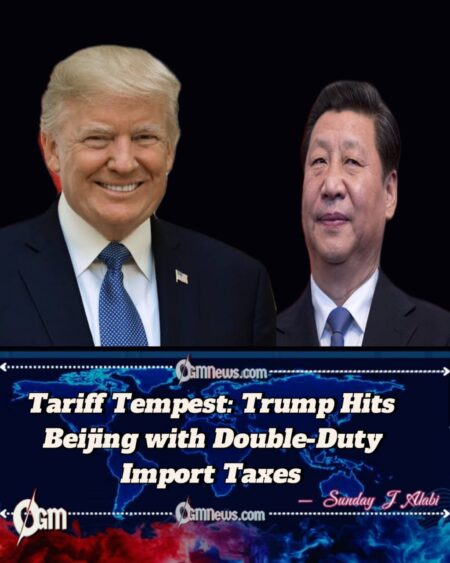
President Donald Trump, currently serving his second term, announced on Friday that his administration will impose an additional 100% tariff on all imports from China beginning next month. The move comes in response to what the White House described as “aggressive and unfair” Chinese export controls, marking a dramatic escalation in the ongoing trade conflict between the two world powers.
The new tariffs will come on top of existing import duties already levied against Chinese goods. Financial markets reacted sharply to the announcement: the S&P 500 fell 2.7%, the Dow Jones Industrial Average declined by 1.8%, and the tech-heavy Nasdaq Composite dropped 3.6%, reflecting investor anxiety over the potential impact on global trade and manufacturing supply chains.
This latest measure underscores President Trump’s commitment to recalibrating America’s economic relationship with Beijing — a central focus of his administration’s trade and industrial policy. However, analysts warn that such an aggressive approach could reignite inflationary pressures and strain diplomatic ties ahead of a planned but uncertain meeting between Trump and Chinese President Xi Jinping later this month.
Trade Talks Between Trump And Xi Jinping in Jeopardy
The U.S.-China trade relationship, already fraught with disputes over technology, exports, and intellectual property, faces renewed uncertainty. While both Trump and Xi Jinping had previously agreed in May to reduce tariffs — the U.S. to 30% and China to 10% — those gains now appear to be unraveling. Trump’s latest move, officials say, is a response to Beijing’s newly announced export restrictions on key technologies and industrial materials, which Washington views as retaliatory.
President Trump suggested on Friday that “there seems to be no reason” for the upcoming meeting with President Xi to proceed, raising concerns that the diplomatic channel for resolving trade differences could close altogether. The Chinese government has not yet formally responded to the new tariffs but has previously warned of “firm countermeasures” should the U.S. intensify its trade barriers.
Economists note that China remains the United States’ third-largest trading partner, behind Mexico and Canada. Last year, the U.S. imported $438.9 billion worth of goods from China, while exporting $143.5 billion in return. Any further disruption, experts say, could ripple through multiple industries, from consumer electronics to agriculture and manufacturing.
Economic and Political Repercussions
Beyond the immediate market reaction, the tariff escalation adds complexity to several sensitive issues between Washington and Beijing. The Trump administration is currently negotiating a deal to transfer ownership of TikTok’s U.S. operations away from its China-based parent company, ByteDance. Beijing’s approval is critical to finalizing that transaction, but analysts suggest that rising tensions could derail the process.
Similarly, ongoing disputes over technology exports and restrictions on Chinese students studying in the United States continue to inflame relations. While the White House maintains that these policies are aimed at protecting national security and intellectual property, China has accused Washington of economic bullying and political interference.
For President Trump, the tariff move signals a continued effort to assert U.S. dominance in global trade policy — a stance popular among parts of his domestic base but increasingly contested by business leaders and economists concerned about long-term economic fallout.