


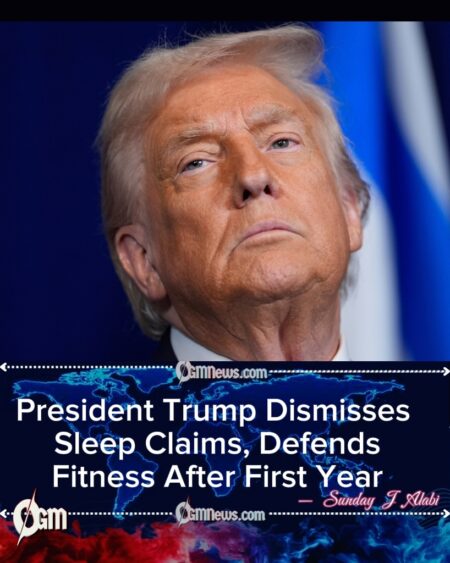
President Donald Trump has firmly rejected claims that he has been falling asleep during public meetings, insisting instead that his health remains “perfect” as he completes the first year of his second term in office. In a wide-ranging interview with The Wall Street Journal, the president pushed back against growing scrutiny of his physical condition, describing such concerns as exaggerated and politically motivated while offering his own explanation for moments when cameras have captured him with his eyes closed.
At 79, Trump is the oldest individual to assume the U.S. presidency, a fact that has intensified public and media attention on his wellbeing. The president, however, has sought to reassure supporters and critics alike that he remains fully capable of handling the demands of the office, portraying himself as energetic, focused, and mentally sharp.
Renewed Focus on Presidential Health After One Year
As Trump marks one year into his second term, questions about his health have increasingly featured in political discourse. The scrutiny has been fueled by televised images from high-level meetings and public events in which the president appeared to have his eyes closed for extended moments, prompting speculation about fatigue or lapses in attentiveness.
Health and age have historically been sensitive topics for American presidents, but Trump’s age has placed the issue more prominently in the spotlight. Political opponents and commentators have argued that transparency about physical and cognitive fitness is essential, particularly given the pressures of global crises and domestic governance.
The White House has largely treated the issue as routine and expected, emphasizing that regular medical evaluations are conducted and that no official medical findings have suggested any impairment. Trump’s interview appears intended to reinforce that message directly to the public.
Trump Rejects Claims of Sleeping in Meetings
In his conversation with The Wall Street Journal, the president categorically denied that he had fallen asleep during meetings, despite photographic and video evidence showing him with his eyes closed. Trump maintained that such moments were misinterpreted and taken out of context.
“I’ll just close. It’s very relaxing to me,” he said, explaining that closing his eyes helps him focus and remain calm. He added that still images can be misleading, noting that photographers often capture him mid-blink, creating the impression that he is asleep.
According to Trump, the narrative around these images reflects what he described as an unfair and selective reading of his behavior, rather than an accurate account of his attentiveness during official proceedings.
‘My Health Is Perfect,’ President Says
Central to the interview was Trump’s emphatic assertion that his health is in excellent condition. “My health is perfect,” he told the Journal, expressing frustration that his wellbeing has become a recurring subject of public debate.
Trump portrayed himself as physically resilient and mentally strong, arguing that the responsibilities of the presidency require stamina he continues to possess. He suggested that the attention given to his health says more about political hostility than genuine medical concern.
This insistence on robust health is consistent with Trump’s long-standing approach to public discussions of his physical condition, which has often emphasized strength, endurance, and confidence.
Aspirin Use and Medical Advice
The president also addressed questions about his daily aspirin intake, revealing that he takes a higher dose than doctors typically recommend. He acknowledged that the practice causes him to bruise easily, a side effect that has been noticeable in recent public appearances.
Trump said physicians have advised him to reduce the dosage, but he has chosen not to follow that guidance. He explained that he has been taking aspirin consistently for 25 years and feels reluctant to change a routine he believes has benefited him.
“I’m a little superstitious,” Trump admitted, framing his decision as a personal preference rather than a medical judgment.
Trump’s Explanation of His Health Choices
In elaborating on his reasoning, Trump offered a characteristically vivid explanation of why he values aspirin. He said he believes the medication helps keep his blood thin, which he views as important for heart health.
“They say aspirin is good for thinning out the blood,” he said. “I don’t want thick blood pouring through my heart. I want nice, thin blood pouring through my heart.” He then added, “Does that make sense?”
Medical experts generally caution against self-directed medication regimens, particularly at higher doses, but Trump framed his choice as informed by long-term habit and personal comfort rather than disregard for medical science.
Political and Public Reactions
Trump’s remarks have drawn mixed reactions across the political spectrum. Supporters have welcomed his forthright defense, viewing it as evidence of transparency and confidence. Critics, however, argue that dismissing medical advice and minimizing visible signs of fatigue may raise legitimate concerns.
Health analysts note that while occasional eye-closing or blinking is not unusual, the broader issue lies in clear communication and adherence to professional medical guidance. The administration has not indicated that any changes to Trump’s health disclosures or medical reporting are planned.
As the second term progresses, the president’s health is likely to remain a point of public interest, particularly in an era where images and brief video clips can quickly shape political narratives