









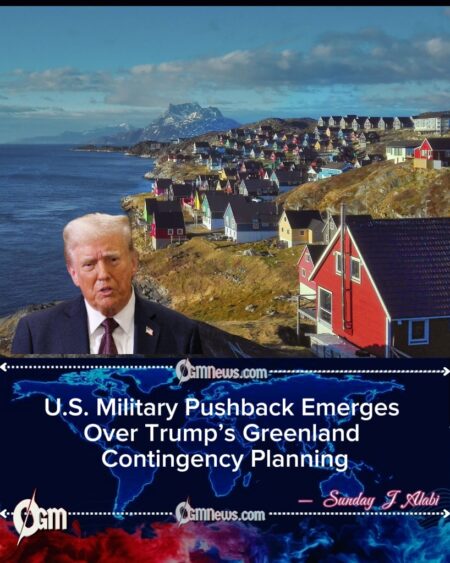
According to diplomatic and military sources cited by British officials, President Donald Trump, the current U.S. president serving a second term, has instructed senior special operations commanders to prepare contingency plans related to Greenland. The reported directive, first disclosed by The Mail on Sunday, has triggered internal resistance within the U.S. military establishment and raised fresh concerns among European allies about the stability of NATO.
The issue has emerged at a sensitive moment for transatlantic relations, with diplomats warning that even preliminary planning for such a move could have far-reaching legal, political, and strategic consequences. While no operational decision has been confirmed, the reports have intensified scrutiny of Washington’s intentions toward the Arctic region.
Origins of the Greenland Planning Directive
Sources familiar with the matter say President Trump asked the Joint Special Operations Command (JSOC) to outline possible military options concerning Greenland. The request, according to these accounts, was framed as preparatory planning rather than an immediate order for action, a distinction often used in strategic defense discussions.
Nevertheless, European diplomats argue that the very act of commissioning such plans signals a willingness to consider force or coercion in pursuit of U.S. objectives. Greenland, an autonomous territory within the Kingdom of Denmark, has long held strategic importance due to its location and Arctic access routes.
Internal Military Resistance and Legal Concerns
Senior U.S. military figures, including members of the Joint Chiefs of Staff, are reported to have pushed back strongly against the directive. According to diplomatic sources, their objections are rooted in concerns over international law, constitutional limits, and the absence of congressional authorization.
One official familiar with the discussions said military leaders have attempted to redirect the president’s attention toward less controversial security issues, such as monitoring Russian “ghost ships” used to evade sanctions or considering responses to Iran. These alternatives, sources say, are viewed as legally defensible and strategically clearer.
Role of Policy Advisers and Strategic Hawks
European and British officials attribute much of the momentum behind the Greenland planning to policy advisers close to the president, particularly political adviser Stephen Miller. These figures are described as emboldened by what they view as recent U.S. successes in assertive foreign policy actions, including pressure campaigns in Latin America.
Diplomatic cables suggest that this group sees Greenland as a strategic prize, fearing potential Russian or Chinese moves in the Arctic. However, critics within the alliance argue that such fears do not justify actions that could destabilize longstanding international agreements.
NATO Implications and Allied Reactions
The prospect of U.S. military action against Greenland has alarmed NATO partners. British diplomats warn that such a move would place Washington on a collision course with Denmark and with key European leaders, including UK Prime Minister Sir Keir Starmer.
One classified assessment reportedly describes a “worst-case scenario” in which NATO fractures from within. Some European officials speculate that forcing a crisis over Greenland could indirectly weaken or even dismantle the alliance, an outcome they believe some hardline figures around the president may favor.
Escalation Versus Compromise Scenarios
Diplomatic war-gaming has outlined two broad pathways. In an “escalatory scenario,” the U.S. would apply military pressure or political coercion to sever Greenland’s ties with Denmark. In a “compromise scenario,” Denmark would formally grant the U.S. expanded military rights while restricting Russian and Chinese access—effectively codifying privileges the U.S. already enjoys.
According to one cable, domestic political considerations could lead the president to begin with strong rhetoric or planning before shifting toward compromise. European officials believe the upcoming NATO summit in July could serve as a focal point for de-escalation, particularly as U.S. mid-term elections approach.
Domestic Politics and Timing Pressures
British diplomats also assess that domestic political pressures in the United States may be influencing the urgency of the discussions. With mid-term elections later in the year and the possibility of Congress shifting control, some allies believe the administration’s window for bold foreign policy initiatives is narrowing.
A diplomatic source summarized the internal U.S. dynamic bluntly, saying senior generals view the Greenland idea as both impractical and unlawful, and are seeking ways to slow momentum without provoking a direct confrontation with the president.