










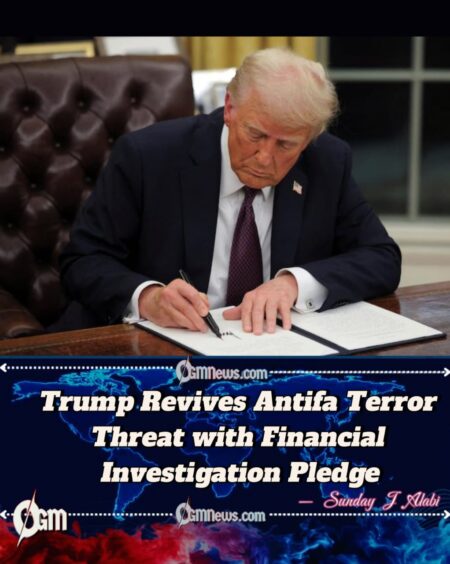
President Donald Trump announced Wednesday his intention to designate antifa as a terrorist organization, marking a significant escalation in his administration’s approach to domestic security during his second term. The declaration, made via Truth Social, represents a renewed focus on what the president characterizes as “radical left political violence” following recent incidents of political unrest.
President Trump Declaration Follows Pattern from First Term
In a forceful statement posted to his Truth Social platform, President Trump declared: “I am pleased to inform our many U.S.A. Patriots that I am designating ANTIFA, A SICK, DANGEROUS, RADICAL LEFT DISASTER, AS A MAJOR TERRORIST ORGANIZATION.” The announcement echoes similar rhetoric from his first presidency in 2020, when Trump made comparable threats during nationwide protests but ultimately did not follow through with formal designation.
The current declaration goes beyond the previous announcement by specifically targeting financial supporters of the movement. Trump stated he would “strongly recommend that those funding ANTIFA be thoroughly investigated in accordance with the highest legal standards and practices.” This expansion suggests a more comprehensive approach to addressing what the administration views as organized political violence.
The timing of the announcement appears directly linked to recent events, particularly the deadly shooting of conservative activist Charlie Kirk last week. Hours after Kirk’s death, Trump vowed to pursue all those “who contributed to this atrocity, and to other political violence, including the organizations that fund it and support it.”
Legal Challenges and Organizational Complexities
The practical implementation of Trump’s directive faces significant legal and structural obstacles. Antifa, short for anti-fascist, operates as a loose affiliation of mostly left-leaning activists rather than a centralized organization with clear leadership or formal membership structures. This decentralized nature presents challenges for any formal designation process.
Federal law currently provides mechanisms for designating international groups as “foreign terrorist organizations,” with criminal penalties for those who provide material support. However, according to Congressional Research Service reports, no similar legal framework exists for domestic groups, creating uncertainty about the practical implications of Trump’s announcement.
Legal experts note that the absence of specific domestic terrorism designation authority could complicate enforcement efforts. The Trump administration would likely need to rely on existing federal statutes related to conspiracy, racketeering, or other criminal activities to pursue cases against individuals or groups.
Political Implications and Investigative Scope
The president Trump’s announcement represents a broader strategy to address what his administration terms “radical left political violence.” When questioned by reporters earlier this week about potential antifa designation, Trump confirmed it was “something I would do” while also floating the possibility of racketeering charges against alleged financial supporters.
The White House has not yet provided specific details about the timeline for implementation or the scope of recommended investigations. Opitanglobamedia News reached out to the White House for additional information following the Truth Social announcement, but no immediate response was provided.
The designation attempt occurs during Trump’s second term, suggesting renewed confidence in pursuing controversial domestic security measures that faced obstacles during his first presidency. The administration’s focus on investigating funding sources indicates a strategy aimed at disrupting what officials view as organized networks supporting political violence.
Trump’s allies have supported the initiative as part of broader efforts to address political violence across the spectrum. However, civil liberties advocates are likely to challenge any formal designation process, arguing that loose activist networks cannot be effectively classified under terrorism statutes designed for more structured organizations.


