










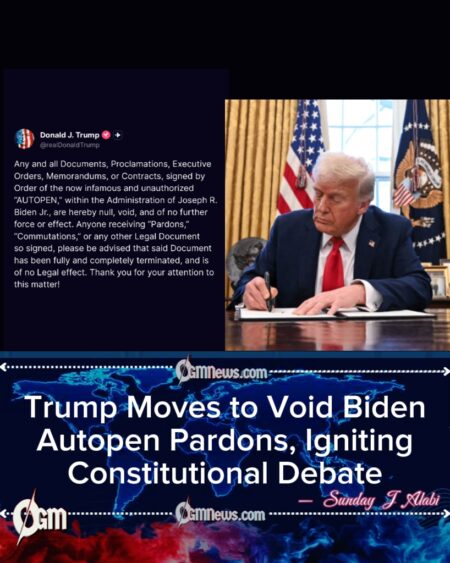
Current U.S. president Donald Trump has escalated his challenge to the legitimacy of autopen-signed documents issued under his predecessor, Joseph R. Biden Jr., announcing that all such documents—particularly pardons and commutations—are now considered “terminated” and without legal effect. In a sweeping directive posted on Truth Social, Trump asserted that any executive order, proclamation, memorandum, or clemency action bearing an autopen signature in the Biden administration is “null, void, and of no further force or effect.”
The move has triggered new legal and political scrutiny, as constitutional experts note that while presidents may rescind many executive actions, there is no mechanism in U.S. law allowing a president to revoke a predecessor’s already-granted pardon.
Trump’s Directive and Its Scope
In his Tuesday announcement, Trump stated that the Biden-era autopen signatures represented “unauthorized” actions lacking proper presidential approval. He declared that any individual who received a pardon, commutation, or official document bearing an autopen signature should consider that action fully terminated.
Trump specifically targeted clemency decisions issued in the final days of Biden’s presidency, arguing that the use of an autopen undermined the authenticity of the decisions themselves. Among these were pardons reportedly granted to Biden family members and high-profile figures such as Dr. Anthony Fauci and General Mark Milley.
White House lawyers and legal scholars have pointed out that although a sitting president may reverse prior regulations or executive orders, clemency actions—once granted—are constitutionally irrevocable, even if later deemed improper or irregularly approved.
Biden’s Use of the Autopen
The autopen, a longstanding device used to replicate a principal’s signature, has been employed by presidents from both major political parties for decades. Its purpose is largely administrative, allowing for rapid signing of letters or routine documents when a president is unavailable.
While Trump has used the autopen himself, he insists that it should never be applied to matters of grave importance, such as pardons. The Biden administration has not publicly confirmed whether the autopen was used on specific pardon documents, though Biden—now 83—has maintained that he personally authorized every clemency decision associated with his signature.
According to accounts from Biden’s former staff, the autopen was occasionally employed toward the end of his tenure due to the volume of end-of-term paperwork. They insist, however, that Biden remained fully engaged in the substance of the decisions.
Controversial Clemency Decisions Draw Focus
As debate deepened, attention centered on Biden’s final-day pardons. These reportedly included clemency for several relatives—James B. Biden, Sara Jones Biden, Valerie Biden Owens, John T. Owens, and Francis W. Biden—actions which critics argue created political complications.
The only major pardon Biden is known to have personally hand-signed in his final months was for his son, Hunter Biden, whom he described as recovering from substance addiction. That order, unlike some others, was not subject to autopen controversy.
Republican allies of Trump have depicted the family pardons as part of a broader pattern of opaque decision-making during the closing stretch of Biden’s presidency. Democratic officials, however, reject claims of impropriety and maintain that the president had complete authority to grant clemency to any individual he deemed deserving.
Oversight Committee Findings and Criticisms
The Republican-led House Oversight Committee recently released a detailed report alleging a “flawed” and “lax” pardons process within Biden’s administration. The report likened the process to a “game of telephone” in which key decisions were communicated indirectly through aides rather than documented formally.
Investigators highlighted an instance in which former Chief of Staff Jeff Zients reportedly relied on second-hand information relayed by aide Rosa Po before authorizing the use of the autopen from his home. According to the committee, Zients approved certain signatures without confirming Biden’s direct intent.
The committee concluded that these procedures raised doubts about Biden’s cognitive condition, arguing that aides exercised excessive influence over executive decisions. Biden allies have dismissed such claims as political theater, pointing to the long-standing nonpartisan use of the autopen.
Justice Department and Legal Expert Reactions
Attorney General Pam Bondi acknowledged in October that the Department of Justice is reviewing the Biden administration’s reliance on the autopen, particularly regarding clemency actions. Legal experts caution that even if procedural discrepancies are confirmed, the Constitution grants presidents unilateral clemency power—and provides no avenue to revoke completed pardons.
Trump’s declaration may therefore carry primarily political, rather than legal, consequences. Still, the directive reflects the administration’s broader effort to distinguish its governance from Biden’s and to question the legitimacy of key decisions made during Biden’s final months in office.
Whether the Justice Department’s review alters public or legal interpretations of the autopen’s use remains uncertain. For now, Trump’s announcement underscores ongoing tensions between the two administrations and amplifies partisan debate over presidential authority, competence, and procedural integrity.
Political Fallout and Public Messaging
Trump’s directive quickly became a focal point among his supporters, who argue that the alleged misuse of the autopen signals deeper institutional problems in the prior administration. They point to concerns about Biden’s mental acuity and reports that decisions often flowed through aides rather than directly from the president.
Democratic lawmakers accuse Trump of manufacturing controversy to discredit political opponents and assert control over narratives surrounding executive authority. They note that Trump himself utilized the autopen for various routine documents and warn that attempting to nullify pardons is legally unworkable.
Both sides agree on one point: the debate has placed an unusual spotlight on an obscure tool of government administration and raised broader questions about how presidential decisions are authenticated in an era of heightened partisanship.
What Comes Next
As legal scholars, political strategists, and federal agencies parse the implications of Trump’s proclamation, affected individuals await clarity on whether their pardons or commutations remain recognized by government institutions. The Justice Department’s review may provide future guidance, though constitutional limitations appear to restrict any retroactive cancellations.
For now, Trump’s directive has intensified debate over presidential procedure and accountability, ensuring that the once-technical issue of autopen usage remains a high-stakes political flashpoint.


