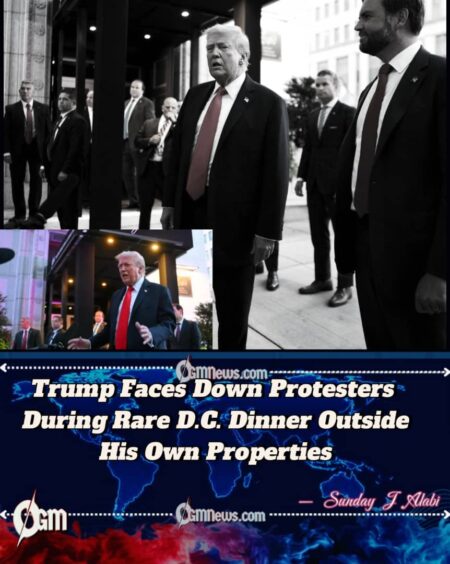
President Donald Trump made a rare outing Tuesday night, dining at Joe’s Seafood, Prime Steak & Stone Crab in downtown Washington, D.C.—the first time in years he has eaten at a restaurant in the city that he doesn’t own. The dinner, just two blocks from the White House, was intended as a symbolic show of confidence in the capital’s security, which Trump has repeatedly declared “safe” since federalizing the city’s police force and deploying the National Guard.
The president was joined by Vice President J.D. Vance, Secretary of War Pete Hegseth, Secretary of State Marco Rubio, Chief of Staff Susie Wiles, Press Secretary Karoline Leavitt, and Deputy Chief of Staff Stephen Miller. The high-profile dinner gathering was framed by the White House as a celebration of D.C.’s revitalized nightlife under Trump’s second-term law-and-order policies.
Protesters Crash the Dinner Scene
The evening was not without confrontation. Video captured by CNN and activists from the anti-war group Code Pink showed protesters chanting at Trump as he entered the restaurant: “Free D.C., free Palestine, Trump is the Hitler of our time.” The president appeared unfazed, staring back at demonstrators before proceeding to his table.
The protest marked one of several recent flashpoints between Trump and progressive activist groups who have opposed both his domestic policing measures and his foreign policy positions. Despite the loud disruption, Trump’s allies characterized his decision to walk into the restaurant undeterred as a demonstration of resolve.
Trump Declares the Capital Safe
Once inside, Trump addressed diners directly. “We have a safe city. Enjoy yourselves—you won’t be mugged going home. Have a good time, everybody,” he said in remarks released by the White House. He added a teasing admonition: “Don’t drink too much.”
In remarks to reporters earlier, Trump contrasted the current state of the capital with what he called its “lawless” reputation in prior years. “I wouldn’t have done this three months ago, four months ago, I certainly wouldn’t have done it a year ago. This is one of the most unsafe cities in the country. Now it’s as safe as it is anywhere in the country.”
Federal Control of D.C. Sparks Legal Battles
The president’s decision to federalize the city’s police force and deploy the National Guard remains deeply controversial. While D.C. Mayor Muriel Bowser has cooperated with the federal takeover, Attorney General Brian Schwalb has filed a lawsuit challenging the legality of deploying armed soldiers for local policing.
Trump dismissed the lawsuit last week and instead praised Bowser for “working together” to restore security in the capital. “We have a capital that’s very, very safe,” he said Tuesday night. “The restaurants now are booming. People are going out to dinner where they didn’t go out for years, and it’s because of the National Guard.”
From BLT Prime to Joe’s Stone Crab
Until now, Trump’s dining in Washington had been limited to BLT Prime, the steakhouse housed in his former Trump International Hotel. During his first term, he often held court there, within walking distance of the White House. Reporters noted that Tuesday’s visit to Joe’s Seafood marked the first documented instance of Trump stepping into a non-Trump establishment in the capital.
When challenged about his dining habits last week, Trump brushed off the scrutiny. “Do you want me to prove you wrong?” he quipped to a journalist, suggesting he was open to exploring other establishments. On Tuesday, he did just that—turning an ordinary dinner into a political statement about law, order, and the image of a “safe” capital city under his watch.
The Optics of Power and Protest
For the White House, the evening was carefully choreographed to highlight Trump’s narrative of reclaiming the capital from crime and disorder. Yet the presence of protesters underscored the city’s enduring political divisions and the resistance among many residents to federal control.
The image of Donald walking past chanting demonstrators, flanked by his top advisers, encapsulated both the defiance and controversy that continue to define his presidency. To his supporters, it was proof that Donald can “stare down” critics. To his detractors, it was a reminder that even amid claims of safety, dissent remains alive on the streets of Washington.