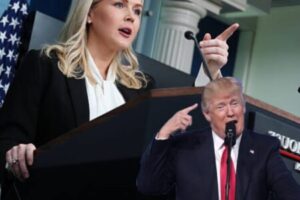

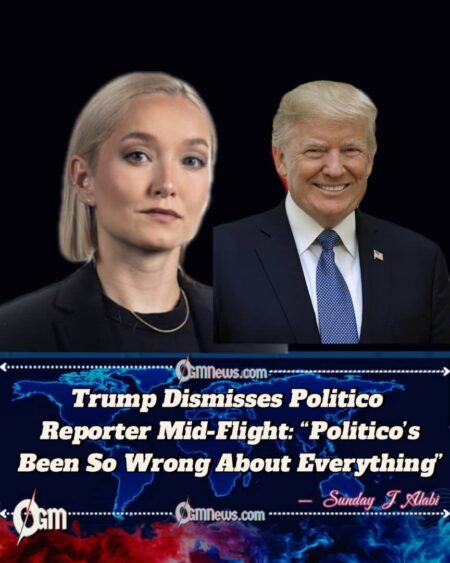
President Donald Trump, currently serving his second term in office, sparked headlines once again after a sharp exchange with Politico’s White House Bureau Chief, Dasha Burns, during a press gaggle aboard Air Force One on Sunday. The incident occurred as Trump fielded questions from journalists while traveling to Tel Aviv, where he is set to oversee the first phase of his recently brokered peace agreement between Israel and Hamas.
The press session lasted roughly 25 minutes, covering topics ranging from the Middle East peace process to the recent government shutdown. Tensions rose when Burns, 33, began a line of questioning on U.S.–China relations and Trump’s recent decision to impose a 100 percent tariff on Chinese goods. Interrupting her mid-question, the president Trump remarked with apparent amusement, “Wow, she asks a lot of questions. Who are you with?”
When Burns identified herself as a Politico correspondent, Trump quickly interjected: “Dasha Politico — oh, Politico’s gone bad. They’ve been so wrong about everything! No, no, Politico’s been so wrong about everything!” As Burns attempted to continue, the president Trump waved her off, concluding, “Let’s get somebody else to ask some questions, you mind? Because Politico is fake news.”
Tariff Policy at Center of Exchange
Burns’ question had sought clarity on Trump’s latest move to increase tariffs on Chinese imports, a decision that has stirred significant debate in Washington and Wall Street alike. The measure, which takes effect November 1, will double existing duties on a wide range of goods and introduce new export controls on critical software technologies.
Trump has described the policy as a “measured response” to Beijing’s recent export restrictions on rare earth metals, which are vital to global tech manufacturing. Speaking before his flight, the president emphasized that the U.S. action was reactive rather than aggressive, stating, “This is not something that I instigated. It was a response to something they did. They didn’t really aim it at us — they aimed it at the whole world.”
The tariffs have already triggered a downturn in the stock market, with major indices sliding as investors brace for potential disruptions in trade flows. Despite the economic turbulence, Trump has insisted the move is necessary to “protect American jobs and industries from unfair practices.”
Trump Shifts Focus to Peace Efforts in the Middle East
Beyond the exchange with Burns, Trump used the in-flight briefing to highlight what he described as a historic diplomatic milestone in the Middle East. According to the president, both Israel and Hamas have agreed to the first phase of a peace accord, which includes the release of 20 Israeli hostages in exchange for roughly 2,000 Palestinian prisoners and a phased withdrawal of Israeli forces from Gaza.
Trump expressed optimism ahead of his arrival in Tel Aviv, saying, “Getting them back was amazing because we were involved and they were in places you don’t want to know about. It’s an honor to be involved, and we’re going to have an amazing time — something that’s never happened before.”
Following his arrival, the president is expected to meet with the families of hostages before addressing the Israeli Knesset. He will then proceed to Sharm El Sheikh, Egypt, to participate in a “Middle East Peace Ceremony”, marking a symbolic moment in his broader diplomatic initiative.
A Familiar Rift with the Press
Sunday’s encounter underscored the enduring friction between President Trump and certain media outlets — particularly those he views as adversarial. The president has often accused Politico, CNN, and The New York Times of biased reporting, framing his exchanges with journalists as part of a broader struggle against “fake news.”
For Burns, who joined Politico earlier this year after nearly a decade with NBC News, the moment reflected both the challenge and visibility that come with covering one of the most combative presidents in modern U.S. history. Beyond her reporting duties, Burns also hosts Ceasefire, a CSPAN program focused on bipartisan dialogue — a contrast to the sharp rhetoric that played out on Air Force One.
While the brief spat drew laughter from some reporters on board, it also reignited questions about the president’s approach to press freedom and accountability, as he continues to dominate both the political and media landscape heading into a crucial period of his second term.