








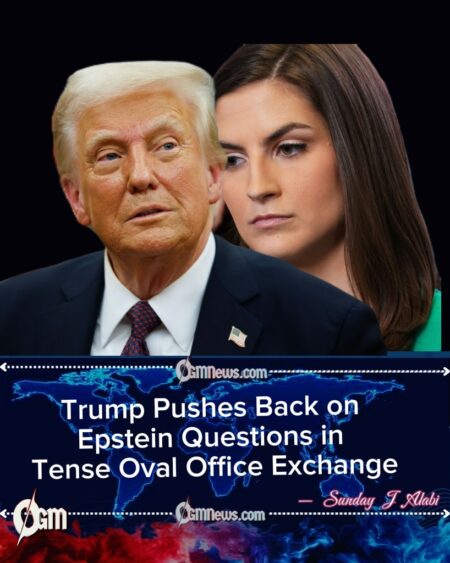
President Donald Trump, the current U.S. president serving a second term, was drawn into a tense exchange with CNN correspondent Kaitlan Collins during an Oval Office appearance on Tuesday, as questions about the Jeffrey Epstein case and its broader implications interrupted a White House event focused on reopening the federal government. The encounter underscored the continuing political sensitivity surrounding the release of Epstein-related documents and the administration’s efforts to shift national attention toward legislative priorities.
The confrontation unfolded in front of Republican lawmakers gathered to witness the signing of a bill aimed at ending a partial government shutdown, turning what was intended as a procedural moment into a pointed media exchange that quickly became personal.
Oval Office Event Overshadowed by Epstein Questions
The president Trump had convened Republican members of Congress in the Oval Office to formally sign legislation reopening the government after a partial shutdown earlier in the week. The atmosphere initially reflected a routine legislative milestone, with remarks centered on governance and continuity.
However, the discussion shifted when members of the press raised questions about the ongoing release of documents connected to the late financier Jeffrey Epstein. What began as a query regarding international fallout soon evolved into a broader interrogation about domestic political figures mentioned in the files.
The pivot highlighted the difficulty the White House has faced in containing discussion of the Epstein matter, even during events designed to emphasize policy achievements.
From UK Politics to Domestic Controversy
The exchange was triggered when a reporter asked President Trump about renewed scrutiny facing former British Ambassador Peter Mandelson over alleged links to Epstein. The president dismissed the relevance of British political developments, stating that the issue was primarily a Democratic concern within the United States.
Trump used the moment to argue that the controversy did not implicate his administration, framing the matter as a partisan issue rather than a cross-party reckoning. His response sought to reorient the conversation away from foreign connections and toward domestic political narratives.
This framing, however, opened the door for further questions that would keep the Epstein files firmly at the center of the briefing.
Mentions of Prominent Figures and Trump’s Response
CNN’s Kaitlan Collins followed up by noting that the released materials referenced figures such as Elon Musk, a donor to the president’s reelection campaign, and Commerce Secretary Howard Lutnick. The mention of high-profile names intensified scrutiny of the scope and implications of the documents.
President Trump responded by saying he had not reviewed the latest batch of Epstein files, citing the demands of his office. He downplayed the significance of the references, suggesting that the absence of major headlines indicated there was no substance to the allegations.
The president Trump emphasized that, in his view, any serious wrongdoing would have already resulted in clear public consequences.
Dispute Over Redactions and Transparency
Collins then raised concerns expressed by survivors of Epstein’s abuse, who have criticized the extensive redactions in the released documents. According to reports, the most recent disclosure involved approximately three million documents, many of which were partially obscured.
President Trump countered by stating that he had heard complaints from others who believed too much information had been released. He argued that the process had already gone far enough and attempted to steer the conversation away from the topic.
At this point, the president Trump suggested that the country should focus on other pressing issues, including healthcare, rather than continuing to revisit the Epstein case.
A Personal Turn in the Exchange
As Collins pressed further, asking what message the president would offer to Epstein’s survivors, the interaction grew increasingly confrontational. President Trump criticized Collins directly, questioning her professionalism and the credibility of CNN as an organization.
He remarked on her demeanor, noting that he had never seen her smile during their interactions over the years, comments that drew attention away from the substance of the issue and toward the tone of the exchange itself.
The president Trump accused the network of dishonesty, asserting that its reporting contributed to declining viewership, before turning his attention to other members of the press.
Final Words and Broader Implications
Collins attempted to refocus the discussion by reiterating that her questions were centered on survivors of sexual abuse. She emphasized the human impact of the Epstein scandal, seeking acknowledgment of their concerns.
President Trump did not respond directly to her final remark, instead moving on to another question from the press pool. The moment concluded without a substantive resolution, leaving the exchange as a reflection of the strained relationship between the president and certain media outlets.
The incident illustrates how unresolved national controversies continue to intersect with day-to-day governance, shaping public discourse even during routine White House events.