







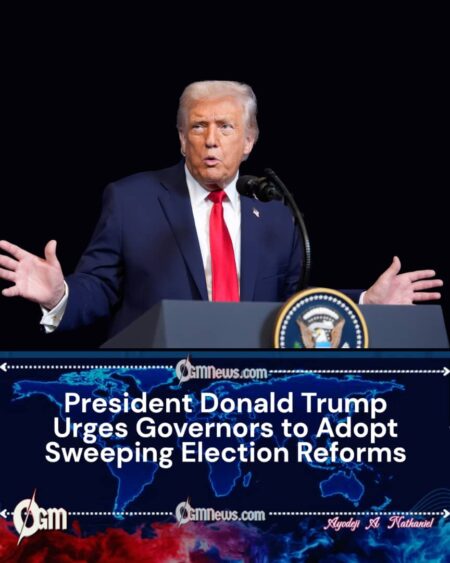
President Donald Trump, the current U.S. president serving his second term, has told every governor across the United States that states should move to paper ballots, same-day voting, mandatory voter identification, and proof of citizenship as core requirements for elections. The directive, framed as a call to strengthen election integrity and public trust, places federal pressure on states that traditionally control their own voting systems.
The remarks immediately reignited long-running national debates over election security, access to the ballot, and the balance of power between federal leadership and state governments.
A Direct Message From the White House
According to officials familiar with the discussions, Donald Trump communicated his position directly to governors, emphasizing that uniform standards are necessary to restore confidence in U.S. elections. He argued that inconsistent voting rules across states create confusion, suspicion, and vulnerability in the electoral process.
The White House maintains that the president’s recommendations are not aimed at limiting participation, but at ensuring that every legal vote is counted accurately and transparently.
Paper Ballots as the Cornerstone
At the center of Donald Trump’s proposal is a shift to paper ballots nationwide. Supporters argue that paper records provide a clear audit trail and reduce dependence on electronic systems that can malfunction or be challenged by the public.
Election experts note that many states already use paper ballots or paper backups, but a full nationwide transition would require significant investment, updated equipment, and training for election workers.
Same-Day Voting and Voter Access
In addition to paper ballots, Donald Trump has called for same-day voting, arguing that consolidating voting into a single day simplifies oversight and reduces administrative complexity. He has framed the idea as a return to traditional voting practices.
Critics counter that limiting early or mail voting could disadvantage voters with work, health, or mobility constraints. Supporters respond that same-day voting, combined with clear rules, could improve transparency and public confidence.
Voter ID and Proof of Citizenship
A major element of the president’s message is the requirement for voter identification and proof of citizenship. Donald Trump has repeatedly argued that such measures are common-sense safeguards that mirror requirements for many everyday activities.
Democrats and voting rights groups have raised concerns that strict ID and citizenship requirements could disenfranchise eligible voters if not paired with accessible documentation options. Republicans argue that these measures are essential to preventing fraud and maintaining election legitimacy.
State Authority and Federal Influence
Under the U.S. Constitution, states retain primary authority over election administration. As a result, Donald Trump’s call functions as political pressure rather than a binding order unless Congress passes federal legislation.
Several governors have welcomed the discussion, while others have signaled resistance, citing states’ rights and existing election frameworks. Legal analysts say any attempt to mandate these changes nationwide would likely face court challenges.
Political Impact and the Road Ahead
The president’s push is expected to energize Republican lawmakers advocating for election reform while intensifying opposition from Democrats who view the proposals as restrictive. Donald Trump has positioned the issue as central to democratic legitimacy, making it likely to remain a defining political battle.
As states consider their next steps, the debate is set to shape legislative agendas, court rulings, and public discourse well beyond the immediate news cycle.