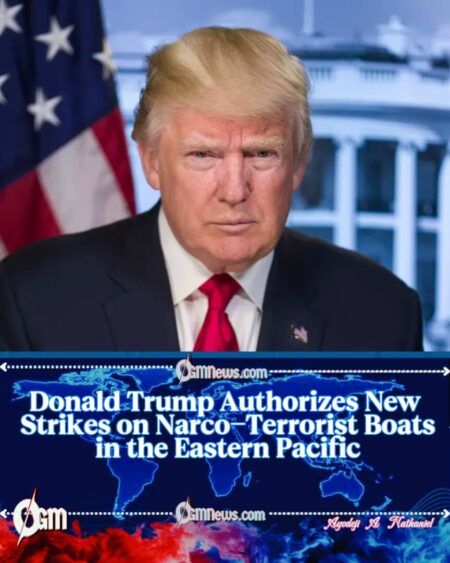
Donald Trump, serving his second term as president of the United States, has authorized new U.S. military strikes in the Eastern Pacific that resulted in the destruction of two additional narco-terrorist boats. U.S. defense officials said the action is part of an expanded strategy under Donald Trump’s administration to disrupt drug-trafficking networks before they reach American shores.
The operation reflects Donald Trump’s continued emphasis on border security, counter-narcotics enforcement, and national safety. Officials said the strikes were designed to weaken maritime supply routes used by transnational criminal organizations operating in international waters.
Donald Trump’s Decision and Strategic Direction
According to senior officials, the authorization followed intelligence briefings outlining increased narco-trafficking activity in the Eastern Pacific. Donald Trump approved the action after reviewing operational assessments and legal clearances.
Administration sources noted that Donald Trump views large-scale drug trafficking as a direct threat to U.S. national security, arguing that offshore interdiction is a critical tool in protecting American lives and communities.
Execution of the Eastern Pacific Operation
Military officials said the vessels were identified through coordinated surveillance involving aerial monitoring and maritime intelligence. The boats were suspected of transporting significant quantities of illegal narcotics through established smuggling corridors.
The strikes were conducted with precision under standing rules of engagement. No U.S. personnel were harmed, and post-operation assessments are ongoing to determine the broader impact on trafficking operations in the region.
Counter-Narcotics Policy Under Donald Trump
Under Donald Trump’s leadership, U.S. counter-narcotics policy has placed increased emphasis on disrupting drug networks beyond U.S. borders. Officials argue that targeting trafficking infrastructure at sea prevents drugs from reaching domestic distribution channels.
Security analysts say this approach raises costs for criminal organizations and forces them to alter routes, though they stress that sustained enforcement is required for long-term effectiveness.
Implications for Public Safety
The administration maintains that offshore interdiction directly supports domestic public safety by reducing the availability of illicit drugs linked to overdose deaths and organized crime. Officials cite maritime operations as a preventive measure rather than a reactive one.
Public health experts acknowledge that supply-side enforcement alone cannot solve drug abuse but note that reduced trafficking capacity can complement domestic prevention and treatment efforts.
International Cooperation and Regional Impact
The operation took place within a broader framework of regional cooperation involving allied nations focused on maritime security. Intelligence sharing remains central to identifying trafficking routes across international waters.
Officials say Donald Trump’s administration continues to encourage multilateral engagement while maintaining U.S. leadership in counter-narcotics enforcement efforts.
Defense officials confirmed that monitoring of drug-trafficking activity in the Eastern Pacific will continue, with additional operations possible as intelligence develops. The administration has signaled that counter-narcotics enforcement remains a standing priority.
As the campaign moves forward, Donald Trump’s approach underscores a policy stance that treats maritime drug trafficking as both a criminal and national security challenge.