







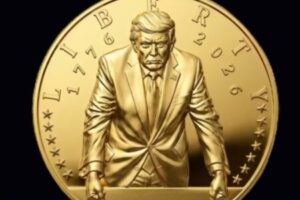



As the United States prepares to mark its 250th anniversary of independence, a federal arts commission has approved a commemorative 24-karat gold coin bearing the image of President Donald J. Trump, a move that is already drawing legal and political scrutiny.
Commission Approval Clears Path for Historic Coin
A federal arts panel, the US Commission of Fine Arts, has approved the final design of a 24-karat gold commemorative coin featuring the likeness of Donald J. Trump, who is currently serving a second term as President of the United States.
The decision, reached without objection during a March meeting, marks a significant step toward production by the United States Mint. The coin is intended to commemorate the nation’s 250th anniversary, set to be celebrated on Independence Day, July 4, 2026.
Officials say the approval allows technical and logistical preparations to move forward, although key details such as the coin’s size, denomination, and production volume remain under consideration.
Design Details Reflect Symbolism and Presidential Authority
The approved design presents a formal portrait of President Trump in a suit and tie, leaning forward with a stern expression. The word “Liberty” arches above his image, accompanied by the dates “1776” and “2026,” symbolizing the nation’s founding and its quarter-millennium milestone.
Additional inscriptions include “In God We Trust,” along with thirteen stars representing the original colonies. The reverse side features a bald eagle in mid-flight, alongside the phrases “United States of America” and “E Pluribus Unum,” reinforcing traditional national motifs.
According to Megan Sullivan, a senior design official at the Mint, the President Trump personally reviewed and selected the final design from multiple options presented by the Treasury.
Legal Debate Surrounds Depiction of Living Presidents
The decision has sparked debate due to longstanding federal law prohibiting the depiction of living presidents on U.S. currency. Critics argue that the approval may conflict with established norms designed to preserve the neutrality of national symbols.
However, Treasury officials maintain that commemorative coins fall under a different regulatory framework. They assert that the Treasury Secretary has the authority to approve special minting programs, including those that may deviate from conventional restrictions.
This interpretation has raised questions among legal experts about the boundaries of executive discretion and whether the commemorative nature of the coin sufficiently distinguishes it from standard currency.
Supporters Frame Coin as Patriotic Tribute
Supporters of the initiative, including members of the commission appointed earlier this year by Trump administration, have defended the design as a fitting tribute to the nation’s leadership during a historic milestone.
Brandon Beach, the U.S. Treasurer, described the coin as a representation of “the enduring spirit of the country and its democracy,” adding that the image of the President Trump is emblematic of the era being commemorated.
Commissioner Chamberlain Harris echoed this sentiment, noting that the strong depiction aligns with the significance of the 250th anniversary and reflects the president’s role at a pivotal moment in American history.
Limited Production and Collector Appeal
Officials have indicated that the coin will be produced in limited quantities, though an exact number has not been finalized. The use of 24-karat gold and the commemorative context are expected to make the coin highly sought after by collectors.
Some commissioners have advocated for a larger coin size, citing both aesthetic considerations and the President Trump known preference for bold and prominent designs. Final specifications are expected to be determined in the coming months.
Numismatic experts suggest that rarity and historical context could significantly influence the coin’s market value, particularly given its association with a major national anniversary.
Silence from Trump Administration and Mint Raises Questions
Despite the significance of the approval, both the Trump administration and the United States Mint have yet to provide detailed public comments regarding the project.
Requests for clarification on legal interpretations, production timelines, and distribution plans have not been immediately addressed. This lack of response has contributed to ongoing speculation and public debate.
Observers note that further disclosures may be necessary to address transparency concerns and clarify the broader implications of the decision.


