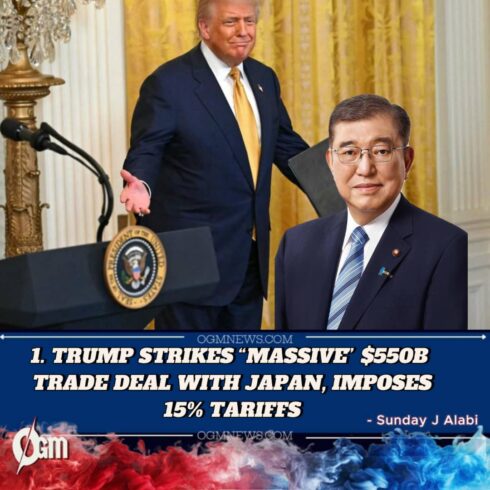
President Donald Trump on Tuesday declared that his administration has struck what he described as a “massive” new trade deal with Japan, promising to realign the economic relationship between the two countries and boost American manufacturing. The deal includes a 15% tariff on Japanese imports to the U.S. and a reported $550 billion Japanese investment into the American economy.
In a post on Truth Social, Trump hailed the agreement as “a great deal for everybody,” emphasizing that the U.S. would retain 90% of the profits from the Japanese investments. He also announced that the Asian economic powerhouse had agreed to open up its markets to a wider range of American exports — particularly automobiles, rice, and other key agricultural products.
Trump Says U.S. Will Profit Big as Japan Opens Markets
According to Trump, the agreement ensures “fairer” access for American manufacturers and farmers to Japanese markets, long considered difficult for U.S. exporters to penetrate. “They had their top people here, and we worked on it long and hard,” he said Tuesday night while addressing Republican lawmakers at the White House. “It’s a great deal for everybody — especially for American workers.”
The new trade framework, if fully implemented, would allow American rice farmers, truck and car manufacturers, and other exporters to enter the Japanese market with fewer restrictions. Japan is currently the fifth-largest trading partner of the United States, and American exporters sold $79.7 billion worth of goods to the country last year.
15% Tariffs Lower Than Earlier Threats — But Still Substantial
The 15% tariff rate is a notable pivot from the 25% rate Trump proposed earlier this month and the 24% suggested during the administration’s sweeping “Liberation Day” tariff rollout in April. Nonetheless, it represents a significant escalation from the 2.5% average U.S. import tariff rate in 2023, according to the Yale Budget Lab.
The Trump administration has made tariffs central to its second-term trade strategy, arguing that they protect U.S. industry from unfair foreign competition and generate vital government revenue. While the current deal softens the originally proposed rate, critics say any additional tariffs could drive up consumer prices and disrupt global supply chains.
Japan Yet to Comment Officially, Auto Sector in Focus
As of Wednesday morning, the Japanese government has not issued an official statement on the trade pact. The scope of goods affected by the 15% tariff — especially automobiles and car parts, which made up more than $52 billion of Japanese exports to the U.S. last year — remains unclear.
Industry analysts and policymakers are closely watching whether the deal will include exemptions or adjustments for Japan’s powerful auto sector. Earlier this year, Trump signaled intentions to impose a 25% tariff specifically on foreign-made vehicles, sparking concern among major Japanese automakers with a strong U.S. market presence.
Broader Strategy: Blitz of Bilateral Deals Before Tariff Deadline
The agreement with Japan is part of a broader campaign by President Trump to secure bilateral trade deals ahead of an August 1 deadline, when steeper tariffs on dozens of countries are set to kick in. The White House has sent formal letters to at least two dozen nations — including Mexico, Canada, and European Union members — urging them to reach new trade terms or face increased duties.
Commerce Secretary Howard Lutnick said on CBS News’ Face the Nation that the administration expects “a record-breaking” number of deals to be finalized in the coming weeks. “These countries are coming to the table,” Lutnick said. “They are going to open their markets or they’re going to pay the tariff.”
Parallel Deals with Southeast Asia and Energy Push in Alaska
Alongside the Japan deal, Trump also announced new trade agreements with the Philippines and Indonesia, featuring 19% tariffs on goods exported from those nations to the United States. The administration is simultaneously negotiating a separate agreement involving liquified natural gas in Alaska, which Trump briefly mentioned during his remarks on Tuesday.
The focus on energy and Southeast Asia complements Trump’s broader strategy of using tariff leverage to rebalance trade relationships and increase domestic production across critical industries. “This is a very exciting time for the United States of America,” Trump wrote, affirming his commitment to “a great relationship with the Country of Japan.”
Economic Debate: Growth Catalyst or Inflation Trigger?
While the administration has praised the tariff-led approach as a long-overdue corrective to decades of trade imbalances, economic experts remain divided. Federal Reserve Chair Jerome Powell has warned that the tariffs could exert upward pressure on inflation, which remains a concern in the current economic environment.
Lutnick pushed back on those concerns, stating Sunday that inflation will “stay right where it is,” and argued that boosting American manufacturing should be prioritized. “The idea that these importers are more important than the people who employ Americans — I think that’s the wrong way of thinking about it,” he said.