










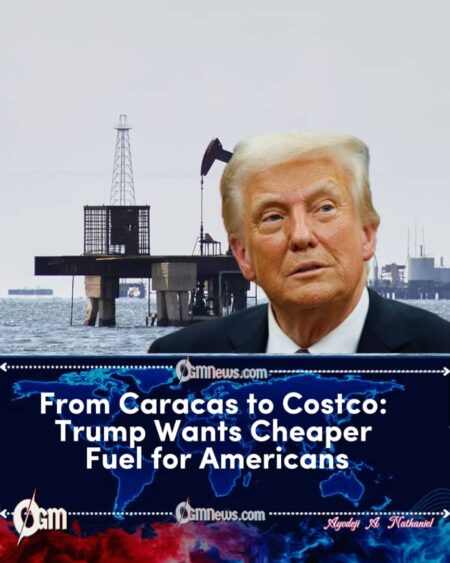
Donald Trump, currently serving his second term as U.S. president, announced that Americans could soon see a notable reduction in fuel prices as a result of expanded access to Venezuela’s oil reserves and increased involvement by U.S. energy companies. Speaking from the White House, Trump said a key objective of U.S. engagement with Venezuela’s oil sector is to lower costs at the pump for American consumers, framing it as a central benefit of recent policy shifts.
Trump also linked the broader strategy to efforts to counter drug trafficking and criminal networks, suggesting that the dual focus on energy and security could deliver tangible economic benefits while addressing cross-border challenges.
Trump Frames Oil Access as Economic Benefit
President Donald Trump said that the United States is close to achieving a “big reduction of oil prices for the American people” through a strategy involving Venezuelan crude and U.S. energy industry investment. This comes amid ongoing efforts to revive and expand Venezuela’s oil output and integrate it into broader U.S. market supply.
Trump noted that U.S. companies are scheduled to meet at the White House with top executives from major oil firms to discuss substantial investment in Venezuela’s oil infrastructure, with expected capital allocations in the tens of billions of dollars. He presented this initiative as a boost for American consumers through increased supply and downward pressure on pump prices.
White House Meeting With Oil Executives
On January 9, President Trump hosted executives from at least 17 major oil companies, including Chevron, ExxonMobil, and Shell, to outline plans for revitalizing Venezuela’s energy sector and expanding U.S. interests in the region.
The administration’s aim, according to officials, is to harness Venezuela’s vast but underutilized crude reserves to increase global supply and generate economic returns. A senior official said the planned investments could exceed $100 billion if companies commit to rebuilding production capacity and infrastructure.
Policy Context and Market Implications
U.S. involvement in Venezuela’s oil industry follows significant political and military developments, including actions that resulted in a change of leadership in Caracas earlier this year. Trump’s administration has taken an assertive stance on Venezuela’s energy assets, with several tankers seized in recent weeks as part of broader enforcement measures.
Analysts caution that while additional oil supply can influence prices, market dynamics are complex and include global demand fluctuations, production from other major producers, and infrastructure constraints. Even with Venezuelan barrels flowing into U.S. markets, significant investments will be required to restore output to historic levels.
Links to Counter-Drug Efforts and Regional Security
In addition to economic goals, President Trump reiterated that part of U.S. engagement in Venezuela is tied to broader security themes, including the disruption of drug trafficking and criminal networks that operate across regional borders. While Trump did not provide detailed operational plans, he positioned these elements as complementary to his energy strategy.
U.S. officials, including Secretary of State Marco Rubio, have framed Venezuelan oil cooperation as a means of stabilizing regional relations and undermining illicit networks that leverage state weaknesses.
Domestic Reactions and Industry Feedback
The president’s remarks have elicited mixed reactions at home. Supporters argue that tapping Venezuela’s oil potential will ease consumer energy costs and strengthen U.S. leverage in global markets. They see the White House investment push as a bold economic initiative.
Some industry voices and analysts, however, express skepticism. Concerns include the feasibility of rapid production growth in Venezuela’s aging and degraded oil fields, the political risk of investing in the region, and the potential impact on U.S. shale producers if prices decline sharply.
International Considerations and Sovereignty Questions
International leaders and energy partners are watching closely as U.S. policy evolves. Venezuela’s oil sector has long been central to its economy, and its integration into U.S.-led initiatives raises questions about sovereignty, legal frameworks, and the balance of influence in the Western Hemisphere.
While some diplomatic engagement is underway, particularly around investment structures and production oversight, experts say the success of any price-lowering strategy will depend on solid legal agreements and operational commitments that extend beyond political rhetoric.


