

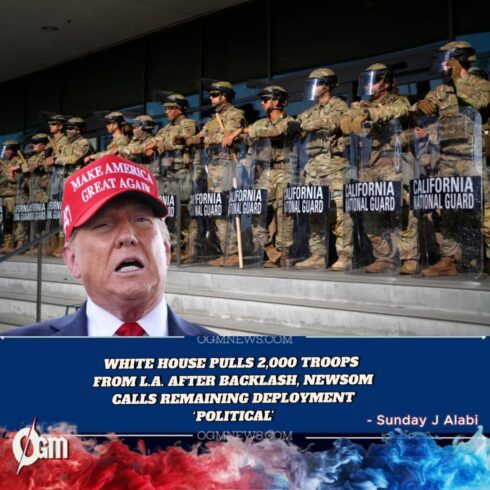
The Trump administration has ordered the release of approximately 2,000 California National Guard troops from their federal deployment in Los Angeles, the Pentagon announced Tuesday. This move comes more than a month after President Donald Trump authorized the deployment under Title 10 authority in response to protests surrounding U.S. Immigration and Customs Enforcement (ICE) operations.
Pentagon spokesman Sean Parnell said the partial drawdown reflects a positive shift in the city’s security environment. “Thanks to our troops who stepped up to answer the call, the lawlessness in Los Angeles is subsiding,” Parnell noted. Roughly half of the 4,000 Guard members under federal control will now return to civilian life.
Trump Deployment Sparked Legal and Political Battle
President Trump initially took control of California’s Guard forces in early June following a wave of protests and clashes related to immigration enforcement in Los Angeles. His decision, made over objections from California Governor Gavin Newsom, was met with swift legal resistance. Newsom sued the Trump administration, arguing the federalization of the Guard was unconstitutional without state consent.
A federal judge temporarily sided with the governor, halting the order, but a federal appeals court later reversed that ruling, allowing the Trump administration to maintain control while the legal dispute unfolded. The court emphasized that the president likely acted within the scope of Title 10, which grants him the authority to use Guard troops in response to domestic unrest or threats to federal law enforcement.
Marines Also Deployed to Protect Federal Assets
In addition to National Guard forces, around 700 active-duty Marines were dispatched to the Los Angeles area to assist in the protection of ICE facilities and other federal properties. The decision followed concerns raised by federal authorities that local law enforcement was failing to adequately shield ICE operations from escalating protest activity.
Federal officials defended the move, asserting that the deployment was essential to maintaining law and order. “This mission was about protecting our personnel and federal assets,” a senior Department of Homeland Security official said. “We had no intention of occupying the city — we were preventing a collapse of federal enforcement capacity.”
Guard Redeployments to Fight California Wildfires
As the demobilization of Guard troops begins, the Trump administration also confirmed that approximately 150 Guard members had already been returned to California earlier this month to assist with ongoing wildfire suppression efforts. These members had been granted a temporary reprieve from federal service to support emergency operations across the state.
The shift in assignments highlights the dual-purpose role of the National Guard — both as a domestic law enforcement support arm under presidential command and as a vital part of state-level emergency response under the governor’s jurisdiction.
Newsom Slams Federal Use of Guard as ‘Political Pawn’
Despite the partial release, Governor Newsom renewed his condemnation of the deployment, calling on the Trump administration to immediately return all remaining Guard personnel. In a sharply worded statement, he accused the White House of manipulating California’s troops for political gain.
“For more than a month, the National Guard has been pulled away from their families, communities, and civilian work to serve as political pawns for the President in Los Angeles,” Newsom said. “While nearly 2,000 of them are starting to demobilize, the remaining guardsmembers continue without a mission, without direction, and without any hopes of returning to help their communities.”
Vance Defends Deployment, Signals Guard Could Be Sent Elsewhere
During a recent visit to Los Angeles, Vice President JD Vance praised the efforts of Guard members and Marines, stating they were “very much a necessary part of what’s going on here.” He acknowledged that conditions had improved significantly, thanks in large part to the federal presence.
Vance also issued a warning to other cities experiencing unrest: “If you enforce your own laws and if you protect federal law enforcement, we’re not going to send in the National Guard because it’s unnecessary,” he said. The administration has made clear it will continue to deploy federal assets if it deems local responses insufficient.
What Comes Next: Legal Fallout and Federal-State Tensions
While the latest move signals a de-escalation, legal experts say the constitutional debate over the president’s authority to federalize the Guard without state consent is far from settled. Analysts predict Newsom’s lawsuit may eventually reach the U.S. Supreme Court, setting a precedent for future clashes over federal intervention in state affairs.
Meanwhile, political tensions between the Trump administration and California’s Democratic leadership continue to simmer. As federal troops head home, the underlying questions remain: How far can a president go to enforce law and order in states that resist — and where is the line between security and overreach?