

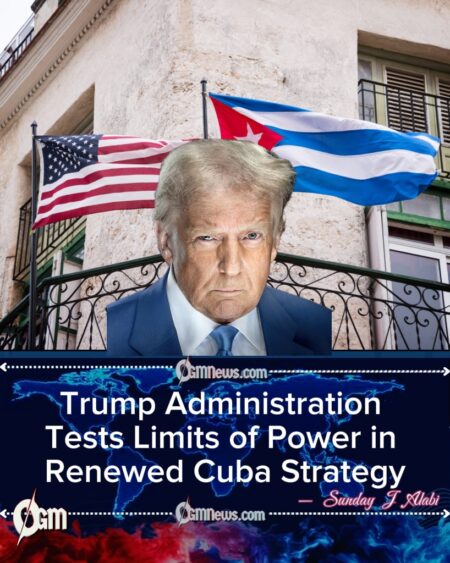
Washington and Havana are bracing for heightened tensions as U.S. officials signal a renewed push to end decades of Communist rule in Cuba, following the dramatic removal of Venezuela’s longtime leader and mounting economic pressure on the island.
A Post-Maduro Shift in U.S. Strategy
The Trump administration is reportedly exploring avenues to bring about regime change in Cuba before the end of the year, according to U.S. officials who spoke with The Wall Street Journal. The discussions mark a significant escalation in Washington’s posture toward Havana and reflect a belief among senior officials that recent developments in the region have altered the strategic balance.
Central to this assessment is the January 3 U.S. military operation that resulted in the capture and removal of Venezuelan President Nicolás Maduro, who had led the country since 2013. Officials say the operation has emboldened policymakers who now view entrenched socialist governments in the region as more vulnerable than previously assumed.
The Trump administration’s confidence is further reinforced by the deep economic and political ties between Venezuela and Cuba. With Maduro no longer in power to guarantee subsidized oil shipments, U.S. intelligence analysts believe Cuba is facing a rapidly deteriorating economic outlook.
Economic Vulnerability and Mounting Hardship in Cuba
U.S. intelligence assessments cited by officials describe a country under severe strain. Cuba is reportedly experiencing frequent blackouts, chronic shortages of food and medicine, and a collapsing supply chain, conditions that have worsened in recent months. Analysts estimate that nearly 90 percent of the population lives below the poverty line.
For decades, Venezuela’s oil exports have underpinned Cuba’s economy, providing energy supplies that kept the island functioning despite longstanding U.S. sanctions. With those shipments now in doubt, economists warn that Cuba could exhaust its oil reserves within weeks if alternative sources are not secured.
The Trump administration is reportedly intensifying an economic pressure campaign designed to accelerate this strain. U.S. military actions to seize oil tankers with Venezuelan ties are now seen as serving a dual purpose: penalizing Caracas for its past policies while also cutting off a lifeline to Havana.
No Blueprint for Overthrow, but Signs of Political Outreach
Despite the rhetoric, U.S. officials caution that there is no finalized plan to overthrow Cuba’s Communist government. Instead, the current focus is said to be on identifying individuals within the Cuban power structure who may be open to negotiation or reform and willing to engage with Washington.
This approach mirrors the strategy used in Venezuela, where an insider reportedly defected and assisted U.S. forces during the operation that led to Maduro’s capture. Officials familiar with that effort argue that internal fractures, rather than a direct invasion, proved decisive.
However, Cuba presents a markedly different political environment. The island is a single-party state with no legal political opposition, and the government has historically acted swiftly to suppress dissent, limiting the pool of potential interlocutors.
Lessons and Warnings From History
Within the Trump administration, there is ongoing debate about how far and how fast to push. Some officials and Trump allies—particularly Cuban-American activists based in Florida—advocate an aggressive strategy to end nearly seven decades of Communist rule that began with Fidel Castro’s rise to power in 1959.
Others urge caution, pointing to past failures such as the 1961 Bay of Pigs invasion and the decades-long trade embargo imposed in 1962. Despite sustained pressure, those efforts failed to dislodge Cuba’s leadership and, critics argue, often strengthened the government’s narrative of external aggression.
Skeptics within the Trump administration also stress that Venezuela and Cuba are not directly comparable. Venezuela, they note, had a visible opposition movement, periodic protests, and contested elections, even if those elections were widely viewed by international observers as manipulated.
Repression, Resistance, and the Limits of Replication
Cuba’s political system is far more closed, according to analysts. The government has allowed little space for organized opposition and has forcefully put down the few major protests that have occurred, notably in Havana in 1994 and nationwide demonstrations in 2021.
By contrast, Venezuela’s opposition remained active for years, creating conditions that some U.S. officials believe made Maduro’s removal feasible. In Cuba, the absence of such an organized movement raises concerns that attempting to replicate the Venezuelan model could prove far more difficult.
There are also fears that a destabilization effort could trigger a humanitarian crisis, given the island’s fragile economy and dependence on state-run distribution systems for basic goods.
Trump’s Legacy Calculus and Public Messaging
President Donald Trump, currently serving his second term as U.S. president, is said by officials familiar with internal discussions to view the prospect of ending Communist rule in Cuba as a defining foreign policy achievement. Some advisers argue that such an outcome would place him alongside—or even ahead of—President John F. Kennedy, who failed to remove Fidel Castro during his tenure.
In recent weeks, the Trump administration has become more explicit about its objectives. Jeremy Lewin, the State Department’s acting undersecretary for foreign assistance, stated publicly that Cuba “has to make a choice to step down or to better provide for its people.”
On January 11, President Trump issued a direct warning on Truth Social, asserting that after Maduro’s capture, no further Venezuelan oil or financial support would reach Cuba and urging Havana to make a deal “before it is too late.”
Havana’s Response and the Road Ahead
Despite the pressure, there is little indication that Cuba’s leadership is prepared to yield. The government remains heavily influenced by Raúl Castro, now 94, who formally stepped down as president in 2021 but continues to wield significant authority behind the scenes. Day-to-day governance rests with President Miguel Díaz-Canel, 65.
Díaz-Canel has rejected U.S. threats outright, stating at a recent memorial for Cuban security personnel killed during efforts to protect Maduro that “there is no surrender or capitulation possible, nor any kind of understanding based on coercion or intimidation.”
As Washington weighs its next steps, the situation underscores the high stakes of U.S.-Cuba relations. Whether economic pressure and political outreach can achieve the administration’s goals—or instead deepen a prolonged standoff—remains an open question with significant regional implications