








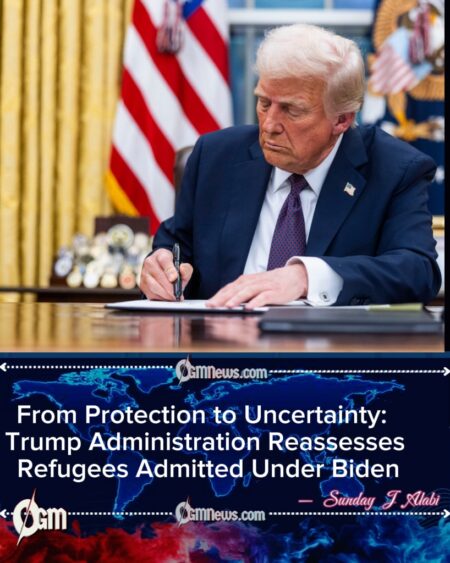
The Trump administration has ordered a sweeping review of refugees admitted to the United States during President Joe Biden’s tenure, while placing an indefinite hold on their pending green card applications, according to an internal government memo.
The directive, dated Nov. 21 and signed by U.S. Citizenship and Immigration Services (USCIS) Director Joseph Edlow, targets refugees who entered the country between Jan. 20, 2021, and Feb. 20, 2025. It instructs officials to reassess whether they met the legal definition of a refugee at the time of their admission and to identify any legal grounds that could disqualify them from permanent residency.
Under the memo, all green card applications filed by refugees admitted in that four-year window are paused indefinitely. This marks a significant escalation in the Trump administration’s approach to the U.S. refugee program, which had already been sharply curtailed since President Trump, the current U.S. president serving a second term, returned to office and ordered a pause on new refugee admissions.
Scope of the Review and Legal Stakes for Refugees
Edlow’s memo directs USCIS officers to undertake a case-by-case review of all refugees admitted during the specified period, with the option to reinterview them. These renewed assessments will focus on two central questions: whether the individuals originally qualified as refugees under U.S. law, and whether any new information or legal issues now render them ineligible for permanent residency.
Refugees in the United States are typically eligible to apply for a green card one year after arrival. For those admitted between early 2021 and early 2025, that process is now effectively on hold. The memo specifies that pending applications are to remain frozen while the reviews are conducted, with no timeline provided for completion.
The stakes are high. Edlow notes that if a “principal” refugee’s application is denied — that is, the main applicant in a family unit — their spouse and children linked to that case would also see their applications rejected. In such circumstances, the entire family would lose refugee status and could be placed in deportation proceedings. The memo further underscores that applicants will not be able to appeal any denial of their green card requests, limiting their legal recourse.
Who Is Affected: Hundreds of Thousands in Limbo
According to federal statistics cited in the memo, approximately 233,000 refugees entered the U.S. between February 2021 and January 2025, a period that closely aligns with Biden’s administration. These individuals now face uncertainty about their long-term legal status in the country.
Refugees are admitted on the basis that they have suffered or fled persecution abroad due to one of five protected grounds: race, nationality, religion, political opinion, or membership in a particular social group. Prior to arrival in the U.S., they generally spend years in third countries undergoing extensive screenings, including medical checks, security vetting, and multiple interviews.
The Trump administration’s move effectively reopens those determinations, treating past approvals as provisional rather than final. For many refugees who believed they had started a stable new chapter in the United States, the review introduces the prospect of renewed scrutiny and possible removal from the country.
Policy Shift Under Trump’s Second Term
Shortly after President Trump began his second term, the federal government paused the refugee resettlement program, with very limited exceptions. The suspension marked a clear break from the Biden administration’s approach, which had aimed to rebuild and expand refugee admissions after reductions in earlier years.
In its recent actions, the Trump administration has signaled a narrower and more selective refugee policy. Last month, it capped refugee admissions for the current fiscal year at 7,500 — the lowest ceiling in U.S. history. The memo states that these limited slots will “primarily be allocated among Afrikaners,” referring to descendants of European settlers in South Africa, along with “other victims of illegal or unjust discrimination in their respective homelands.”
Officials have argued that Afrikaners face discrimination in South Africa on account of being White, a claim the South African government has publicly rejected, denying that Afrikaners as a group are being persecuted. The administration’s prioritization of this group, alongside the broader review of Biden-era refugees, underscores a significant reshaping of both the scale and focus of U.S. refugee policy.
Trump Administration’s Rationale: Vetting, Security, and the Biden Legacy
In the memo, Edlow frames the decision as a corrective measure aimed at enhancing the integrity of the refugee system. He writes that the Trump administration believes the Biden-era process “prioritized expediency, quantity, and admissions over quality interviews and detailed screening and vetting.”
By ordering reinterviews and comprehensive reviews, the administration is seeking to determine whether any refugees were admitted who did not fully qualify under U.S. law or who might now be subject to exclusion or removal provisions. The memo suggests that the administration sees the Biden refugee program as having potentially allowed through applicants whose backgrounds were not sufficiently scrutinized.
Critics are likely to view the move as an attempt to retroactively undermine Biden-era immigration policies and to dramatically reduce the number of refugees who can obtain permanent residency in the United States. Supporters, however, may argue that the measures are necessary to ensure that refugee protections are reserved only for those who clearly meet the statutory standards and pose no security risk.
Human Impact and Next Steps for Affected Refugees
For the refugees whose cases are now under review, the practical and emotional consequences could be profound. Many will have spent several years in the U.S., integrating into communities, working, studying, and sending their children to American schools, all with the expectation that permanent residency was the next step.
The indefinite pause on green card processing means they may face prolonged legal insecurity — unable to advance to permanent residency, but also unsure whether they will ultimately be allowed to remain in the country. The lack of an appeals process for denied applications further heightens the vulnerability of these individuals and families.
Immigration attorneys and advocacy groups are expected to challenge aspects of the policy, arguing that retroactive scrutiny on such a large scale could violate due process principles or run afoul of protections traditionally afforded to refugees. For now, however, the memo stands as formal guidance to federal officials, and thousands of refugees remain in limbo as their futures in the United States are reassessed.
International and Domestic Political Repercussions
The decision is likely to reverberate beyond U.S. borders. Refugee policy has long been a key marker of America’s stance on humanitarian protection and international responsibility-sharing. Reopening previously settled cases and sharply limiting new admissions may prompt criticism from international partners and human rights organizations.
Domestically, the review is poised to become another flashpoint in the broader debate over immigration policy. Supporters of the Trump administration’s approach may argue that it restores a stricter standard after what they view as a period of lax enforcement under Biden. Opponents are likely to accuse the administration of politicizing refugee admissions and targeting some of the world’s most vulnerable people for heightened scrutiny and potential removal.
As the reviews proceed and individual cases begin to be decided, the real-world consequences of the memo will become clearer — for the roughly 233,000 people directly affected, and for the future direction of U.S. refugee policy more broadly.