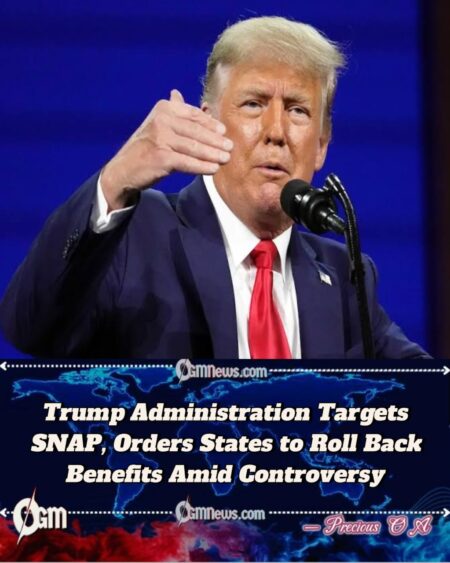
President Donald Trump’s administration has issued a sweeping and unprecedented directive mandating that all U.S. states undo full Supplemental Nutrition Assistance Program (SNAP) food benefit payments, a move that threatens to upend one of the country’s largest social safety nets. The directive comes with a clear warning: states that fail to comply could face severe financial penalties, including cuts to federal funding. This order has ignited controversy across the nation, provoking immediate backlash from state officials, advocacy organizations, and millions of Americans who rely on SNAP to feed their families, including children, seniors, and individuals with disabilities. The announcement underscores a dramatic policy shift that prioritizes federal control and fiscal austerity over the well-being of vulnerable populations.
Trump’s administration justifies the rollback as a corrective measure aimed at addressing what officials describe as “systemic overextension” of welfare programs. Administration sources argue that the expansion of SNAP benefits during the pandemic, while well-intentioned, has created long-term dependency among recipients, weakening incentives for work and self-reliance. Officials claim that returning to pre-pandemic benefit levels is necessary to restore fiscal discipline, ensure proper allocation of federal resources, and prevent misuse of taxpayer funds. Critics, however, contend that the directive is not only insensitive but also politically motivated, disproportionately affecting low-income households at a time when economic pressures, inflation, and rising food costs are already straining American families.
The order tasks the Department of Agriculture (USDA) with monitoring compliance, enforcing strict penalties against any state that resists, and conducting audits to ensure the directive is followed without delay. Sources within the USDA indicate that the federal government will scrutinize state budgets and allocate penalties aggressively, creating significant administrative and political friction between the federal government and state authorities. Analysts describe the policy as both aggressive and unprecedented, raising questions about the limits of federal authority over programs traditionally administered at the state level.
Trump’s administration emphasizes that the move is part of a broader effort to reshape social welfare in the United States. Officials argue that the policy will incentivize self-reliance, encourage employment among lower-income populations, and reduce government dependency. Critics, however, highlight the immediate consequences for millions of Americans, particularly families with children who depend on SNAP to maintain basic nutrition. Hunger advocates warn that the directive could create a humanitarian crisis in some communities, overburdening food banks and charitable organizations already struggling to meet rising demand.
Political and Public Outcry
Trump’s administration’s decision has provoked intense criticism from lawmakers, advocacy groups, and state officials across the political spectrum. Governors from multiple states, including both Republican and Democratic leadership, have voiced concerns about the immediate humanitarian impact of the policy, warning that reversing full SNAP payments will push millions into deeper poverty and increase food insecurity nationwide. Several governors have indicated their intent to challenge the federal directive in court, arguing that the administration is overstepping its constitutional authority by threatening financial penalties against states for implementing programs in accordance with their local budgets and public needs.
Political analysts note that Trump’s administration appears to be positioning the policy as both a fiscal and ideological statement. Supporters praise the measure as a necessary correction to what they describe as unsustainable welfare expansion, while critics argue it represents a punitive action against vulnerable populations for political purposes. The stark contrast between public opinion, media coverage, and political messaging has intensified the so-called “culture war” debate over social welfare, government responsibility, and economic justice in the United States.
Public reaction has been swift and widespread. Social media platforms such as X (formerly Twitter) and Instagram are flooded with commentary, debate, and outrage, with hashtags like #HandsOffSNAP and #StopTheCuts trending nationally. Advocates for low-income Americans argue that the rollback undermines the moral and social obligation of the government to protect its most vulnerable citizens. Organizations including Feeding America and the Center on Budget and Policy Priorities (CBPP) have issued statements condemning the move, warning that millions of children, seniors, and working adults will face immediate hunger if states comply with the federal directive.
Meanwhile, communities across the United States are bracing for the real-world impact. Food banks report rising demand, with volunteers noting that families are lining up earlier each day out of fear that federal assistance will no longer meet their basic needs. Economists also warn that reducing SNAP benefits could have wider economic repercussions, as food assistance funds are often spent immediately within local economies, supporting small businesses, grocery stores, and farmers’ markets. A reduction in this spending could therefore negatively affect economic activity in already vulnerable regions.
Economic and Social Implications
Trump’s administration’s SNAP rollback carries significant and far-reaching economic and social consequences. Policy analysts estimate that millions of Americans could lose full food assistance benefits within the coming months, exacerbating food insecurity and malnutrition. The long-term effects could include higher healthcare costs, increased reliance on emergency food services, and broader social instability in communities heavily dependent on SNAP for basic sustenance.
State governments are currently scrambling to interpret and comply with the federal directive. Some have begun exploring emergency funding mechanisms and public-private partnerships to mitigate the impact, but these efforts are unlikely to fully replace the scale and immediacy of federal support. Critics argue that the administration’s framing of the policy—emphasizing work incentives and fiscal discipline—fails to recognize that most SNAP recipients are already employed or actively seeking employment, and that many use the program as a temporary support during financial hardship rather than as a long-term dependency strategy.
The directive also raises broader political questions. With the midterm elections approaching, analysts suggest the move may appeal to fiscal conservatives who favor cuts to government spending, while simultaneously alienating moderate and low-income voters who rely on the program. The controversy underscores the growing tension between federal authority and state autonomy, particularly in programs that directly affect citizens’ daily lives.
Trump’s administration has framed the policy as a moral and economic imperative, emphasizing accountability and self-reliance. However, as states mobilize, advocacy groups organize, and families prepare for reduced benefits, the directive is already shaping up to be one of the most controversial and consequential social policy decisions of his second term. For millions of Americans, the stakes could not be higher, as this policy represents a direct impact on nutrition, health, and economic stability—elements central to the well-being of families across the nation.
The coming months are likely to see legal battles, state-level resistance, and ongoing public debate over the ethics, legality, and social consequences of reversing full food stamp payments. As this high-stakes confrontation unfolds, it is clear that President Donald Trump’s administration’s policy has sparked a critical national conversation about the role of government, the balance of federal and state power, and the moral responsibilities inherent in social welfare programs.