










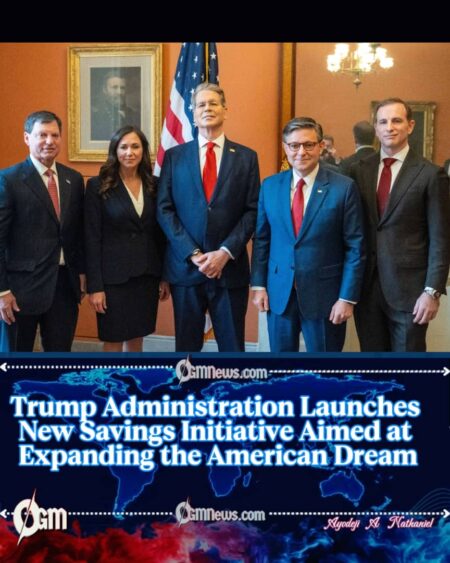
This week, senior administration officials formally launched the Trump Accounts initiative, unveiling a new policy platform aimed at expanding long-term financial opportunity for young Americans. The launch coincided with the debut of the Trump Accounts website, which outlines how the program is designed to support savings, education, and homeownership—key pillars traditionally associated with the American Dream.
The initiative is being advanced under the leadership of President Donald Trump, with the administration describing it as a practical effort to ensure that economic opportunity is accessible regardless of a citizen’s background or circumstances of birth.
Launch Event and Participating Leaders
The rollout brought together a mix of senior lawmakers, administration officials, and private-sector leaders. Among those present were House Speaker Mike Johnson, Senator Katie Britt, entrepreneur Joe Gebbia, and financial executive Frank Bisignano.
Officials described the event as both a policy launch and a public discussion on intergenerational economic mobility. The administration emphasized collaboration between government and the private sector as a central feature of the initiative’s design and implementation.
What Trump Accounts Are Designed to Do
Trump Accounts are structured as long-term savings vehicles established early in life, with the intention of giving young Americans a financial foundation as they reach adulthood. The accounts are designed to grow over time and provide flexibility once beneficiaries turn 18.
At that point, account holders may continue saving toward retirement or redirect funds toward major investments such as purchasing a first home or financing higher education. Administration officials highlighted these options as two of the most enduring benchmarks of economic stability and upward mobility.
Expanding Access to the American Dream
Supporters of the initiative argue that Trump Accounts translate the idea of the American Dream into concrete policy. Rather than focusing solely on broad economic indicators, the program emphasizes individual access to savings tools that can shape long-term outcomes.
The administration has framed the initiative as inclusive by design, asserting that it places opportunity within reach of every citizen, regardless of income level, geography, or family background. Officials say this approach reflects a commitment to equal opportunity rather than equal outcomes.
Economic Philosophy and Policy Context
The initiative aligns with the administration’s broader economic philosophy, which combines market-based growth with targeted mechanisms to encourage personal savings and financial responsibility. By promoting early and sustained saving, Trump Accounts are intended to reduce long-term dependence on debt.
Private-sector involvement was cited as a means of improving efficiency and innovation, with proponents arguing that partnerships with financial institutions and technology platforms can expand access without excessive bureaucracy.
Transparency, Oversight, and Public Reception
Administration officials pointed to the dedicated website as a transparency tool, providing clear explanations of eligibility, usage, and long-term benefits. They said ongoing engagement with lawmakers and stakeholders will shape the program’s evolution.
Public reaction has been mixed but attentive. Supporters view the initiative as a forward-looking investment in the next generation, while critics have called for additional clarity on funding mechanisms, oversight structures, and fiscal impact. The White House has indicated that further details will be released as implementation progresses.
Measuring Long-Term Impact
The launch of Trump Accounts represents a strategic attempt to institutionalize access to opportunity for future generations. By focusing on savings, education, and homeownership, the initiative seeks to address structural barriers that have made traditional milestones harder to achieve.
As the program moves from concept to execution, its success will likely be measured by participation rates, savings growth, and its ability to help young Americans reach key economic milestones over time.


