









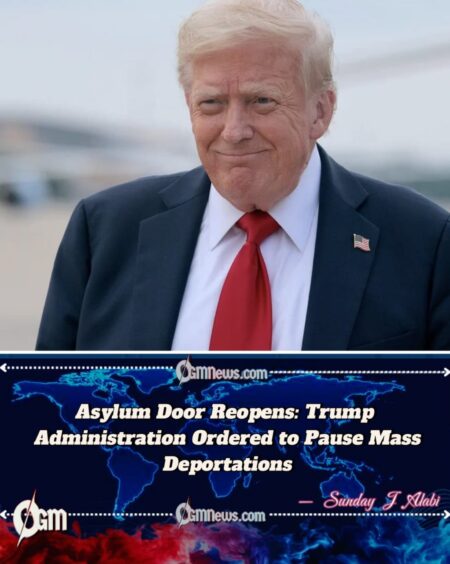
U.S. Customs and Border Protection (CBP) agents have been directed to immediately stop deporting migrants under President Donald Trump’s sweeping asylum ban, following a federal court ruling that found the measure violated long-standing immigration protections. According to two Department of Homeland Security (DHS) officials, the directive marks a significant shift in the administration’s hardline immigration policy that had sharply curtailed asylum access for months.
The decision comes after a federal appeals court lifted a temporary hold on a lower court ruling that restricted the scope of President Trump’s January asylum proclamation. While the court acknowledged the administration’s power to limit asylum access, it reaffirmed that deportation laws protecting migrants from torture or persecution could not be ignored.
Court Decision Reins In Key Powers of Trump’s Proclamation
The federal appellate court’s ruling dealt a partial blow to President Trump’s immigration strategy by limiting how his administration can enforce the asylum ban. While acknowledging the president’s authority to pause aspects of the asylum system under the Immigration and Nationality Act, the court ruled that the administration could not bypass humanitarian protections enshrined in U.S. and international law.
The ruling emphasized the government’s obligation to consider claims under the “withholding of removal” doctrine and the United Nations Convention Against Torture. These protections, unlike asylum, do not offer permanent residency or shield migrants from removal to third countries, but they do prevent deportation to places where individuals face likely persecution or torture.
CBP Instructed to Resume Processing Under Immigration Law
Following the court’s decision, CBP officers were ordered over the weekend to suspend deportations authorized solely by Trump’s proclamation and resume processing migrants according to traditional immigration procedures. These include expedited removal, which allows swift deportation but still permits migrants to apply for asylum if they demonstrate credible fear of harm.
Officials said this directive will restore access to asylum screenings, marking a return to due process for migrants previously subject to rapid removal under what agents internally labeled “212(f) repatriations.” The CBP said it would continue to process all inadmissible migrants in accordance with immigration law, including detaining them while their claims are reviewed.
Trump’s Asylum Ban Credited for Record Drop in Illegal Crossings
President Trump has consistently defended the necessity of his asylum ban, describing it as a vital measure to combat what he calls an “invasion” of illegal migrants. The policy, which took effect hours after his return to office in January 2025, was credited by the administration for a historic decline in unlawful border entries.
According to CBP statistics, Border Patrol recorded just 4,600 apprehensions in July — the lowest monthly figure ever publicly reported. By contrast, the Biden administration had frequently encountered similar numbers in a single day. Trump officials argue that these figures validate the effectiveness of the crackdown.
Humanitarian Concerns and Legal Challenges Continue
Despite the sharp drop in crossings, immigrant rights groups and legal advocates have consistently challenged the legality and morality of the asylum ban. Critics argue that the policy stripped migrants of their legal right to seek protection on American soil and forced many into dangerous conditions in Mexico or other third-party nations.
Legal analysts note that the latest ruling preserves critical safeguards for migrants fleeing violence or persecution. The court’s decision sends a clear message that even amid heightened border security efforts, the U.S. must honor its humanitarian obligations under domestic and international law.
Potential Supreme Court Appeal Looms
The Trump administration has not ruled out a Supreme Court appeal to suspend or overturn the lower court’s ruling. Legal experts suggest that if the Department of Justice seeks emergency relief, the case could return to the high court within weeks, potentially reshaping immigration enforcement again before the end of the year.
In the meantime, CBP emphasized that the administration will continue to detain migrants who cross illegally and ensure they “face consequences for their criminal actions,” including prosecution and rapid removal where legally permitted. The agency reiterated its commitment to a lawful and orderly immigration system.
Looking Ahead: Asylum Access Restored, But Barriers Remain
Although the court decision lifts a major obstacle to asylum access, the road ahead for migrants remains uncertain. President Trump has ended the practice of releasing most asylum seekers into the U.S. while they await hearings, sharply reducing incentives for illegal entry. Most will remain detained during the adjudication process.
In effect, while the asylum system has been reopened, its gatekeepers remain strict. Migrants must now navigate a high-stakes legal process with limited relief options, while the Trump administration continues to pursue the toughest border enforcement posture in modern U.S. history.