

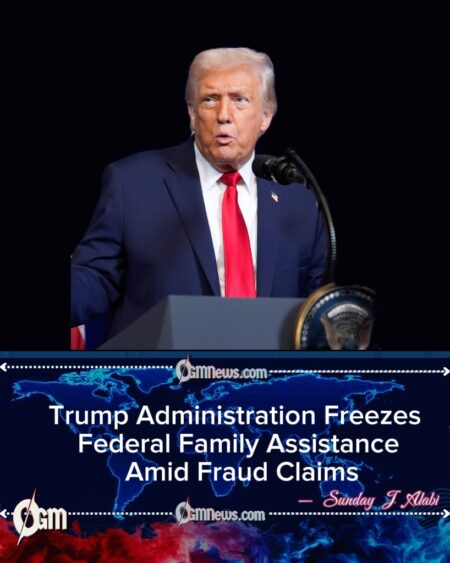
The administration of President Donald Trump, currently serving a second term as U.S. president, has halted more than $10bn in federal childcare and family assistance funding to five Democrat-led states, citing concerns over alleged fraud and misuse of public funds. The decision, announced by the Department of Health and Human Services (HHS), has drawn swift condemnation from Democratic governors and lawmakers, who accuse the White House of using essential social programmes as leverage in a broader political dispute.
The freeze affects California, Colorado, Illinois, Minnesota and New York, all governed by Democrats. While the administration argues that stricter oversight is necessary to protect taxpayers’ money, critics warn the move could disrupt childcare services and assistance for vulnerable families, particularly low-income households that rely heavily on federal support.
Scope of the Funding Freeze
According to HHS, the funding pause applies to three major federal programmes that together total more than $10bn. These include the Child Care and Development Fund, valued at approximately $2.4bn, the Temporary Assistance for Needy Families (TANF) programme worth about $7.35bn, and the Social Services Block Grant, which provides roughly $869m.
HHS said the affected states have been notified that their access to these funds will be restricted pending further review. Officials indicated that the freeze is not necessarily permanent but is contingent on additional verification and oversight measures being put in place. However, the department has not publicly detailed the specific allegations of fraud or the standards states must meet to have funding restored.
Several state governments have said they were caught off guard by the announcement. Officials in more than one state told the Associated Press that they had not received clear guidance from federal authorities on what additional documentation or compliance steps would be required.
Trump Administration’s Rationale and Fraud Allegations
The Trump administration has framed the move as part of a broader effort to combat fraud in federal programmes. Andrew Nixon, an HHS spokesperson, said in a statement that “for too long, Democrat-led states and governors have been complicit in allowing massive amounts of fraud to occur under their watch.”
President Trump has not addressed the funding freeze in detail, but he posted on social media that a “fraud investigation of California has begun.” The Trump administration has previously warned that federal funds could be withheld from states or organisations accused of misusing public money or failing to comply with federal standards.
Beyond fraud claims, the Trump administration has also threatened or enacted funding cuts over issues ranging from diversity initiatives to university protests related to the conflict in Gaza. Critics argue that this pattern suggests a willingness to use federal spending as a tool to pressure political opponents.
Democratic Governors and Lawmakers Push Back
Democratic leaders have responded sharply, describing the funding freeze as punitive and politically motivated. New York Governor Kathy Hochul said states should not be treated as “political pawns” in disputes between the White House and Democratic governors, calling the decision “vindictive” and “cruel.”
California officials were particularly outspoken. Tara Gallegos, a spokesperson for Governor Gavin Newsom, defended the state’s efforts to combat fraud and rejected the administration’s claims. She argued that California has invested heavily in oversight and enforcement mechanisms to protect public funds.
At the federal level, Senator Kirsten Gillibrand of New York said the move appeared designed to score political points rather than address legitimate concerns about fraud. She warned that families who depend on childcare assistance could be caught in the crossfire of a partisan battle.
Minnesota at the Centre of Wider Scrutiny
Minnesota has emerged as a focal point in the administration’s recent fraud allegations. In recent weeks, federal officials have claimed that welfare and social service programmes in the state are vulnerable to abuse, particularly by immigrant communities.
Federal childcare funding in Minnesota has been on hold since late last month amid investigations into alleged fraud schemes involving daycare centres operated by individuals with family roots in Somalia. Authorities say the investigations are ongoing, though specific findings have not yet been made public.
The Trump administration has also sharply criticised Minnesota Governor Tim Walz, the 2024 Democratic vice-presidential nominee, and Representative Ilhan Omar, a Somali American lawmaker who represents a Minneapolis-based district. These criticisms have intensified tensions between state and federal officials.
Concerns Over Targeting and Civil Rights
Rights advocates and community leaders have expressed concern that the fraud investigations are being used to stigmatise immigrant communities, particularly Minnesota’s Somali population, the largest in the United States. They argue that broad funding freezes risk unfairly punishing entire states and communities for alleged misconduct by a limited number of actors.
Advocacy groups warn that halting childcare and family assistance funds could have immediate consequences for working parents, childcare providers and low-income families. Many programmes supported by the affected grants operate on thin margins and depend on consistent federal funding to remain open.
These groups have called for transparent investigations and targeted enforcement rather than sweeping funding suspensions. They also urge the administration to release detailed evidence supporting its claims of widespread fraud.
Uncertainty Ahead for States and Families
HHS officials have said that no state will receive childcare funds without providing additional verification, but the lack of clear guidance has left state agencies uncertain about next steps. Administrators in affected states are now assessing how long existing reserves can sustain programmes if the freeze continues.
Legal challenges are also possible, as states explore whether the administration has the authority to impose such broad funding restrictions without congressional approval. In the meantime, families and service providers face uncertainty about the future of critical support systems.
As the dispute unfolds, the funding freeze underscores the growing tension between the Trump administration and Democratic-led states, raising broader questions about federal oversight, state autonomy and the role of social programmes in an increasingly polarised political environment.