










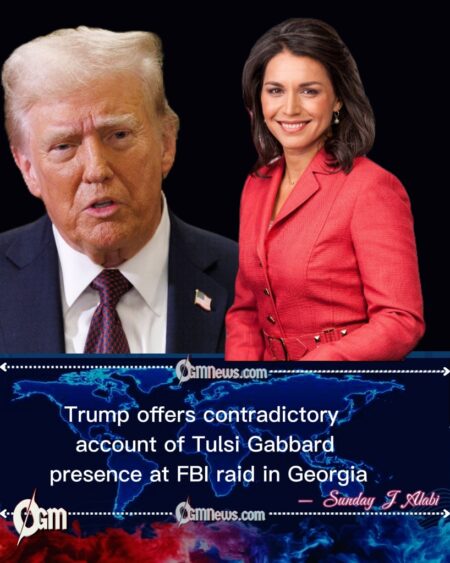
The Trump administration has come under renewed scrutiny following contradictory explanations from President Donald Trump regarding the presence of Tulsi Gabbard, the director of national intelligence, at an FBI raid on an election center in Georgia. The shifting narratives have raised questions about the scope of Gabbard’s role, the decision-making process behind her involvement, and the broader implications for the administration’s handling of election-related investigations.
President Trump, currently serving his second term, offered a revised explanation during a high-profile public appearance, diverging from earlier statements and from Gabbard’s own account to lawmakers. The evolving explanations have intensified debate over the unusual intersection of intelligence oversight and domestic law enforcement activity in a politically sensitive context.
Contradictory Statements From the President Trump
Speaking at the National Prayer Breakfast, President Trump said Gabbard attended the FBI operation at the urging of Attorney General Pam Bondi. He suggested that her visit was connected to examining votes in Georgia that “wanted to be checked out,” framing her presence as part of a broader concern over election integrity.
This account contrasted sharply with remarks Trump made a day earlier in an interview with NBC News, when he said he did not know why Gabbard was present at the raid. In that interview, he also raised claims of foreign interference in the 2020 election without providing evidence.
The differing explanations have drawn attention to inconsistencies in the administration’s messaging, particularly given the sensitivity of federal action related to elections and voting infrastructure.
Gabbard’s Role and Legal Authority
As director of national intelligence, Gabbard oversees the coordination and analysis of intelligence across federal agencies, including assessments related to national security threats. However, her position does not grant her authority over domestic law enforcement operations, which are typically conducted by agencies such as the FBI and the Department of Justice.
Her presence at an FBI raid of an election center therefore stood out as highly unusual. Legal and governance experts have noted that while intelligence officials may provide assessments on election security, direct involvement in enforcement actions raises questions about jurisdiction and precedent.
The distinction between intelligence oversight and law enforcement authority has become a central issue in evaluating the administration’s explanations.
White House Response to the Discrepancy
At a White House briefing, press secretary Karoline Leavitt defended the president, arguing that his comments to NBC News had been taken out of context. She emphasized that election security is closely linked to national security and said the administration’s focus was on ensuring elections remain free, fair, and protected from foreign interference.
Leavitt contended that critics were focusing on isolated phrases rather than the full substance of the president’s remarks. However, her explanation did not directly resolve the question of why Gabbard, rather than Justice Department officials alone, attended the raid.
The response highlighted the administration’s effort to frame the issue within a national security narrative, even as questions persisted about procedural norms.
Gabbard’s Letter to Lawmakers
In a letter sent to senior members of the House and Senate, Gabbard offered yet another account. She stated that her presence at the raid was requested by President Trump and that she attended only briefly. She cited her “broad statutory authority” to coordinate and analyze intelligence related to election security.
The letter appeared to contradict the president’s assertion that her attendance was prompted by the attorney general. It also reinforced the perception that decisions surrounding the raid were communicated inconsistently across different branches of the administration.
Lawmakers from both parties have taken note of the discrepancies, with some calling for clearer explanations regarding who authorized Gabbard’s involvement and for what specific purpose.
Parallel Investigations Into the 2020 Election
Reports have indicated that Gabbard is conducting her own review of the 2020 election through the Office of the Director of National Intelligence, with the president’s approval. This effort is said to be separate from the Justice Department’s investigation and has involved regular briefings to Trump and senior advisers over several months.
The existence of parallel inquiries underscores the continued importance the president places on the 2020 election, nearly six years after his loss to Joe Biden. Administration officials familiar with the matter say Gabbard’s review has focused on intelligence assessments rather than prosecutorial action.
Her presence at the Georgia raid has been linked to this separate review, suggesting she was observing developments relevant to claims the president has repeatedly raised about voting machine manipulation.
Political and Institutional Implications
The overlapping investigations and conflicting explanations have amplified concerns about the boundaries between intelligence work, law enforcement, and political objectives. Critics argue that the episode risks blurring institutional roles, while supporters say it reflects a comprehensive approach to safeguarding election security.
The scrutiny also reflects broader tensions surrounding the administration’s renewed focus on the 2020 election and ongoing claims of irregularities. How these issues are addressed may influence public confidence in federal institutions and in the administration’s commitment to established legal processes.
As lawmakers continue to seek clarification, the episode is likely to remain a point of debate within Washington, highlighting the challenges of managing sensitive investigations amid intense political scrutiny.


