









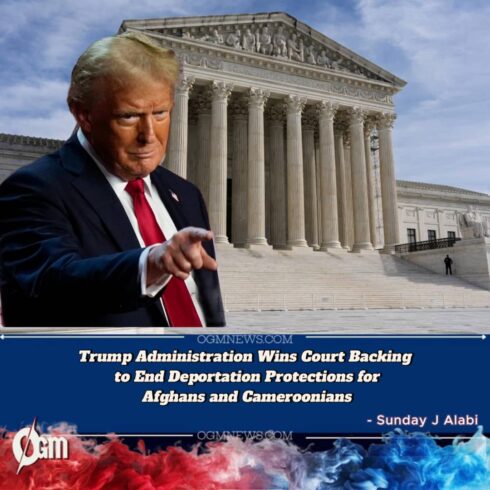
The Trump administration has secured a critical legal victory in its bid to terminate Temporary Protected Status (TPS) for thousands of nationals from Afghanistan and Cameroon. In a ruling on Monday, the U.S. Court of Appeals for the Fourth Circuit allowed the administration to proceed with ending the deportation protections and work permits for more than 10,000 individuals from both countries.
Although the court acknowledged that the plaintiffs — led by immigrant rights group CASA — presented a plausible case, it ruled that the evidence was insufficient to justify halting the phase-out of TPS while the legal process plays out. The decision comes just one week after the same court issued a temporary block on the Afghanistan policy, a move it has now reversed. The appellate panel also instructed the lower court to act “expeditiously” in hearing the underlying case.
Thousands Face Deportation Risks as Program Winds Down
According to government estimates, about 11,700 Afghans and 5,200 Cameroonians currently hold TPS status. However, roughly 3,600 Afghans and 200 Cameroonians are lawful permanent residents and will not be affected by the decision. The remaining TPS recipients will face the risk of detention and deportation unless they can secure alternative legal status, such as asylum.
The Trump administration had initially scheduled the end of TPS protections for Afghans last week, while Cameroonians are expected to lose protection by August 4. The Trump administration maintains that both countries are now stable enough to warrant the return of their nationals. Critics and immigrant advocacy groups strongly disagree, citing ongoing violence, repression, and humanitarian crises in both regions.
Outrage and Warnings from Advocacy Groups
The decision sparked immediate backlash from immigrant rights advocates. AfghanEvac, an organization that has helped resettle Afghans in the United States, issued a grave warning about the consequences of lifting protections. “Lives will be upended. Families will be separated. Allies will be detained, deported, or forced into hiding—while their legal rights remain unsettled,” said AfghanEvac President Shawn VanDiver in a statement Monday night.
CASA, the group leading the legal challenge, has argued that forcing individuals to return to Afghanistan or Cameroon would place them in grave danger. They cite Taliban repression, ongoing conflict with ISIS-K insurgents in Afghanistan, and separatist and extremist violence in Cameroon as evidence that both nations remain unsafe. The group also alleges that the administration’s decision was based on discriminatory motives and flawed legal processes.
Trump Administration Defends the Termination as Lawful and Necessary
The Trump administration, for its part, insists it is restoring the TPS program to its original statutory purpose. “This administration is returning TPS to its original temporary intent,” Homeland Security Secretary Kristi Noem stated in May, adding that the current conditions in Afghanistan and Cameroon no longer justify the continuation of temporary protections.
Officials argue that Afghanistan, despite the Taliban’s control, has seen security and economic improvements, and Cameroon’s conflicts are “contained in limited regions.” The Department of State, however, continues to issue stern travel warnings for both countries, advising Americans against visiting due to risks such as terrorism, civil unrest, kidnapping, and limited healthcare services.
Legal and Political Ramifications of the Court’s Decision
The court’s refusal to block the TPS termination does not end the legal fight. A federal district judge had previously declined to dismiss CASA’s lawsuit and refused to grant a preliminary injunction against the policy. CASA then escalated the matter to the Fourth Circuit, resulting in Monday’s decision. The appellate court did not rule on the substance of the case, leaving open the possibility of a future victory for TPS holders if the lower court rules in CASA’s favor.
The Trump administration’s broader efforts to curtail TPS have also affected nationals from other countries including Venezuela, Haiti, Nicaragua, and Honduras. In May, the U.S. Supreme Court permitted the administration to proceed with ending TPS for Venezuelan migrants — another move met with widespread criticism from human rights organizations.
Concerns Over Racial Bias and Policy Motivation
In its filings, CASA has alleged that the administration’s decision to end TPS for these predominantly non-white countries is rooted in racial animus. The group points to what it calls a pattern of targeting immigration programs benefiting non-white populations while easing restrictions for migrants from predominantly white nations.
“Racial animus is evidenced by the Trump administration’s efforts to eliminate lawful immigration status for noncitizens from countries the Trump Administration believes are predominantly non-white,” CASA’s lawyers argued in court documents. The group asserts that such discriminatory motivations undermine the legality and integrity of the administration’s actions.
Next Steps and the Human Toll Ahead
As the case proceeds in federal court, the fate of over 13,000 individuals from Afghanistan and Cameroon hangs in the balance. Those who lose TPS protections may attempt to file asylum claims or seek other legal pathways to remain in the U.S., but immigration experts warn that these options are complex, limited, and often unsuccessful.
For now, many TPS holders live in uncertainty, caught between a shifting legal landscape and the danger of being returned to countries still grappling with conflict, repression, and instability. The administration’s actions signal a hardline continuation of its immigration policy, even as humanitarian concerns mount at home and abroad.