


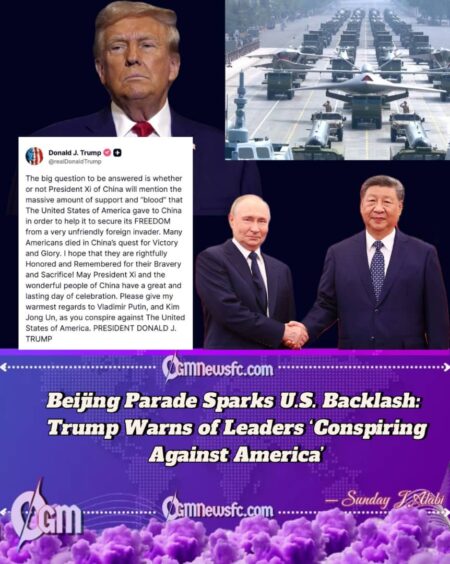
President Donald Trump has launched a blistering attack on Chinese leader Xi Jinping, Russian President Vladimir Putin, and North Korean leader Kim Jong Un, accusing them of “conspiring against the United States of America.”
The remarks came after the three leaders gathered in Beijing to watch a grand military parade marking 80 years since World War II, an event framed by China as both a commemoration and a projection of global strength.
In a Truth Social post on Tuesday night, Trump sarcastically urged Xi to “please give my warmest regards” to Putin and Kim, while condemning the trio for what he described as a deliberate attempt to undermine American leadership. He also reminded Beijing of the sacrifices made by U.S. troops during World War II to help secure China’s freedom.
Beijing’s Parade Showcases Cutting-Edge Weapons
The Beijing parade stunned military analysts worldwide as China unveiled a formidable array of advanced weaponry. Among the most discussed was the LY-1 laser weapon, mounted on an eight-wheeled armored vehicle, which experts warn could disable electronics or blind enemy pilots in the event of war.
The showcase also featured hypersonic missiles, stealth submarines capable of avoiding detection, and long-range nuclear-capable systems touted as part of a “three-in-one” strategic nuclear force spanning land, sea, and air. Unmanned underwater drones, capable of reaching depths of 20 meters, further underscored Beijing’s technological ambitions.
For many observers, the parade was not only about commemorating the past but signaling China’s readiness to challenge the U.S.-led postwar order with its own military and political model.
Xi, Putin, and Kim Display Unity in Beijing
Xi Jinping, flanked by Putin and Kim Jong Un at Tiananmen Square, opened the ceremony with an artillery salute and a call for global peace. He nevertheless stressed that China’s rise was “unstoppable,” framing his message as both a warning and a declaration of national confidence.
The leaders shook hands with World War II veterans, some over a century old, before ascending a viewing platform together in a carefully choreographed display of solidarity. For Xi, the gathering reinforced his push to rally non-Western nations around Beijing as an alternative center of power.
While India’s Prime Minister Narendra Modi did not attend the parade, his recent displays of closeness with Putin and Xi have heightened Washington’s concerns over New Delhi’s growing ties with Moscow and Beijing.
Trump’s Rebuttal and Kremlin’s Response
Trump’s online remarks struck a balance between condemnation and diplomacy. While he blasted the trio for plotting against Washington, Trump also signed off with a courteous note, wishing Xi and “the wonderful people of China” a meaningful day of celebration.
The Kremlin quickly pushed back at Trump’s accusations. Yuri Ushakov, a top foreign policy aide, denied any conspiracy, insisting that “no one has been plotting anything” and dismissing suggestions of a coordinated anti-U.S. strategy. He also acknowledged Trump’s outsized role in shaping the global political climate, calling him a decisive figure in today’s international affairs.
Strategic Implications for the Global Order
The Beijing summit underscores a shifting world order where rival powers increasingly band together to present alternatives to U.S. dominance. China’s overt military flexing, combined with Putin’s defiance of Western sanctions and Kim’s isolationist resilience, paints a picture of a new bloc asserting itself against Washington.
For Trump, the optics of Xi, Putin, and Kim standing shoulder to shoulder in Tiananmen Square are both a strategic warning and a political opportunity. His message seeks to rally Americans around the memory of past sacrifices while warning of contemporary threats to U.S. security and influence.
The event also raises critical questions for U.S. allies, particularly in Europe and Asia, who now face the challenge of navigating a more fragmented and confrontational international landscape.