








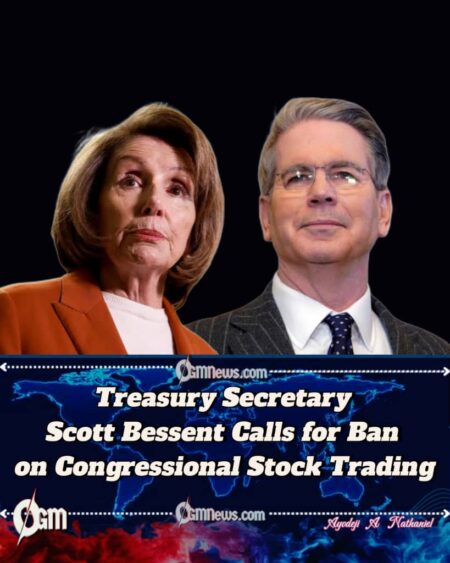
Amid renewed scrutiny of ethics and accountability in Washington, Treasury Secretary Scott Bessent has called for a complete ban on individual stock trading by members of Congress. His remarks, delivered during a public statement on governance standards, framed the issue as a matter of institutional credibility rather than partisan advantage, reigniting a long-running debate over conflicts of interest on Capitol Hill.
A Renewed Push for Ethics Reform
Scott Bessent said the practice of lawmakers trading individual stocks while shaping economic and regulatory policy undermines public trust in Congress. He argued that unusually high investment returns reported by some members raise legitimate questions about fairness and transparency.
Bessent emphasized that ethical standards must keep pace with public expectations, particularly at a time when confidence in democratic institutions is under strain. He urged lawmakers to move beyond rhetoric and enact enforceable rules.
Concerns Over Conflicts of Interest
The Treasury Secretary highlighted what he described as “returns that far exceed many of the world’s top performing hedge funds,” warning that such outcomes create the perception of insider advantage. According to Bessent, even the appearance of impropriety weakens the credibility of legislative decision-making.
He noted that Americans expect elected officials to act solely in the public interest, free from personal financial incentives. Without clear prohibitions, he argued, skepticism about congressional motives will persist.
Focus on Congressional Leadership
Bessent’s comments drew attention to prominent figures in congressional leadership, including Nancy Pelosi, whose investment disclosures have previously fueled public debate. While he did not allege wrongdoing, he said the scale of reported gains illustrates why stronger rules are necessary.
Supporters of reform contend that leadership figures set the tone for the institution and therefore bear particular responsibility for upholding ethical norms. Critics caution, however, that reforms must be crafted carefully to withstand legal and political challenges.
A Nonpartisan Framing
Bessent stressed that banning congressional stock trading should not be viewed through a partisan lens. He described the proposal as a governance reform essential to restoring faith in the legislative branch rather than a political weapon aimed at any one party.
This framing aligns with past bipartisan proposals that sought to limit or prohibit individual stock ownership by lawmakers, often allowing alternatives such as blind trusts or diversified funds.
Legislative Landscape and Challenges Ahead
Several bills addressing congressional stock trading have been introduced in recent years, but none have cleared both chambers of Congress. Resistance has come from concerns over personal financial freedom, enforcement mechanisms, and the scope of any restrictions.
Bessent said he expects Congress to act, arguing that continued inaction risks deepening public cynicism. Whether lawmakers will coalesce around a single proposal remains uncertain.
Conclusion
The Treasury Secretary’s call adds new urgency to an issue that has lingered unresolved for years. As pressure mounts for stronger ethical safeguards, the debate over congressional stock trading may prove a critical test of lawmakers’ willingness to police themselves and rebuild public trust.