








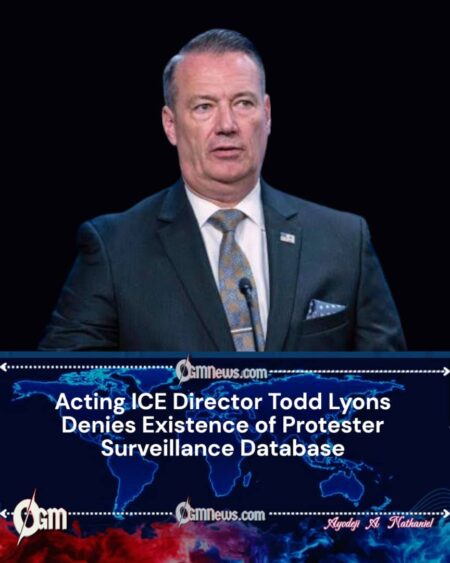
Acting Immigration and Customs Enforcement (ICE) Director Todd Lyons has publicly denied claims that the agency maintains a database tracking protesters or U.S. citizens. Speaking in response to mounting concerns raised by lawmakers and civil liberties advocates, Lyons stated unequivocally that ICE does not operate any system designed to monitor lawful protest activity or track Americans based on political expression.
His remarks come amid heightened scrutiny of federal law enforcement practices and renewed debate over transparency, data collection, and constitutional protections.
The Director’s Statement
In his comments, Lyons sought to draw a clear boundary between ICE’s enforcement responsibilities and allegations of domestic surveillance.
“There is no database for protesters. I can assure you there is no database that’s tracking United States citizens,” he said.
The statement was framed as a direct response to fears that federal agencies may be expanding intelligence-gathering activities beyond their legal mandates.
Context: Rising Concerns Over Federal Monitoring
Questions about surveillance have intensified in recent months as oversight hearings and public commentary have focused on how law enforcement agencies collect and store information. Critics argue that aggressive enforcement environments can blur the line between legitimate intelligence work and improper monitoring of lawful activity.
ICE has found itself at the center of these concerns due to its high-profile role in immigration enforcement and cooperation with other federal agencies.
ICE’s Mandate and Legal Constraints
ICE officials emphasize that the agency’s mission is narrowly defined by federal law. Its primary focus is the enforcement of immigration statutes and the investigation of transnational crimes such as human trafficking and smuggling.
According to agency leadership, ICE operates under constitutional limits, internal compliance rules, and external oversight, including congressional review and judicial scrutiny. Lyons’ denial was intended to reaffirm those constraints.
Reaction From Lawmakers and Advocates
Civil liberties organizations have welcomed the clarity but say continued oversight is necessary. They argue that transparency must extend beyond verbal assurances to include clear policies and accessible documentation on data practices.
Some lawmakers have called for formal reporting requirements to ensure that no informal or inter-agency databases are used in ways that could indirectly track lawful protest activity.
Public Trust and Institutional Credibility
For ICE, the issue is not only legal compliance but public confidence. Allegations of surveillance even when denied can undermine trust in law enforcement institutions, particularly among communities already wary of federal authority.
Lyons’ statement reflects an effort to reassure the public that constitutional rights, including freedom of speech and assembly, are not targets of ICE operations.
Looking Ahead: Oversight Likely to Continue
While Lyons’ comments may ease immediate concerns, the broader debate over surveillance and data collection is unlikely to subside. Congressional oversight committees are expected to continue examining how federal agencies gather information and share intelligence.
The episode underscores a recurring tension in American governance: balancing enforcement priorities with civil liberties in an era of heightened political and social activism.