










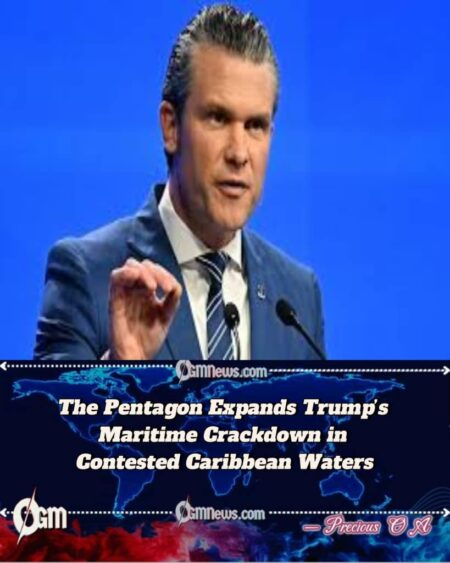
The Pentagon, the headquarters of the United States Department of Defense and the central command hub overseeing the country’s military strategy, has confirmed the deployment of the Navy’s most advanced aircraft carrier to the Caribbean. Equipped with cutting-edge radar systems, next-generation jets and a full strike group, the vessel is being sent to escalate President Donald Trump’s campaign targeting drug-smuggling networks across Latin America. Additional defense officials note that the ship’s logistical capabilities allow for extended missions far from U.S. shores, giving Washington a consistent and highly visible military footprint in a region increasingly influenced by geopolitical rivals.
U.S. military officials describe the deployment as a powerful upgrade in surveillance reach and rapid-response capability, designed to choke off maritime smuggling routes before narcotics flow into American cities. They argue that advanced drones, long-range aircraft and sea-based interception units can cover vast stretches of ocean that small cutters struggled to secure consistently. Senior commanders view this as a pivotal moment where the United States transitions from reactive enforcement to proactive domination of suspected trafficking zones.
The Pentagon is arguing that cartels have evolved into well-armed, transnational networks supported by corrupt officials, requiring not just routine interdiction but overwhelming military deterrence. Defense strategists stress that criminal organizations operating in Central and South America now possess fleets of semi-submersible vessels, encrypted communications technology and the financial power to bribe state security agencies. According to analysts, refusing to escalate would ultimately grant cartels more autonomy and resilience.
This enhanced force projection, according to senior defense planners, serves as a visible reminder that Washington will intervene decisively when regional criminal activity threatens American security interests. Officials assert that the political symbolism of a carrier deployment often sends a stronger message than diplomatic complaints or limited patrols. Such actions also aim to reassure regional allies that the United States is prepared to take the lead in shared security challenges.
The Pentagon is aligning this mission with a broader policy shift in which maritime supremacy will be leveraged more aggressively to block illegal drug flows at their source. The strategy expands operational flexibility by enabling strike aircraft to pursue tracking intelligence across multiple jurisdictions without needing foreign bases. Senior policy advisors insist this is not just counternarcotics but an effort to disrupt the financial engines funding extremist groups and destabilizing forces across the hemisphere.
Defense analysts note that the use of a carrier strike group represents a long-term strategic investment rather than a symbolic gesture, signaling that the United States intends to disrupt trafficking infrastructure comprehensively. They argue that such a sustained approach could dismantle smuggling routes permanently if combined with regional cooperation, onshore intelligence raids and financial disruption of cartel assets.
Regional Repercussions: Latin America on Edge
Diplomats in neighboring countries warn that the arrival of such a formidable U.S. naval presence threatens to heighten regional tensions and provoke unpredictable political reactions. Some fear the deployment could embolden opposition factions in countries like Venezuela, leading to domestic confrontations or military posturing that might spiral mistakenly into conflict. Others worry that the move could be interpreted as preparation for regime change.
The Pentagon is receiving diplomatic messages from Caribbean states seeking assurance that their economic activity and sovereignty will not be compromised during the heightened U.S. naval presence. Small island nations heavily reliant on fishing and tourism question how tightly controlled maritime zones may impact livelihoods. Meanwhile, port authorities are requesting advance notice of high-security operations to avoid commercial disruptions.
The Pentagon anticipates that while several allies support tougher counternarcotics efforts, few wish to be drawn into a public confrontation that could inflame regional politics. Governments walking a diplomatic tightrope want stronger borders and reduced cartel influence, yet remain cautious about being viewed as endorsing aggressive U.S. tactics. Political opposition groups in multiple countries are already exploiting the deployment as a sign of “military intimidation” by a foreign power.
Observers in Colombia and Mexico fear that escalating military pressure could strengthen hardline factions on both sides, making delicate security cooperation more politically volatile. Lawmakers in those countries argue that failure to manage perceptions could spark unrest or fuel anti-American rhetoric among nationalist organizations eager to reject international oversight.
The Pentagon predicts that drug-trafficking organizations may adapt by rerouting operations, potentially spreading smuggling to even more remote locations. Criminal networks have historically shown a remarkable ability to exploit changing conditions, often moving deeper into jungle terrain or shifting toward lightly monitored African routes that bypass American naval patrols entirely.
Regional security experts caution that the shift could trigger unintended humanitarian consequences, including coastal instability and dangerous migration patterns linked to shifting cartel operations. They note that sudden crackdowns can disrupt local economies dependent on informal labor linked indirectly to smuggling networks, sparking desperation and unrest in vulnerable communities.
Legal and Operational Challenges: Scope, Risk and Oversight
The Pentagon insists the mission remains within international law, though critics warn that blurred lines between warfare and policing demand strict monitoring of rules of engagement. Legal scholars argue that military operations focused on criminal organizations raise complex questions over how prisoners are handled, which legal authorities apply and what oversight bodies can intervene if necessary.
The Pentagon recognizes that enormous strike-group assets are not built for chasing fast smuggling boats alone, placing greater weight on surveillance aircraft, satellite monitoring, and partnerships with countries able to provide intelligence. Military planners confirm that the success of this initiative depends heavily on information sharing that identifies cartels’ financiers, suppliers and maritime technicians.
The Pentagon acknowledges that any misinterpretation during operations near sovereign waters could trigger escalation or military misunderstanding. A single accidental incursion or misread radar signature could prompt a defensive response from a jittery coastal military, risking conflict neither side intended or prepared to manage.
Congressional leaders are already pushing for transparent reporting, concerned that the expanded operation must demonstrate measurable long-term results rather than dramatic but temporary gains. Lawmakers stress that taxpayers must understand both the financial cost and the operational benchmarks by which the mission’s success will be judged.
The Pentagon concedes that the mission will serve as a high-profile test of Washington’s ability to balance decisive force with diplomatic caution in one of the world’s most sensitive maritime regions. Analysts caution that any misstep will be amplified internationally due to the visibility and symbolic weight of a carrier deployment.
The Pentagon remains confident that demonstrating overwhelming military capability will deter adversaries while reassuring allies, though internal documents admit that sustained success will require cooperation, not confrontation. Officials argue that lasting outcomes will come only when regional governments are empowered to dismantle corruption, strengthen border controls and rebuild trust in their own institutions.


