





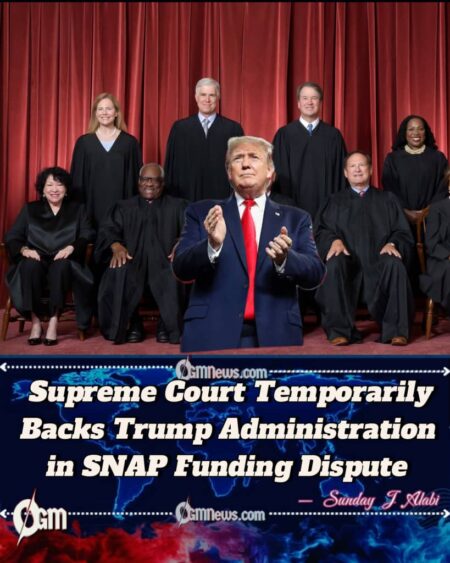
In a late Friday decision, the U.S. Supreme Court issued an emergency order temporarily permitting the Trump administration to withhold $4 billion in Supplemental Nutrition Assistance Program (SNAP) funds, commonly known as food stamps. The ruling comes amid the protracted federal government shutdown—the longest in U.S. history—leaving millions of low-income Americans uncertain about their access to food aid.
The administration, led by President Donald Trump in his second term, had appealed to the high court after a lower court in Rhode Island ordered the government to release full SNAP payments by Friday. U.S. Supreme Court Justice Ketanji Brown Jackson’s administrative stay pauses that ruling for two days while government lawyers continue their appeal.
The Department of Agriculture (USDA), which oversees SNAP, has argued that the shutdown limits its financial capacity to fully fund the program. The temporary order means benefits for millions of recipients will remain in limbo pending further judicial review.
Lower Courts Challenge Trump Administrations’s Handling of Food Aid and SNAP
Earlier this week, U.S. District Judge John McConnell sharply criticized the Trump administration, accusing it of withholding food assistance “for political reasons.” He ruled that the government must immediately pay out the full benefits, warning that “16 million children are immediately at risk of going hungry” if the aid is delayed.
The Rhode Island ruling followed another federal decision that required the administration to dip into contingency funds to at least partially fund November’s distribution. However, the USDA had already warned that without congressional action to reopen the government, SNAP benefits could not be sustained.
The SNAP program serves more than 42 million Americans—about one in eight citizens—and costs roughly $9 billion each month. The program provides pre-loaded debit cards for grocery purchases, which are essential for millions of families facing food insecurity.
Political Stalemate Deepens as Shutdown Drags On
The funding dispute underscores the broader paralysis gripping Washington as lawmakers remain deadlocked over budget negotiations. The government shutdown has stretched beyond a month, leaving hundreds of thousands of federal employees without pay and causing widespread disruptions, including airport delays and halted federal services.
While some states have dipped into local reserves to continue food assistance, others say they cannot sustain SNAP payments without federal support. The temporary Supreme Court order offers only brief reprieve but no resolution, setting the stage for what could become a defining legal and political battle over the federal safety net.
Observers warn that the decision could exacerbate partisan tensions as Democrats and Republicans spar over how to reopen the government and secure funding for essential programs. The court’s next move—and the Trump administration’s handling of SNAP funds—will likely shape public sentiment as the crisis unfolds.