










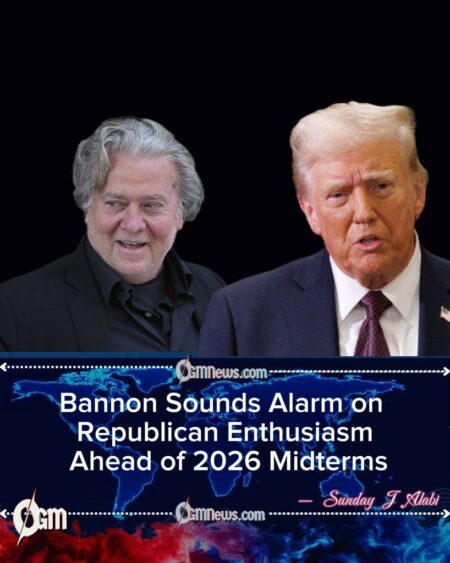
As the United States approaches the high-stakes 2026 midterm elections, a warning from within President Donald Trump’s political orbit has underscored growing unease inside the Republican Party. Steve Bannon, a former White House strategist and a prominent voice among Trump’s supporters, has cautioned that enthusiasm within the MAGA base is eroding at a moment when electoral momentum may prove decisive.
Speaking on his War Room podcast, Bannon urged President Trump—currently serving his second term as U.S. president—and congressional Republicans to take swift, tangible action to re-energize their supporters. His remarks reflect broader concerns about voter motivation, party unity, and the strategic direction of the administration and its allies as control of Congress hangs in the balance.
A Blunt Warning From a Key Trump Ally
Bannon’s comments were notable for both their urgency and their directness. He argued that Republican leaders are failing to inspire their core supporters, many of whom propelled Trump to electoral victories and remain central to the party’s grassroots strength. According to Bannon, the prevailing mood among these voters is one of frustration rather than anticipation.
He framed the issue as a crisis of momentum, suggesting that without visible results or clear priorities, even loyal supporters may disengage. Bannon’s message was not aimed at Democrats but squarely at Republicans, whom he accused of complacency during a politically sensitive period.
The warning carries weight because Bannon has long served as a conduit between populist activists and the party’s leadership. His remarks therefore highlight internal anxieties that extend beyond a single media appearance.
Bannon Concerns Over Republican Leadership and Strategy
Central to Bannon’s critique was his assessment of congressional Republicans. He accused party leaders of lacking resolve during negotiations over funding for the Department of Homeland Security, arguing that compromises signaled weakness to voters seeking decisive action.
In Bannon’s view, such episodes reinforce perceptions that Republican officials are more inclined toward political caution than confrontation. This, he argued, risks alienating supporters who expect assertive governance, particularly on issues like border security and domestic priorities.
The criticism reflects a broader debate within the party about whether pragmatic negotiation or ideological firmness is more effective in sustaining voter enthusiasm during a midterm cycle.
Polling Data and the Emerging Enthusiasm Gap
Recent polling has added empirical weight to these concerns. Data from Big Data Poll, conducted by conservative pollster Rich Baris, suggests that Democrats currently hold an advantage on the generic congressional ballot among likely voters.
According to the survey, 46.1 percent of respondents favored Democratic candidates, compared with 42.0 percent for Republicans when undecided voters were excluded. More significantly, the poll indicated a notable enthusiasm gap, with Democrats leading among those who described themselves as “extremely enthusiastic” about voting.
Baris cautioned that such trends, if left unaddressed, could shape turnout patterns in November. He emphasized that reversals are possible but require strategic shifts well ahead of election day.
Messaging Challenges for the Trump Administration
Other conservative analysts have echoed concerns about the administration’s political messaging. Mark Mitchell, head pollster at Rasmussen Reports, argued in a recent opinion piece that the administration’s focus has appeared fragmented, potentially diluting its appeal to voters.
Mitchell suggested that an emphasis on high-profile controversies over concrete policy outcomes may be contributing to voter fatigue. He pointed to economic anxieties, job security, and affordability as areas where clearer messaging could resonate more strongly with the electorate.
Such critiques do not deny the administration’s policy ambitions but highlight the importance of aligning communication strategies with voter priorities during a competitive midterm cycle.
Divisions Within the Conservative Movement
Bannon’s remarks also illuminate ideological divisions within the conservative movement itself. While some supporters remain focused on international affairs and national security, others have expressed concern that domestic economic pressures are not receiving sufficient attention.
This divergence has fueled debate over whether the administration’s agenda adequately addresses everyday challenges faced by households. Bannon’s emphasis on enthusiasm suggests that electoral success may hinge as much on emotional engagement as on policy substance.
The internal debate underscores the complexity of maintaining a broad coalition within a movement that encompasses varied priorities and expectations.
Election Security Rhetoric and Official Pushback
In recent weeks, Bannon has intensified his rhetoric around election security, making claims about potential federal involvement at polling places. These statements prompted swift responses from administration officials, who rejected the notion that federal immigration officers would be deployed to oversee voting.
White House Chief of Staff Susie Wiles described such claims as inaccurate, reiterating that elections are primarily administered by state and local authorities under the U.S. Constitution. The clarification aimed to reassure voters and local officials amid heightened sensitivity around election administration.
President Trump has, however, publicly questioned whether the federal government should play a larger role in ensuring election integrity, arguing that intervention may be warranted if states fail to conduct elections fairly. These comments continue to fuel debate over the appropriate balance of federal and state responsibilities.


