










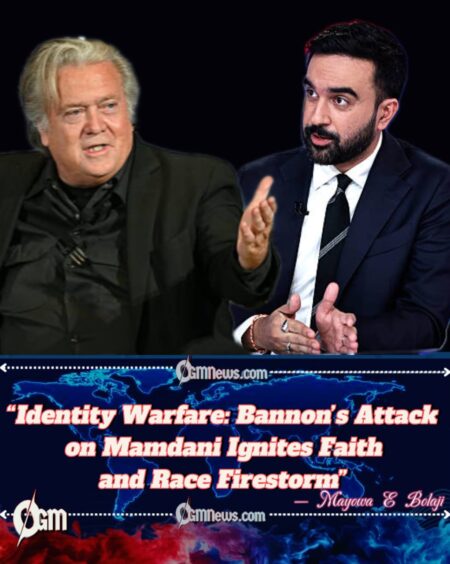
Steve Bannon, Former Trump strategist has ignited fresh controversy by labeling New York Assemblyman Zohran Mamdani “the new face of the Democratic Party,” using the moment to unleash highly inflammatory rhetoric against the progressive lawmaker. Calling Mamdani a “Marxist jihadist,” Bannon sought to portray him not merely as a political opponent, but as a symbolic enemy of the America-first movement. The remarks add to Bannon’s ongoing strategy of painting Democrats—especially younger, left-wing and minority elected officials—as existential threats rather than participants in a democratic debate.
Steve Bannon’s attack aligns with a growing tactic on the right: tying progressive economic policies to extremism and using religiously charged language to inflame cultural tensions. By invoking “jihadist,” Bannon signaled his intent to stoke fear, particularly among nationalist segments of the GOP base that see the country as being under ideological siege. In doing so, he continues to blur the line between critiques of policy and personal, identity-based assaults.
Mamdani, a vocal advocate for tenants’ rights, immigration reform, and police accountability, has become a rising voice in New York politics. Bannon’s decision to single him out suggests that the strategist sees figures like Mamdani as useful foils—symbols of what MAGA world wants voters to fear as the 2026 political cycle intensifies. It is not only a political swipe, but an attempt to define the battlefield on Bannon’s terms: nationalism versus multicultural progressivism.
“Trump Will Win Without New York”: The Narrative of Inevitability
Steve Bannon went on to claim that Donald Trump “won three times without New York,” insisting that the former president will secure “a fourth” victory without the state’s support. The declaration reflects one of Steve Bannon’s most consistent messaging pillars: that Trump’s success is inevitable, unstoppable, and ordained by a populist wave that transcends traditional electoral math. The comment also dismisses the strategic importance of blue states, framing them as irrelevant obstacles rather than battlegrounds.
New York has not voted Republican in a presidential race in four decades, making Steve Bannon’s claim less about numbers and more about maintaining morale among MAGA loyalists. By implying that Trump does not need states like New York to return to the White House, Steve Bannon is attempting to preserve the myth of a historic movement that thrives despite institutional resistance and demographic headwinds. The rhetoric serves to energize supporters who feel alienated by coastal political power centers.
Critics argue, however, that statements like these reveal a deeper anti-pluralist sentiment. By writing off entire regions of the country, the movement signals that it is no longer interested in persuasion or coalition-building, but in raw, defiant power. In effect, Bannon is reinforcing a form of political tribalism: the idea that winning means conquering opponents, not governing a diverse nation.
A Broader Clash Over Identity, Power, and Democracy
The clash between Steve Bannon’s rhetoric and figures like Mamdani underscores a larger battle unfolding in American politics—a struggle not just over policy, but over identity, faith, and who gets to define “American values.” On one side is a populist-right movement that thrives on the language of threat and siege; on the other, a rising progressive bloc that champions pluralism, redistribution, and immigrant inclusion. Both sides view the stakes as existential, and both are increasingly unwilling to compromise.
Steve Bannon’s use of religiously and ideologically loaded attacks exemplifies how political discourse has drifted beyond traditional debate into cultural warfare. The goal is not simply to discredit the opposition, but to dehumanize and delegitimize them—turning political opponents into enemies of civilization. As this language becomes normalized, it raises the risks of political violence, discrimination, and deepening social fracture.
For Democrats, and especially for leaders like Mamdani, the challenge will be responding without allowing themselves to be defined by caricature. As the nation heads into its next political cycle, the question is no longer whether the rhetoric will intensify, but how far both sides are willing to go—and whether American democracy can withstand the fire they are stoking.


