










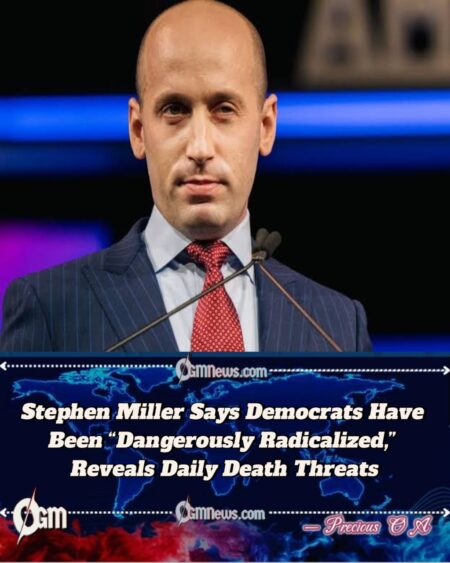
Stephen Miller, a senior adviser and long-time policy architect for President Donald Trump, has once again set the political world ablaze with a series of explosive statements targeting the Democratic Party. Known for his firm stance on immigration and his sharp-tongued defenses of the Trump administration’s agenda, Miller’s recent remarks have reignited conversations about political extremism, media bias, and the growing dangers faced by public figures who dare to challenge the establishment. Speaking in his characteristic direct and unflinching tone, Miller painted a vivid picture of the toxic environment he believes has overtaken American politics.
Stephen Miller emphasized that he and his family have become frequent targets of harassment simply for standing by their political convictions. “I get death threats every day. My wife gets death threats every day. We’ve had to deal with pretty extensive doxing campaigns,” he stated passionately, revealing the psychological toll of being one of the most polarizing figures in modern American politics. The longtime Trump aide underscored that the threats are not isolated incidents but part of a wider campaign of intimidation designed to silence conservative voices. His tone was not merely accusatory but deeply reflective of the growing hostility that defines today’s political discourse.
Stephen Miller didn’t stop there. He argued that the Democratic Party has not only shifted leftward but has become, in his words, “dangerously, violently radicalized.” His warning carried both a moral and political dimension, suggesting that the opposition party has embraced a destructive ideology that threatens the very foundation of democracy. Stephen Miller’s words, though controversial, were delivered with conviction — a sign that he believes the stakes have never been higher for the United States.
The Broader Political Context
Stephen Miller’s comments arrive at a time when political polarization in the United States has reached alarming levels. His remarks tap into a growing sense of frustration among conservatives who feel vilified by mainstream institutions, including the media, academia, and big tech platforms. For Miller, this is not just a passing moment in partisan conflict — it’s an existential crisis. He warned that the Democratic Party’s radicalization is not limited to rhetoric but has seeped into policy decisions and public behavior, encouraging hostility toward dissenting viewpoints.
While many of Stephen Miller’s critics dismiss his words as hyperbolic or fearmongering, his supporters view them as a necessary wake-up call. They argue that Miller’s experiences of threats and harassment are not isolated but part of a broader pattern of intolerance toward those associated with Trump’s presidency. Indeed, the issue of “cancel culture” has long been a flashpoint, and Miller’s statements reignite that debate with renewed intensity.
The political establishment, however, appears deeply divided in its response. Some Republican lawmakers rallied behind Miller, praising his courage for speaking out against what they described as a “leftist intimidation machine.” Others within Washington’s conservative circles quietly acknowledged that Miller’s tone, while fierce, reflected real fears of political violence and personal targeting that many public figures now face. Meanwhile, Democrats pushed back forcefully, accusing Miller of trying to distract from his own record and the controversies surrounding his tenure in the Trump administration.
The Man Behind the Message
Stephen Miller has long been recognized as one of the most disciplined and ideologically driven figures in Washington. As a key architect of Trump’s signature immigration policies, including the “America First” framework, Miller has been both celebrated and vilified in equal measure. His ability to shape messaging, craft political strategy, and push controversial policies has made him an enduring force in conservative politics. Even after Trump’s return to the White House for a second term, Miller continues to play a pivotal role behind the scenes, advising on communications, legislation, and key campaign priorities.
Miller’s recent revelations about receiving constant threats serve as a window into the darker realities of American political life. The normalization of online hate, combined with real-world acts of intimidation, has created an atmosphere of fear that extends far beyond partisan boundaries. While Miller’s critics argue that his own combative style invites backlash, his defenders contend that no one — regardless of ideology — should face threats for expressing their views.
It is also worth noting that Stephen Miller’s statements reflect a broader pattern among conservative thinkers who see the Democratic Party’s evolution as part of a larger ideological shift. His warnings about “radicalization” align with a growing conservative narrative that portrays progressivism as not just misguided but dangerously destabilizing. Whether one agrees with his assessment or not, Miller’s comments underscore how emotionally charged and divided America’s political landscape has become.
The National Reaction
Stephen Miller’s statements have already ignited a storm of reactions across media platforms and political circles. Supporters hail his courage and candor, describing him as one of the few voices unafraid to confront what he perceives as hypocrisy within the Democratic ranks. Critics, on the other hand, accuse him of inflaming tensions and using exaggerated rhetoric to paint opponents as enemies of democracy. Nonetheless, Stephen Miller’s remarks have succeeded in thrusting the issue of political extremism — on both sides — back into the national conversation.
Social media has since become a battleground, with hashtags like #StephenMillerTruth and #RadicalLeft trending across platforms. Conservative commentators have rallied to his defense, arguing that the left’s silence on harassment against right-wing figures reveals a double standard. Meanwhile, liberal analysts insist that Miller’s statements are part of a deliberate strategy to shift public attention from Trump’s policies to culture-war issues.
As the controversy unfolds, one thing is clear: Stephen Miller’s words have once again disrupted the political narrative in Washington. Whether seen as an act of courage or provocation, his “truth nuke” has exploded across the American political landscape — leaving behind a charged debate about freedom, fear, and the future of political discourse in a deeply divided nation.


